

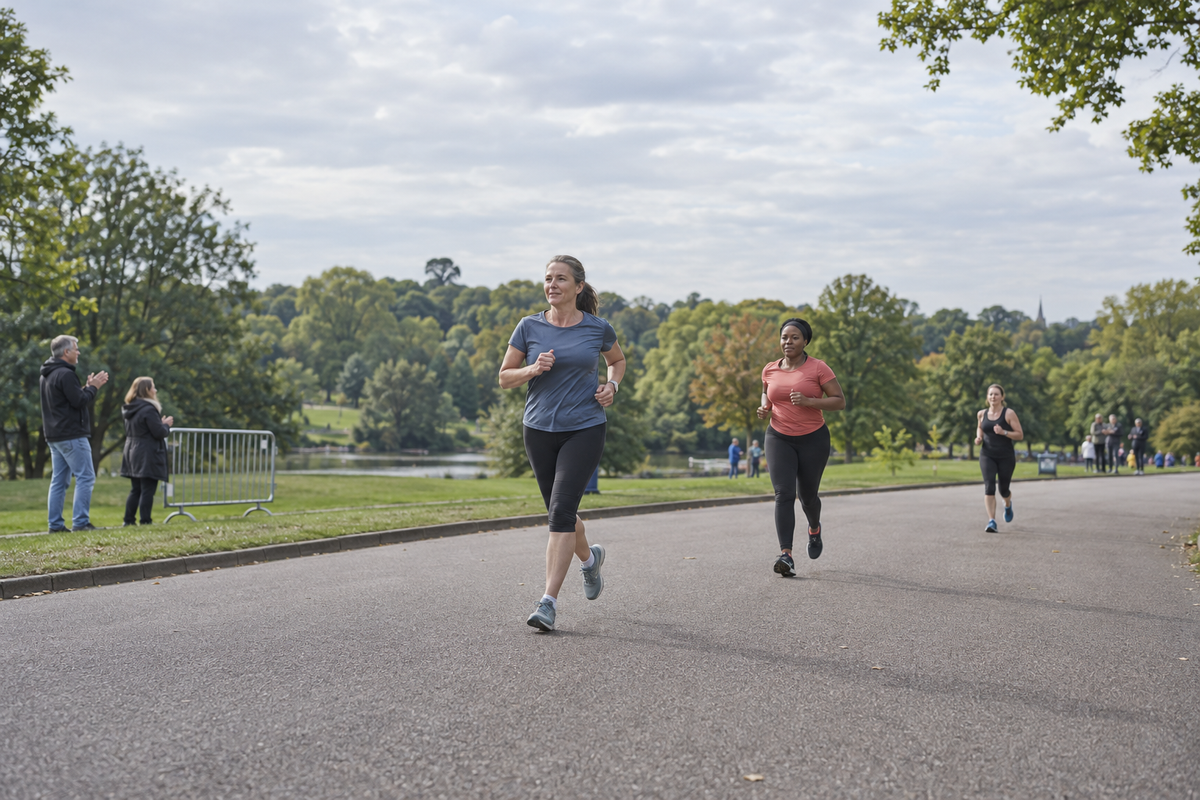
The start of a race is an excellent place to feel briefly convinced that you are much faster than you thought. There is music, movement and someone just ahead who looks wonderfully easy to follow.
The useful skill is giving that excitement a little supervision. Your opening kilometre should belong to the event you prepared for, with enough room to respond when the course, weather or your body has other ideas.
One quick opening does not automatically ruin a race, either. If you notice it, ease back. You do not need to complete the mistake for the sake of consistency.
Decide what you are trying to do
A first finish and an ambitious time target need different decisions. For a completion goal, use the manageable running or run-walk approach you have practised. A race number does not create an obligation to run continuously.
If you have a time goal, ground it in recent, relevant preparation, and treat it as conditional on the course and conditions. A calculator cannot know how well you are feeling that morning. The existing finish-goal guide explains that distinction. Use the pace calculator or kilometre pace tables for the arithmetic, then keep the result open to revision.
Before the start, reduce the plan to three ideas: how to begin, what to check as you go and what would make you adapt. Our Race-pace training guide covers rehearsing this beforehand. Today is the performance of that preparation, without an extra workout squeezed into the opening mile.
Let the crowd go when it needs to
The adrenaline and excitement of the start can make a faster opening tempting; neither tells you what pace you can sustain. Other runners also influence pacing decisions; research on competition describes the social environment as part of how people regulate effort.[1] The runner you follow may have a different goal, different preparation or an overenthusiastic start of their own.
Use your assigned pen or wave and start in the appropriate position for your expected pace. If there is no assignment, follow the organiser's signs and advice. You do not have to hurry into a gap simply because one appears.
Avoid repeated weaving and sudden accelerations to recover seconds in a crowded opening. Look ahead, pass when there is room and let a short delay remain a short delay. For the practical details, see Race etiquette without the rulebook anxiety.
Give yourself time to settle
For a first finish, begin at an effort that feels familiar and sustainable. If you are already straining well before you expected to, ease off or walk. For a time-focused race, resist running faster than your realistic opening plan just because the first few minutes feel good.
There is no universal rule to start exactly a certain number of seconds slower. A short road event, hilly trail run and marathon are different tasks. The effort may rise later even when your speed does not, so the opening is a poor moment to spend all your options.
An illustrative check is: am I following my plan, breathing as expected for this effort and moving comfortably enough to make decisions? This is an editorial cue, not a medical test or a demand that racing must feel easy throughout.
Your watch is useful. It is also an estimate
GPS distance and pace can be affected by the environment, including buildings and tree cover. Research testing sport watches has found accuracy differences across settings and devices.[2][3] A momentary pace reading can jump about or take time to settle after a change of speed. Do not answer every flicker with another surge.
Cross-check elapsed time at reliable official distance markers when available, while continuing to notice your effort. If you press lap at a marker, read the elapsed lap time: displayed lap pace may still use GPS distance. Our running-watch accuracy guide explains the difference and why watches can disagree with a measured course. Run to the actual finish, not to the beep that announces your watch has reached 5K.
Hills and weather get a vote
Holding flat-road pace uphill can ask for much more effort. Let the pace slow, use a comfortable stride and walk steeper sections if that suits your plan. On the descent, choose control over trying to win back every second.
Heat, humidity, strong wind and difficult footing can also make your usual pace unsuitable. London Marathon Events explicitly advises adjusting goals and slowing in hot conditions.[4] There is no universal seconds-per-kilometre correction that makes every runner safe.
Our practical recommendation is to reassess early, before a time target becomes an argument with the day. Pay attention to organiser updates, especially warnings or route changes. Feeling unwell needs a safety decision, not a more determined pace calculation.
Keep planned walking in the plan
If you trained using walking breaks, use them from the beginning as intended. The Run-walk guide covers planning that strategy. Waiting until you are exhausted changes the strategy you rehearsed. Other people's continuous running does not invalidate yours.
Check behind, move aside safely and signal before a substantial change of speed where useful. Follow the event's instructions about which side to use; that detail is not universal.
If you unexpectedly need to walk, the run is not automatically over. Ease the effort, assess how you feel and choose what is appropriate now. Pain, dizziness or other concerning symptoms are reasons to seek help rather than force the original pattern.
Even pace or a negative split?
Even pacing means keeping speed broadly steady. A negative split means completing the second half faster than the first. Both can be useful ideas for an appropriate event and runner, but neither is a pass-or-fail rule.
Pacing research shows that distance, course, conditions and competitive context matter. Findings from elite races or observational marathon results do not prove one ideal pattern for every beginner.[5][6]
On a fairly level course in stable conditions, avoiding large early surges is a sensible starting principle. On hills, steadier effort may produce uneven splits. If you reach the later stages feeling well and in control, you may choose to increase effort gradually. There is no requirement for a sprint finish.
When the original goal has gone
If the target is no longer realistic, choose the next useful aim: sustainable effort, manageable walking breaks, getting appropriate help or stopping. Chasing lost time aggressively can make the remaining distance harder.
The race-day nerves guide can help you return attention to the next action. And When race day goes wrong covers what to do when the adjustment needs to be bigger. A good pacing decision responds to the race you are actually having.
Sources and further reading
-
Hettinga FJ, Konings MJ, Pepping GJ. The Science of Racing against Opponents: Affordance Competition and the Regulation of Exercise Intensity in Head-to-Head Competition (2017). ↩︎
-
Accuracy of Distance Recordings in Eight Positioning-Enabled Sport Watches: Instrument Validation Study (2020). ↩︎
-
Garmin Support. GPS Distance, Speed, and Pace Accuracy With Garmin Devices (technical guidance, accessed 7 October 2026). ↩︎
-
London Marathon Events. Big Half Warm Weather Guide (organiser guidance, accessed 7 October 2026). ↩︎
-
Casado A, Hanley B, Jiménez-Reyes P, Renfree A. Pacing profiles and tactical behaviors of elite runners (2021). ↩︎
-
Pacing strategies in marathons: A systematic review (2024). ↩︎

