

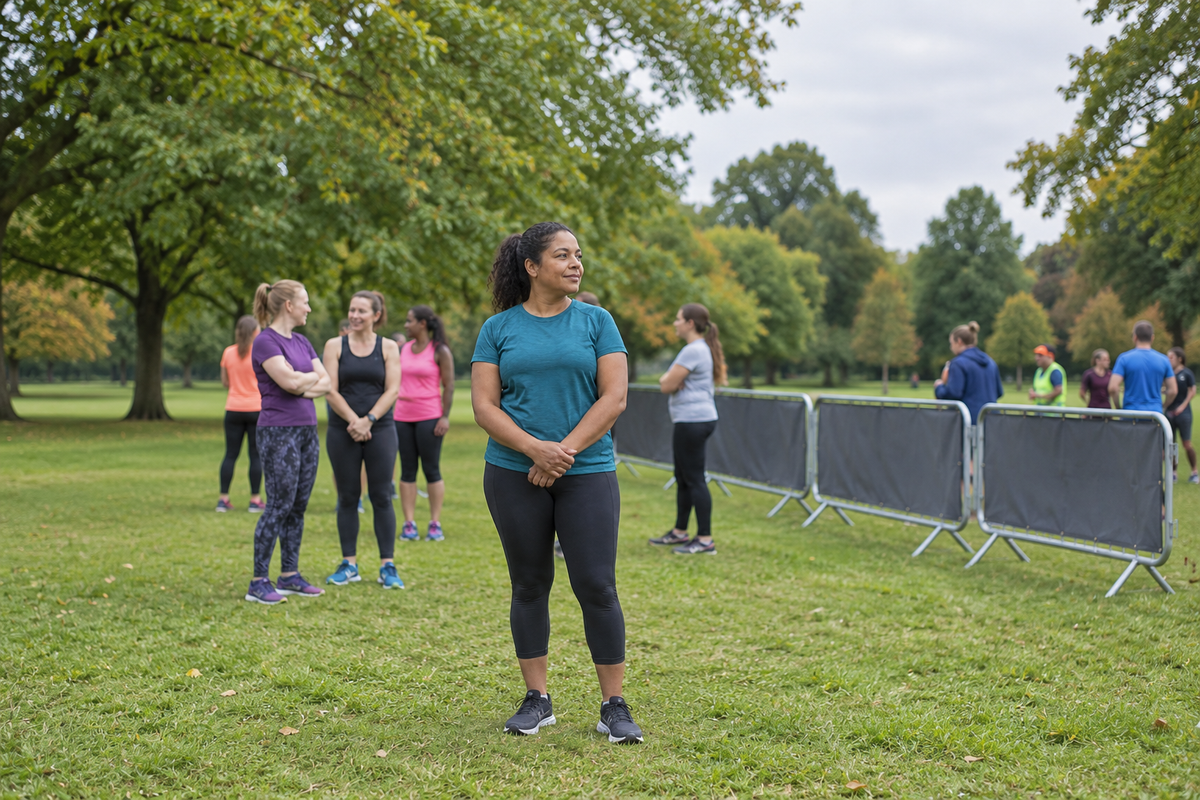
Your number is pinned on. Your shoes are tied. Somehow, your brain has decided that this is a splendid moment to ask whether you have ever actually run before.
Race-day nerves can feel ridiculous when you know, logically, that you chose to be here. They can also feel very real. You do not have to become perfectly calm before you are allowed to start. A more useful aim is to feel supported, understand what happens next and have a few manageable actions to return to.
Why your body has joined the conversation
Anxiety can involve thoughts, such as worrying about finishing, and physical sensations, including a faster heartbeat, sweating or an unsettled stomach. A situation can trigger the body's stress response even when the challenge is something you want to do.[1]
A first event adds uncertainty. There are unfamiliar instructions, other runners and a result you might care about. You may be excited and apprehensive together. Those feelings do not tell you how everyone else feels, or reliably predict how your run will go.
Do not automatically label unfamiliar or severe symptoms as nerves. Chest pain, faintness or breathing trouble deserve attention, particularly when they differ from your usual experience. Ask the medical team for help instead of trying to diagnose yourself in the start pen.
Give the practical worries somewhere to go
Try dividing the jumble into things you can check and things you cannot know yet.
You can check your route to the start, arrival time, number collection, toilets and where your belongings will be afterwards. You cannot know exactly how the third kilometre will feel or whether the person beside you will run faster.
Make one short note with the useful information. Save it somewhere you can reach without a mobile signal. Then use our guide to what happens at your first event and race-day checklist to fill any actual gaps. Re-reading six different packing lists after yours is complete may simply give the worry another job.
Our suggestion is to prepare a small fallback too: a later transport option, the event information point and a contact who knows your plans. This reduces avoidable decisions. It cannot remove every uncertainty, and does not need to.
Choose a job you can actually do
Finishing in a certain time is a result. Starting at a controlled effort, following your planned walking breaks and checking how you feel are actions.
Research on goal setting in sport supports process goals, although evidence about their effects on anxiety is less clear. It does not establish a special set of goals for women at their first race.[2]
Pick two or three actions for the day. For example:
- Find my start area without rushing.
- Begin with the effort I practised.
- Respond sensibly if conditions or symptoms change.
These are our examples, not a psychological assessment. Choose words that sound like you. A useful cue might be “comfortable start” or “one decision at a time”. It does not need to resemble the caption on a motivational poster.
Try gentle breathing, before you are running
If it feels comfortable, find a little space to sit or stand, loosen your shoulders and let your breathing become gentle and regular. You can count softly during the in-breath and out-breath, without forcing a deep breath or reaching a particular number. The NHS has a simple breathing exercise that is best practised regularly, rather than first attempted in a crowded start pen.[3]
There is no need for breath-holding or an elaborate pattern. If concentrating on breathing feels unpleasant, return to ordinary breathing and use another anchor, such as noticing your feet on the ground or reading your arrival note.
This is an optional settling technique. It is not treatment for unexplained breathlessness and it is not an instruction to restrict your breathing while running.
Let your attention have a smaller task
When the worry is about the entire race, bring your attention back to the next useful step: find the sign, join the correct queue, adjust the loose lace, listen to the announcement.
At the start, notice the space ahead and let the crowd move without making every passing runner your responsibility. During the run, alternate a brief check of your effort with attention to the route. You do not have to monitor every breath, heartbeat and footstep continuously.
Psychological interventions can help competitive anxiety, but studies use different sports, populations and combinations of techniques. A recent review found considerable uncertainty around some comparisons. Evidence does not justify declaring one quick trick the winner, particularly for a first-time recreational runner.[4] Try a small number of familiar strategies, rather than creating another performance to get right.
What about the strange feelings in race week?
Doing less running can leave more room to notice your legs, revisit your plan or wonder whether you should squeeze in a final test. Restlessness alone does not mean you have lost fitness overnight.
Keep following the appropriate plan and ordinary routines. The existing Tapering, race week and the days afterwards guide explains why missed sessions are not a debt to repay. New pain or illness still needs its own assessment. “It must be taper nerves” is not a medical explanation.
When nerves need more support
If anxiety repeatedly disrupts sleep, daily life or activities you want to do, or your own coping strategies are not helping, speak to your GP or an appropriate mental health professional. NHS guidance explains how to seek help, including talking therapies where available.[1] You can also ask the organiser about a quieter waiting area or relevant accessibility arrangements, without assuming every event offers the same facilities. If you feel overwhelmed before the start, step out of the crowd where safe and ask for support. You can decide not to start; it need not become a test of courage.
For a medical emergency, alert event staff and call 999 in the UK, or the local emergency number elsewhere. Do not try to manage serious symptoms as nerves.[5]
You can care about the day and still give yourself room to change the plan. Our first-race pacing guide gives you a calm opening strategy; When race day goes wrong explains your options if the day changes. Being prepared includes permission to look after yourself.
Sources and further reading
-
NHS. Get help with anxiety, fear or panic (NHS guidance, accessed 7 October 2026). ↩︎ ↩︎
-
Williamson O et al. The performance and psychological effects of goal setting in sport: A systematic review and meta-analysis (2022). ↩︎
-
NHS. Breathing exercises for stress (NHS guidance, accessed 7 October 2026). ↩︎
-
Li L, Wang J, Li Q, Fu Q. The Effect of Different Psychological Interventions on Athletes' Competitive Anxiety: A Systematic Review and Bayesian Network Meta-Analysis (2026). ↩︎
-
NHS. When to call 999 (NHS guidance, accessed 7 October 2026). ↩︎


