

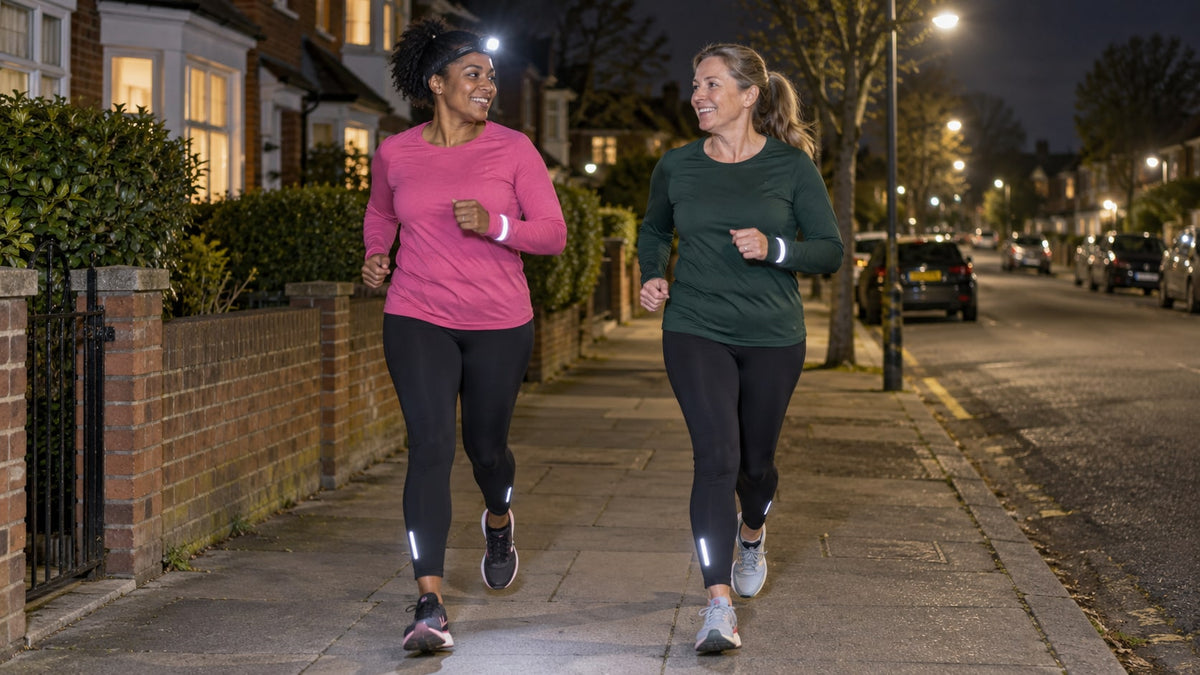
The darker mornings arrive quietly.
One week your usual evening run finishes in daylight. A couple of weeks later you're setting off under street lights, checking whether your favourite path is illuminated and wondering where you put that reflective jacket.
Running after dark does not need to mean staying indoors until spring.
It does mean thinking slightly differently.
Visibility matters. Route choice matters. What is under your feet matters. And for many women, personal safety is part of the calculation too.
This is our practical guide to keeping running as the nights draw in, without pretending that women should have to redesign their lives because somebody else might behave badly.
The short version
If you are heading out after dark:
- Choose a route that suits the conditions, preferably somewhere familiar and well lit.
- Wear reflective material, not just bright clothing.
- Use a head torch or running light where the ground is poorly lit.
- Tell someone where you are going and roughly when you expect to be back.
- Consider sharing your live location with somebody you trust.
- Carry a charged phone.
- Keep enough awareness of your surroundings to hear traffic and other people.
- If there is no pavement, face oncoming traffic and follow the Highway Code.
- Run with somebody else or a group when that makes you more comfortable.
- If something feels wrong, change your plan. A training session is never more important than getting home safely.
And one more thing:
Being harassed while running is not something you caused by choosing the wrong route, wearing headphones or running after dark.
The responsibility for harassment lies with the person doing it.
Why this matters particularly to women
The arrival of darker evenings does not affect everybody's freedom in the same way.
Research published in 2024 and commissioned by Sport England's This Girl Can campaign found that 72% of women in the UK change their outdoor activity routines during winter.
Almost a quarter said they stick to well-lit routes, 23% avoid certain areas and one in five reported looking behind them to check they were not being followed.[1]
This is not simply nervousness about running on an unlit pavement.
It sits within a much broader issue around women's freedom to use public spaces.
This Girl Can's Let's Lift the Curfew campaign exists because many women effectively find their world getting smaller as daylight disappears. England Athletics is supporting the campaign again in 2026, with running clubs and communities encouraged to organise visible group activities when the clocks go back.[2]
"Women shouldn't have to change their behaviour to stay safe."
Kate Dale, This Girl Can[3]
We agree.
The practical suggestions in this article can help you manage traffic, visibility, weather and personal safety. They should not be read as a list of things women must do to prevent somebody else behaving badly.
1. Be reflective, not simply bright
There is an important distinction between being bright and being visible in vehicle headlights.
Fluorescent colours are particularly useful in poor daylight.
Once it is properly dark, reflective material becomes much more important.
The Highway Code advises pedestrians to wear or carry something light-coloured, bright or fluorescent in poor daylight and to use reflective materials after dark. It says reflective material can be visible to drivers using headlights from up to three times the distance of non-reflective material.[4]
That might include:
- reflective strips on leggings
- reflective panels on jackets
- reflective shoe details
- ankle or wrist bands
- reflective running belts
- reflective vests
Clip-on running lights can add visibility too, but lights and reflective material do different jobs.
Reflective details on moving parts may be particularly useful
There is some interesting science behind this.
Humans are remarkably good at recognising the movement pattern of another human body. Researchers call this biological motion or biomotion.
Night-driving research has found that putting retroreflective material on moving joints such as the ankles, knees, wrists and elbows can help drivers recognise a person earlier than reflective material placed only on the torso.[5]
A review of this research published in 2023 concluded that reflective material positioned around moving joints can substantially improve a pedestrian's night-time conspicuity.[6]
That does not mean you need to dress like a Christmas tree.
But if you are choosing between otherwise similar pieces of winter kit, reflective detailing around the legs, shoes, wrists or ankles is genuinely useful.
What about an all-black running outfit?
Black kit itself is not the issue.
Black kit with no reflective detailing on an unlit road is.
If your favourite winter leggings are black, add reflection or lighting elsewhere.
2. Remember that being seen and being able to see are different things
Reflective material helps other people see you.
A head torch helps you see what is ahead of you.
Those are different jobs.
England Athletics recommends headlamps or handheld lights for running after sunset, particularly where routes are not well illuminated.[7]
A light can help you spot:
- potholes
- raised paving slabs
- branches
- tree roots
- puddles
- ice
- uneven trail surfaces
- dogs and leads
- other runners, walkers and cyclists
On genuinely dark trails, a proper running head torch is much more useful than relying on your phone's torch.
Point the beam towards the ground ahead rather than directly into the faces of approaching pedestrians, cyclists or drivers.
If you run regularly in the dark, also get into the habit of checking the battery before leaving home.
A head torch sitting powerless on your forehead three miles from home is mainly decorative.
3. Change the route before you abandon the run
Your perfect summer route might not be your perfect winter route.
That is fine.
England Athletics advises runners to prioritise well-lit streets and avoid poorly lit areas such as isolated footpaths or towpaths when running in darkness. It also recommends considering alternatives such as an athletics track or well-lit leisure facility.[7]
Police guidance gives similar advice.
Gwent Police recommends:
- well-lit routes rather than secluded areas
- bright clothing and lights
- telling somebody where you are going
- sharing your route or running with others
- taking your phone[8]
Think about your route in terms of more than distance.
Ask:
- Is it lit?
- Are there pavements?
- Are there safe places to cross?
- Will other people be around?
- Do I know the route?
- Is there somewhere I could stop if I needed help?
- Is there phone signal?
- Does this path become muddy, flooded or icy in winter?
- Would I feel comfortable here alone?
There is no medal for completing your usual trail loop when the sensible option was three laps of a well-lit neighbourhood.
4. Know the road rules
Runners are pedestrians in the eyes of the Highway Code.
If a pavement or footway is available, use it.
If there is no pavement, the Highway Code says pedestrians should generally keep to the right-hand side of the road so they can see oncoming traffic.
On narrow roads or in poor light, be prepared to move into single file and stay close to the side.[4]
There is one useful exception worth knowing.
On a sharp right-hand bend, it may be safer to cross the road before the bend so approaching drivers have a better chance of seeing you, then cross back afterwards when safe.[4]
At night, the Highway Code also recommends crossing near a street light if there is no pedestrian crossing nearby, so drivers can see you more easily.[4]
And never assume that because you can see a car, the driver can see you.
Those are very different things.
5. Tell somebody where you're going
This is one of the most consistent recommendations across police and athletics guidance.
England Athletics recommends sharing your location with someone you trust, telling them when you arrive and finish, and considering live location tracking.[7]
West Midlands Police similarly advises runners to tell somebody where they are going and for how long, and to consider a running tracker that allows a trusted friend or family member to follow their location.[9]
This does not need to become an expedition briefing.
Something as simple as:
"Heading out for 45 minutes. Doing the park loop and should be back around 7."
is useful.
For longer runs, unfamiliar routes or quiet areas, consider sharing your live location.
And remember to tell them when you're home.
Otherwise your very well organised safety system ends with somebody wondering why you've apparently been missing for two hours while you're actually in the shower.
6. Take your phone, but think about how you share your runs
A charged phone gives you:
- a way to call for help
- navigation
- live location sharing
- access to transport if you need to abandon the run
- a record of where you have been
It is sensible to carry it.
It is also worth checking how much information your running apps are sharing publicly.
For example, Strava allows users to hide:
- an address
- the beginning and end of activities
- selected portions of a route
- the entire activity map
It also allows activity visibility to be limited to followers or only yourself.[10]
Strava currently hides the first and final 200 metres of future activity maps by default after a user's first upload, but you can configure much larger privacy areas if you choose.[10]
If most of your runs start and finish outside your front door, it is worth reviewing those settings.
Hiding part of a map does not guarantee that somebody cannot work out where you live. Check the privacy settings on any connected services too, because Strava's settings may not carry across.
You can still enjoy sharing your running without necessarily sharing exactly where you live and the times you regularly leave home.
7. Think about your headphones
We love running with music too.
This is not a lecture about abandoning your playlist.
It is about keeping enough awareness of what is happening around you.
Both West Midlands Police and the Suzy Lamplugh Trust advise considering the use of only one earphone so runners can still hear changes in their surroundings.[9][11]
Other options include:
- reducing the volume
- pausing audio on busy roads
- leaving one ear completely free
- using audio only on familiar, well-lit sections
- going without audio where traffic or personal safety requires greater awareness
Whatever technology you use, the goal is the same:
don't let it completely disconnect you from what's happening around you.
8. Carry the small things that could get you home
You do not need a survival kit for a 5K.
A few things can make an unexpected situation easier:
- charged phone
- bank card or small amount of money
- house key
- any medication you may urgently need
- a small personal alarm if you choose to carry one
- identification or emergency details if appropriate
The Suzy Lamplugh Trust suggests carrying a card or small amount of money so you can get home if plans change, and says some people may wish to carry a personal alarm.[11]
A personal alarm is not a force field.
It may help you draw attention or create an opportunity to move away, but it cannot guarantee that somebody will hear it or come to help.
9. Running with other people is an option, not an admission of defeat
Some runners love running alone.
Some feel far happier with company once the evenings get dark.
Both are valid.
England Athletics, Welsh Athletics and several police forces recommend group running as one option for improving confidence and safety after dark.[7][8][12]
If winter nights are affecting how often you run, this might be the perfect time to try:
- a local running club
- a RunTogether group
- parkrun friends
- a regular running buddy
- colleagues
- neighbours
- Running Woman community members nearby
England Athletics' Let's Lift the Curfew campaign is encouraging groups across England to organise runs specifically around women's freedom to be active after dark in autumn 2026.[2]
Welsh Athletics has developed a similar Own the Night campaign alongside police forces and women's safety organisations.[12]
Sometimes the best piece of winter running equipment is another runner.
10. Watch the ground as well as the people around you
Darkness is only part of the winter problem.
The surface itself changes.
The Met Office warns that frost and moisture can create ice on roads and pavements and that compacted frost can become slippery ice underfoot.[13]
Black ice is particularly difficult because you may not see it before your foot lands on it.
On cold evenings and early mornings:
- check the forecast
- pay attention to ice warnings
- favour treated or busier pavements
- slow down through suspicious patches
- be particularly cautious on bridges, shaded paths and untreated surfaces
- use a light strong enough to see the surface ahead
If conditions are genuinely icy, changing the session is sensible training, not weakness.
A treadmill, indoor session or rest day is considerably more useful to your training than recovering from a fall.
11. If something feels wrong, listen to that feeling
You do not need courtroom-quality evidence before changing direction.
If a person, vehicle, route or situation makes you uncomfortable:
- change direction
- cross the road
- move towards other people
- head into a shop, café, pub or other staffed place
- call somebody
- end the run
- arrange transport home
The Suzy Lamplugh Trust advises seeking a place of safety where other people are present if you feel uncomfortable or at risk.[11]
West Midlands Police also recommends moving towards a place of safety if you feel at risk.[14]
Your watch can cope with an unfinished workout.
12. What to do if somebody harasses you
This deserves its own section because too many women have been told to ignore behaviour that is intimidating, sexual or threatening.
Catcalling, sexualised comments, deliberately following somebody, threatening behaviour and intimidating use of a vehicle are not simply "part of running outside".
Our Streets Now's work on sport and public sexual harassment found that harassment can include sexual comments, persistent staring, being followed, somebody lingering too close or suspected filming.[15]
In England and Wales, the Protection from Sex-based Harassment in Public Act 2023 came into force on 1 April 2026.
It created an aggravated offence where somebody intentionally causes harassment, alarm or distress in public because of a person's sex or presumed sex.[16]
Cheshire Constabulary has subsequently launched a campaign specifically addressing harassment of women runners and encourages women to report sexual harassment, inappropriate comments and intimidating behaviour.[17]
If you are in immediate danger
Call 999.
Move towards other people or a place of safety if you can do so safely.
If the incident is not an emergency
You can report harassment or intimidating behaviour to the police online or through 101.
If you are unsure whether something is worth reporting, you are still allowed to report it.
Patterns matter.
Information about repeated incidents, locations, vehicles or individuals can help police understand what is happening in an area.
If a place itself feels unsafe
Police.uk operates StreetSafe, which allows people to anonymously report public places where they feel unsafe.
That could include:
- poor lighting
- abandoned buildings
- vandalism
- locations where people have been followed
- places associated with verbal abuse or intimidation
StreetSafe is not for reporting a crime or an emergency.[18]
And if you're another runner, you can help too
Women's safety is not just a women's issue.
Police.uk has published specific advice about how people can make others feel safer in public.
For runners, some of it is wonderfully simple.
If you're running up behind somebody at night:
- give them space
- cross the road if practical
- make your presence known before passing
- do not run inches behind them waiting for a gap
- do not shout comments about their appearance
- if someone is being harassed, consider whether you can safely act as a bystander or offer support
A completely harmless runner approaching quickly from behind can feel very different to the person who cannot see who is coming.[19]
A few seconds of thought can make somebody else's evening considerably less stressful.
The winter running kit checklist
You do not need to buy an entirely new wardrobe because the clocks changed.
Before heading out, think about four things.
Can drivers see me?
Look for:
- reflective detailing
- reflective ankle or wrist bands
- reflective outer layers
- clip-on lights
- bright colours in poor daylight
Can I see the ground?
Consider:
- head torch
- chest light
- handheld torch
- sufficiently lit route
Can I call for help?
Take:
- charged phone
- emergency contacts
- payment method
- optional personal alarm
Can somebody find me?
Consider:
- telling somebody your route
- expected return time
- live location
- appropriate privacy settings on public running apps
You are allowed to change the session
One of the strangest ideas runners sometimes absorb is that changing a planned run somehow means failing.
It doesn't.
If tonight's route is icy, run tomorrow.
If the canal path is completely dark, choose the lit streets.
If you don't feel comfortable running alone, message somebody.
If you cannot face the weather, get on a treadmill.
If something feels wrong halfway through, go home.
Training plans are meant to help your life.
Your life is not meant to serve the training plan.
Dark nights should not mean a smaller life
Running after dark has its own atmosphere.
Quiet streets.
Cold air.
That satisfying cloud of breath appearing in front of you.
A familiar route suddenly feeling completely different.
For plenty of us, winter running can be one of the best parts of the year.
What we should not accept is the idea that shorter days automatically mean women have less freedom.
This Girl Can calls it a curfew because that is how it can feel. Their research shows women changing routes, timings and habits simply because daylight has disappeared.[1]
Practical safety choices matter.
Reflective kit matters.
Road awareness matters.
Sharing your location might help.
Running together might help.
But making public spaces safer, challenging harassment and changing the behaviour that makes women feel unsafe matters too.
Running Woman wants women to be able to run.
Early.
Late.
Fast.
Slow.
Alone.
Together.
In summer sunshine and on freezing Tuesday evenings in November.
The nights getting darker should not mean our world gets smaller.
Need help now?
If you are in immediate danger in the UK, call 999.
For non-emergency police reports, use your local police force's online reporting service or call 101.
StreetSafe can be used to anonymously report public locations where you feel unsafe, but it should not be used to report a crime or emergency.[18]
Running Woman note
This article provides general safety information and does not guarantee personal safety. Circumstances differ, so use your judgement and adapt your route, kit and plans to the conditions around you.
Responsibility for harassment, abuse or violence always lies with the person responsible for that behaviour.
Sources and further reading
-
Sport England / This Girl Can: Majority of women change behaviour getting active outdoors in winter (2024) Back Back
-
England Athletics: Sign your club or running group up for Let's Lift the Curfew 2026 Back Back
-
The Highway Code: Rules for pedestrians, including Rules 1, 2, 3 and 17 Back Back Back Back
-
Tyrrell RA et al.: Seeing pedestrians at night: visual clutter does not mask biological motion (2009) Back
-
Wood JM: Improving the conspicuity and safety of pedestrians and cyclists on night-time roads (2023) Back
-
England Athletics / RunTogether: Guide to Running in the Dark (PDF) Back Back Back Back
-
Gwent Police and Crime Commissioner: New initiative aims to keep female runners safe Back Back
-
Strava: How do I edit my map visibility on Strava? Back Back
-
Suzy Lamplugh Trust: Personal Safety Out and About Back Back Back
-
Welsh Athletics: Own the Night, championing women's running and safety across Wales Back Back
-
West Midlands Police: Staying safe and seeking a place of safety Back
-
Home Office: Protection from Sex-based Harassment in Public Act 2023 statutory guidance Back
-
Cheshire Constabulary: Campaign launched to tackle harassment facing female runners in Cheshire East (June 2026) Back
-
Police.uk: Tips for making other people feel safer on the streets Back

