

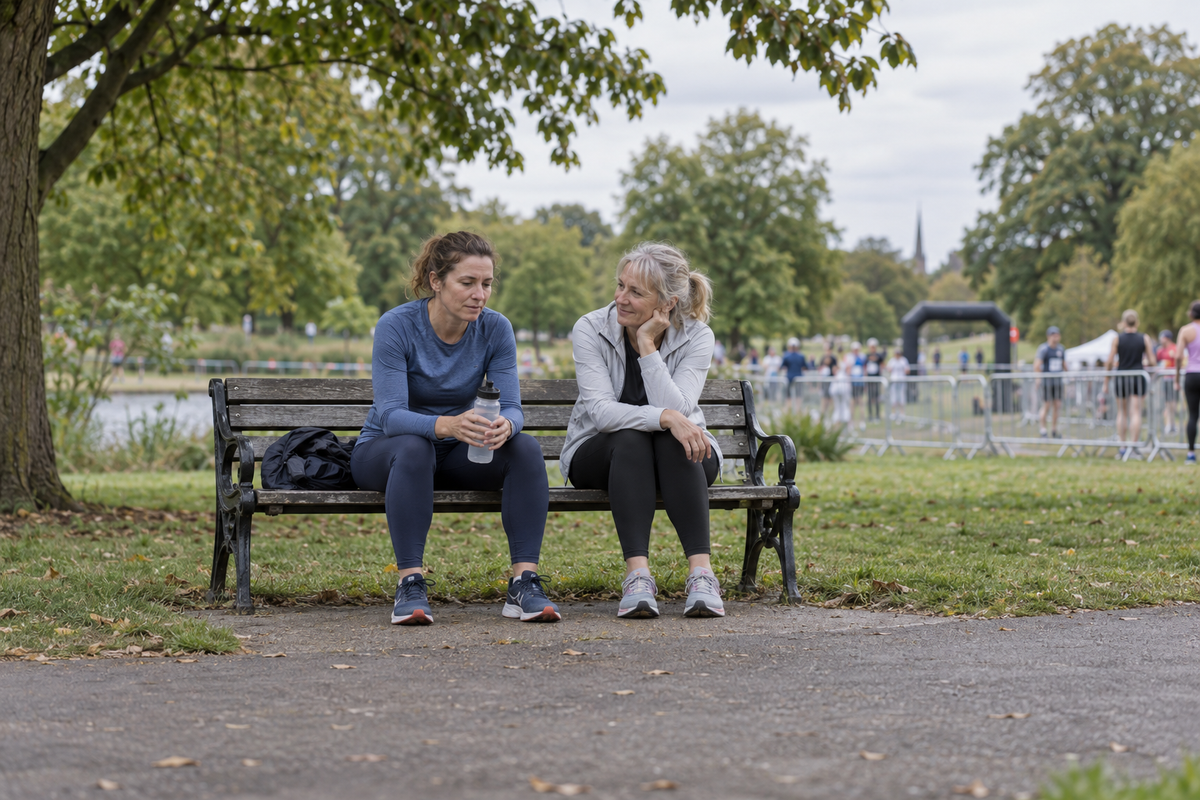
Some race days produce the finish you imagined. Others produce a toilet queue, a blister and a long conversation with yourself somewhere you had hoped to be running faster.
It is disappointing when preparation and outcome do not line up. You are allowed to care. You are also allowed to change the plan while the race is still happening. The entry fee, fundraising page and training diary do not require you to keep going at any cost.
First, decide what sort of problem you have
A watch that has stopped, a missed split and severe chest pain need very different responses. Before trying to rescue the result, consider whether you are dealing with an inconvenience, an effort you can safely reduce or symptoms that need help.
For an inconvenience, find a practical adjustment. For unexpectedly difficult running, slow down or walk and reassess. If you feel unwell, have concerning pain or are unsure what is happening, stop and speak to an event medic or marshal. You do not need to diagnose the problem before asking.
When the time goal slips away
If your target is disappearing, repeatedly calculating a faster required pace may only add pressure. Choose a new aim for the remaining distance: a manageable effort, planned walking breaks or reaching the next staffed point to reassess.
Walking that you did not expect can feel emotionally louder than walking you planned. It is still an available way to reduce the demand. Check behind and move safely before slowing; follow the organiser's route instructions.
If you otherwise feel well, a slower finish may be reasonable. If symptoms suggest stopping, the goal has changed to getting help. Our first-race pacing guide explains how to adapt before a target takes over every decision.
When your stomach objects
Running-related stomach symptoms can have several contributors, including exercise intensity, movement and food or drink choices. One uncomfortable race does not establish an intolerance, and the cause is not always simply “the wrong gel”.[1]
For mild nausea or an urgent toilet need, ease the effort, use the event toilets and reassess. Do not force down more fuel to make up a schedule while feeling progressively worse. For preparation before a future event, our fuelling and hydration guide explains the place of practising your plan. Seek event medical advice if symptoms persist or you cannot continue comfortably.
Repeated vomiting, inability to keep fluids down or bloody diarrhoea need urgent assessment. Sudden severe abdominal pain or vomiting blood require emergency help.[2][3] Do not treat these as ordinary runner's tummy or attempt to fix them with an untried medicine.
Afterwards, note the timing, conditions and what you consumed. Recurring symptoms are worth discussing with a clinician and, where relevant, a registered sports dietitian rather than progressively removing foods on your own.
When a muscle cramps
Exercise-associated cramps are not explained by one universal salt or dehydration problem. The evidence points to several interacting factors, and prevention advice needs to consider the individual.[4]
Stop safely. For a familiar, localised muscle cramp without other concerning symptoms, gentle static stretching may help it settle. Do not yank or bounce the muscle. If pain persists, the cramp is severe or you feel generally unwell, get medical help rather than stretching harder.[4]
Salt tablets and a large bottle of water are not an automatic solution. Whether to continue depends on how you feel afterwards and any medical advice, not on how close the finish looks.
When the weather or equipment changes the day
In heat, reduce your ambition early and follow the organiser's advice. If you become unwell, stop and seek help. More water is not the answer to every headache, cramp or dizzy spell: drinking too much can also be dangerous. Follow appropriate event hydration guidance and any individual medical plan.[5]
Cold rain, strong wind, slippery surfaces or a changed route may also require slower running, extra layers or withdrawal. Respect event cancellations and instructions to stop.
A failed watch can mean running by familiar effort and official markers. A loose lace needs a safe place to stop. A broken shoe, worsening blister or damaged essential equipment may mean you cannot continue safely. Ask for assistance; there is no obligation to improvise a painful finish.
Symptoms that need immediate help
At a UK event, alert the nearest marshal or medical team and call 999 for a medical emergency. Do not wait to reach the finish with:
- Persistent chest pain or pressure, particularly with breathlessness, sweating, nausea or pain spreading to the arm, jaw or back.[6]
- Severe breathing difficulty, collapse with unresponsiveness or sudden confusion.[7][8]
- Confusion, loss of coordination, a seizure or collapse in hot conditions, which can signal serious heat illness.[9]
- Sudden severe abdominal pain or vomiting blood.[2][3]
For suspected serious heat illness, follow medical or 999 instructions while help is coming, including cooling the person with water on the skin and fanning where practical.[9]
This is not an exhaustive list. Stop for symptoms that feel concerning or markedly different from expected exertion, and ask for help. Tell staff your location and bib number if you can. If someone is unresponsive and not breathing normally, call 999 and start CPR, following the call handler's instructions. Ask someone else to bring an AED if available. Do not leave them to search for one yourself.[10]
Stopping, DNF and cut-offs
DNF means “did not finish”. It records an event outcome, not the value of your preparation.
Follow the organiser's withdrawal procedure. Usually that means telling a marshal, medical point or event control, giving your bib number and confirming what to do next. Do not simply disappear from the course. Check arrangements for transport, collecting belongings and contacting anyone waiting for you.
Cut-offs may apply at intermediate checkpoints as well as the finish. Check whether the clock starts with the first wave, your wave or your own start. If you miss one, follow staff instructions. Some events require withdrawal; others permit a clearly defined, unsupported continuation. Permission, road closures, facilities and transport vary. The London Marathon's published arrangements are an example, not a rule for other races.[11]
For a future event, our event-choice guide helps you check these details before entering.
Afterwards, let disappointment be ordinary
You do not need to manufacture gratitude immediately or announce your next race from the finish area. Get warm or cool as appropriate, collect your things, reach your support person and deal with any symptoms first.
Once you have had time to recover, make a short, factual review: what happened, what you could influence, what was outside your control and one change worth trying. Avoid writing a full character assessment based on a difficult hour.
The existing race-week and afterwards guide covers returning to ordinary recovery. If worry about another event is taking over, start with Race-day nerves and seek further support if needed. The next decision can be kind and useful, even when the result still hurts.
Sources and further reading
-
de Oliveira EP, Burini RC, Jeukendrup A. Gastrointestinal Complaints During Exercise: Prevalence, Etiology, and Nutritional Recommendations (2014). ↩︎
-
NHS. Stomach ache (NHS guidance, accessed 7 October 2026). ↩︎ ↩︎
-
NHS. Diarrhoea and vomiting (NHS guidance, accessed 7 October 2026). ↩︎ ↩︎
-
Miller KC, McDermott BP, Yeargin SW, Fiol A, Schwellnus MP. An Evidence-Based Review of the Pathophysiology, Treatment, and Prevention of Exercise-Associated Muscle Cramps (2022). ↩︎ ↩︎
-
London Marathon Events. Big Half Warm Weather Guide (organiser guidance, accessed 7 October 2026). ↩︎
-
NHS. Chest pain (NHS guidance, accessed 7 October 2026). ↩︎
-
NHS. Shortness of breath (NHS guidance, accessed 7 October 2026). ↩︎
-
NHS. When to call 999 (NHS guidance, accessed 7 October 2026). ↩︎
-
NHS. Heat exhaustion and heatstroke (NHS guidance, accessed 7 October 2026). ↩︎ ↩︎
-
St John Ambulance. How to do CPR (reviewed 2025). ↩︎
-
London Marathon Events, 2026 TCS London Marathon Event Guide (2026). ↩︎

