

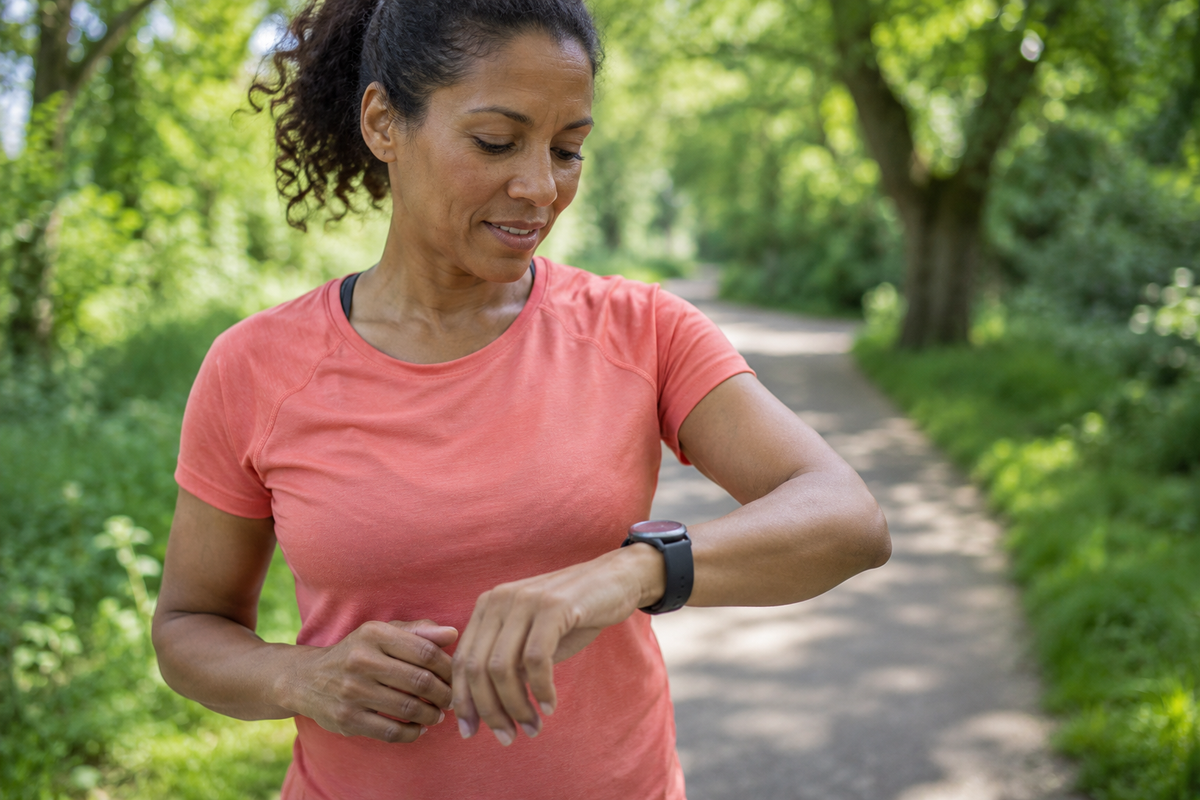
Your running friend records 5.02 km. You record 4.87 km. You ran together, nobody took a shortcut, and now your watches appear to be having a small disagreement.
Which one is right? Possibly neither. A running watch gathers several kinds of information, and being good at one does not make it equally good at all of them. A tidy route map does not validate your heart rate. A convincing heart-rate graph does not turn the calorie total into a measurement of your lunch.
The useful question is what each number can reasonably tell you, and when it needs a second look.
Four numbers, four different jobs
| Number | What it represents | A sensible way to use it |
|---|---|---|
| GPS distance | An estimate of the route travelled using satellite positioning and the watch's processing | Keep a training record, while allowing for route and signal differences |
| Current pace | An estimate of how quickly you are moving over a recent period | Treat small, sudden changes cautiously |
| Wrist heart rate | Pulse estimated from an optical signal at the skin | Look at the trace and context, especially when effort changes quickly |
| Calories | A calculated estimate of energy expenditure | Treat it as approximate information, without turning it into a food allowance |
Those uses are our editorial starting points. The research behind them is more varied than a single accuracy score suggests.
Why GPS distance can disagree with the route
GPS is one satellite navigation system; GNSS is the broader term covering GPS and other constellations. Watches differ in the signals they receive and how they process them. Buildings, bridges and trees can obstruct signals, while reflections from nearby surfaces can confuse positioning. GPS.gov explains these limitations.
A 2020 study tested eight sports watches on measured urban, woodland and open-track routes. Across its walking, running and cycling conditions combined, mean absolute percentage errors ranged from 3.2% to 6.1%. The open setting generally produced better results than the built-up and wooded routes. However, this involved older models and one participant. Those percentages describe average error size in that experiment, not the maximum error or a prediction for your watch today. Read the distance-validation study.
A later, 2024 validation of ten watches also found substantial variation between models and running settings in a small repeated-test protocol. Its repeated 4 km track runs produced mean absolute percentage errors ranging from 0.8% to 12.1%. The lesson is that a watch category, price or brand name cannot supply one universal accuracy figure. Read the 2024 smartwatch validation.
Our practical suggestion is to look for a pattern over several outings. Does a familiar route usually come out similarly, with the occasional strange result under trees? Or does the map repeatedly wander through buildings? Keep the route, recording mode and start point comparable before drawing conclusions.
Agreement with a friend's watch is interesting, but it is not an independent reference measurement. Two devices can agree and still be wrong.
Why a 10K race can look longer on your watch
AIMS and World Athletics use the calibrated bicycle method for official road-course measurement. It does not depend on a runner's wrist GPS. AIMS explains course measurement.
The course is measured along the shortest route runners are permitted to take, as set out in UK Athletics' current rules, TR55.3.
You may travel farther by going wide around bends or moving around people. GPS can then add its own error in either direction. A watch reading of 10.2 km therefore cannot tell you, on its own, that the race course was long. Equally, certification does not make an incorrectly placed cone impossible. A substantial discrepancy is something to raise with the organiser, with context.
For race pacing, our preference is to check elapsed time against the official course markers where available. A manually recorded split between two kilometre markers gives you the time for that section. It is different from relying on a GPS-triggered kilometre alert.
Current pace, lap pace and average pace are different
Current pace describes a recent window. Lap pace describes the current lap; average pace describes the activity so far. Exact calculations and display behaviour vary. Garmin, for example, documents a narrow time window for its pace chart and a time-and-distance calculation for average lap pace. That explains those fields, without proving their accuracy. Garmin's field explanation.
Here is a simple illustration. Run a true 5 km in 30 minutes and your pace is 6:00/km. If a device records 5.1 km over the same time, its average becomes about 5:53/km. That seven-second difference comes from the distance figure. It is not a sudden fitness breakthrough.
Our practical recommendation for a steady run is to give more attention to an established lap average than to every flicker of current pace. Averaging can make a display steadier; it cannot repair a consistently wrong distance. At the beginning of a new lap, there is very little information to average.
For short repetitions, time a known-distance section or use time-based efforts if that suits your session. If you manually press lap at race markers, read lap time: the watch's displayed lap pace may still use its own estimated distance. Check your device's definitions before treating the two as interchangeable.
Wrist heart rate needs a good signal
Most wrist sensors shine light into the skin and use changes in the reflected signal to estimate pulse. This is photoplethysmography, usually shortened to PPG. Movement and signal crossover can interfere with it. Research comparing wearables with ECG has found differences between devices and in their response to changing activity. Bent and colleagues' optical-sensor study.
One possible problem is a trace that follows the rhythm of movement rather than the pulse, often called cadence lock. A number resembling your step rate can be a clue, but it is not proof: heart rate and cadence can coincide legitimately.
Our first practical check is fit. Follow your watch's placement instructions, keep the sensor against clean skin and aim for secure contact without overtightening. If it slides around, or sits awkwardly against the wrist bone, adjust it before deciding that the whole sensor is useless. Check the full graph afterwards. A session average can conceal a period of implausible readings.
If heart-rate precision matters for a session, an appropriately fitted electrical chest strap can be a useful comparison. In a 50-person exercise study reported by the American College of Cardiology, a chest strap agreed more closely with ECG than the tested wrist devices. These were older products, so this is not a ranking of today's watches. Read the ACC study summary.
A strap is still a consumer device: fitting, contact, battery and connection deserve checking too. It is not infallible, and it does not replace a clinical ECG. If you have medically prescribed heart-rate limits, agree the monitoring method with your clinician.
Does accuracy vary between people?
It can, and the evidence does not justify assuming every runner gets the same result.
A systematic review of ten studies found mixed evidence about skin tone: some reported lower accuracy with darker skin, some no difference and some mixed findings. The authors called for better studies. Read the skin-tone review.
In 2025, a study of 25 adults, including 16 women, found greater errors at higher exercise intensities in participants with darker skin tones. It tested one wrist device against a chest strap during recumbent cycling. That matters, but it cannot establish the performance of every watch on every runner. Read the 2025 validation.
Small study groups also cannot represent every wrist size, age or training background. Including women in a sample does not automatically establish equivalent accuracy for all women. We would want product reviews to describe who tested the device, rather than quietly treating one reviewer's results as universal.
Calories deserve the loosest grip
A watch does not directly measure energy expenditure. It estimates it using sensor data and an algorithm, often with information from your profile.
In a 2017 laboratory study of seven wearables and 60 adults, no device achieved energy-expenditure error below 20%. That is historical evidence, not a reason to subtract 20% from a modern watch's total. Read the original validation.
A subsequent meta-analysis found that accuracy varied with activity and device. Read the energy-expenditure review. More recently, a 2026 study of four watches in 58 adults still found substantial errors against indirect calorimetry. It used a short cycling protocol, so it does not provide a correction formula for your long run. Read the 2026 study.
Our editorial advice is to keep calorie estimates in the optional-information category. Do not use them to decide whether you have earned food, or exactly how much to eat after a run. Apparent consistency does not establish accuracy, even for comparisons with your own previous sessions. For practical eating advice, use our separate running nutrition guidance.
Make the next run a useful check
Before setting off, use the correct activity profile, follow the device's instructions for obtaining a satellite signal and check whether a battery-saving mode changes recording. Follow its fit and care instructions too. These are sensible setup checks, not a promise of perfect data.
Then change one thing at a time. Try the same familiar route with comparable settings. Inspect the route map when distance looks odd. Compare a questionable heart-rate trace with a suitable reference over more than one run, if you have access to one.
You do not need to investigate every decimal place. Decide which measurement actually matters for the session, and how much uncertainty you can live with. For the wider question of choosing and using a watch, see Is your running watch helping, or turning every run into a test?.
Your watch can make a useful running companion. It just needs you to keep a little judgement on the other wrist.
Love RW x

