

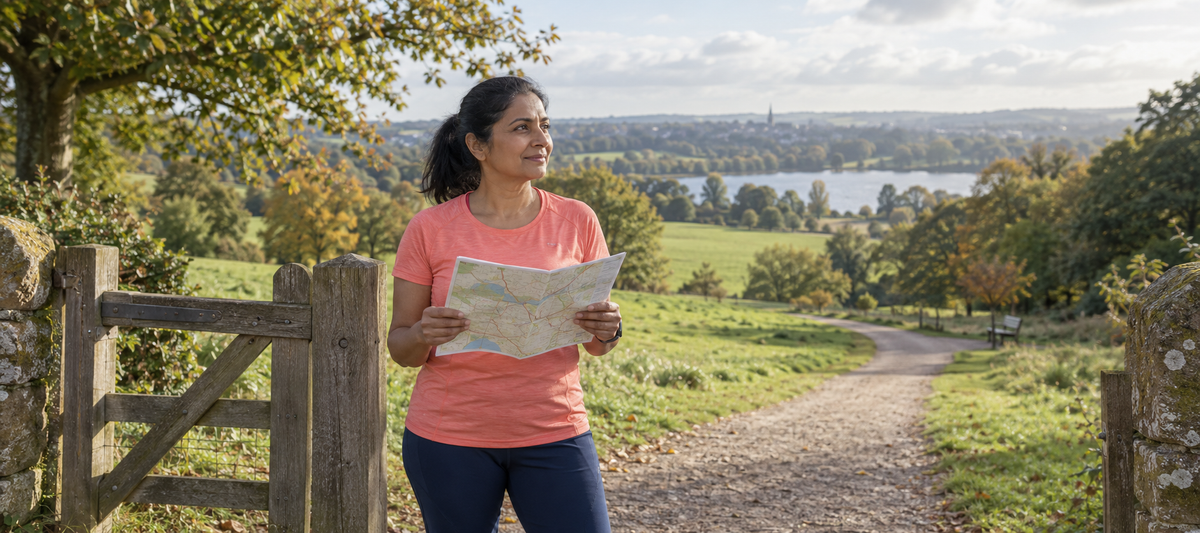
The most famous race on your feed does not automatically make the best first race for you. A good choice might be a small local 5K, a busy town-centre 10K or a trail event you are excited to explore.
Start with a more useful question than “What should a real runner enter?”: what would give me a manageable, enjoyable first experience?
Here is our practical framework. It is a way to compare events, not a scientific ranking of which kind is best.
Choose a distance you can prepare for
Consider your recent running, the time available before the event and the training time that fits your week. A longer distance brings more preparation and usually more time on your feet. It need not be your first step just because a friend has entered it.
Read the starting requirements of a suitable Running Woman training plan. Give yourself room for normal interruptions rather than choosing a date that depends on everything going perfectly.
If you intend to run-walk, look for an event whose time limits accommodate that plan. You do not have to earn an entry by running every step.
Read the route, not just the distance
A flat road 5K and a steep, muddy trail 5K can be very different outings. Check the surface, total climbing, steep sections, steps, narrow paths and likely ground conditions. Look at the elevation profile alongside the map: a single large climb can feel different from rolling hills throughout.
For trails, ask whether you need navigation skills or mandatory kit. Some races are clearly marked; others expect much more independence. Do not assume that “trail” means either a gentle woodland jog or a mountain expedition.
If the surface raises a footwear question, our road-versus-trail shoe guide explains the differences without making a new pair the price of entry.
Check every cut-off
An overall cut-off is the deadline for completing the event. An intermediate cut-off is a deadline at a point along the route. You may need to meet both. Ultra Tour Monte Rosa's rules provide one clear example of events using intermediate and final limits, although that mountain race is not a beginner recommendation.
Ask the organiser:
- Does the clock start with the first wave, my wave or my own start-line crossing?
- Are intermediate checkpoints assessed on arrival or departure?
- What happens if I miss a limit?
- When do road closures, water stations, timing and finish support end?
Those are separate questions. “No cut-off” may still involve changes to road access or support. Great Run's general FAQ, for example, describes a sweep vehicle and moving behind it onto pavements, subject to event-specific information.
Compare the limits with a realistic run-walk estimate, including stops and terrain, with some breathing room. If the event would require your best-ever day simply to remain supported, choose another one.
Decide how much bustle you want
A large field can bring music, spectators and more people moving at a similar pace. It can also bring crowded transport, queues and a long wait for your wave. A small event may feel simpler, but you might spend more of the route on your own.
Neither atmosphere is better. Look for photos, route information and the expected field size, then ask whether you want a festival, a quiet morning or something in between. Check where supporters can watch and meet you afterwards if that matters to your day. Previous results can show the range of finishing times, but confirm this year's support arrangements directly.
Check how waves are allocated and whether there is a walking or run-walk option. A “beginner-friendly” description is most useful when the practical details back it up.
Make the whole journey work
Check the start time against actual transport services, parking availability, road closures and the distance from arrival point to start. A cheap entry can become an expensive weekend if it needs accommodation and several journeys.
Find out whether number collection requires a separate trip. Check bag drop and how you will get back from a point-to-point finish. Read cancellation, transfer and deferral terms before paying. The Road Runners Club of America's event-selection guidance usefully emphasises clear organiser information, course details and entry terms.
Ask about facilities and access
Confirm toilets at the start and on the course, drinking-water provision, and whether you must carry a cup or bottle. “Facilities available” does not tell you where they are or whether they meet your needs.
For accessibility, ask specific questions about surfaces, gradients, step-free routes, accessible parking and toilets, support runners, mobility equipment, sensory provision and the finish area. Arrangements differ. Bath Half's accessibility information shows the sort of detail an organiser may provide; it does not establish what every race offers.
You are allowed to ask before committing. Access requirements are part of choosing an event that fits.
Read the headphone rule
Check the rule for your exact event and headphone type, including bone-conduction models. Permission varies with the course and organiser; “open ear” on a box is not permission to use it in a race. RunThrough's event policy illustrates that variation.
If music is part of your usual running, decide whether you would be comfortable practising without it for an event that prohibits headphones.
Choose the event you actually want
Our suggestion is to make three short lists: must-haves, nice-to-haves and things that would make the day unnecessarily difficult. Compare a few events against them.
There is no bonus for picking the most intimidating option. A convenient start, a suitable route and enough time to complete it can be a lovely combination.
Once you have chosen, our first-event walkthrough explains what happens when you arrive. If the thought of entering is stirring up a few butterflies, our race-day nerves guide can help you prepare for those too.


