

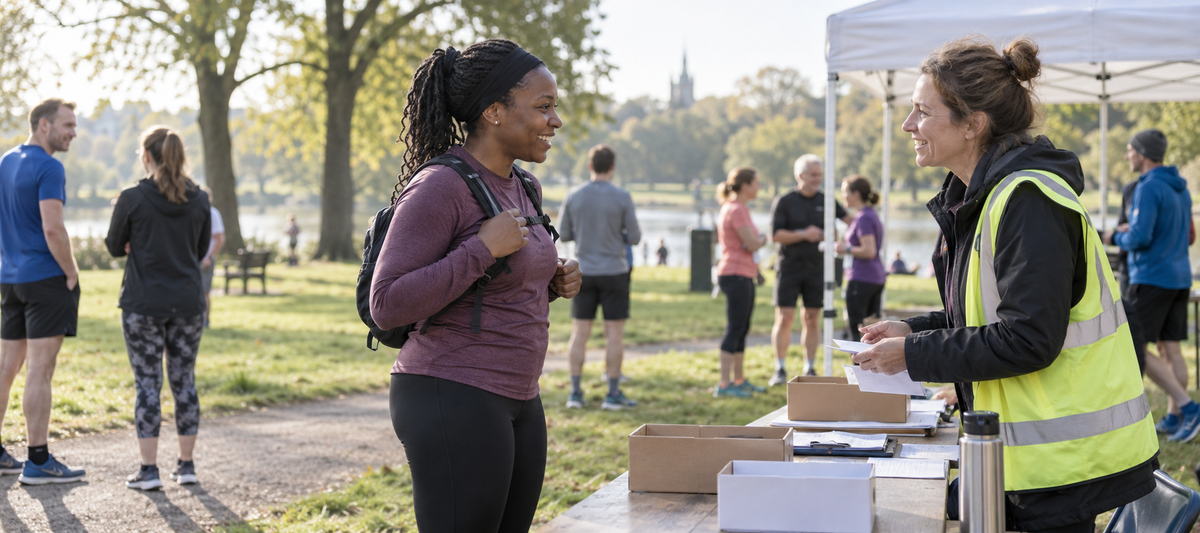
You have an entry confirmation. You have done some running. Now there is a new set of questions, starting with: where, exactly, am I supposed to put myself?
An organised race adds a little administration to a familiar activity. Once you know the order of things, it becomes easier to picture the morning.
This guide covers entered events such as a local 5K or a larger road race. If you are heading to parkrun, use our first-parkrun guide, which explains its different registration and finish system.
The sequence below is a guide. Your organiser's current instructions take priority, including late changes announced on the day.
Before you leave home
If you are still deciding what to enter, start with choosing your first event. Once you have an entry, read the event guide and save the parts you need: travel details, collection instructions, site map, your start time and the organiser's contact information. Great Run's first-timer guidance explains how much of the practical information lives there.
Plan the journey to the correct entrance, rather than simply the town or park. Check parking arrangements, road closures and the actual bus or train service on the event day. Include the walk from your stop or parking space. Think about the return trip too, especially if the finish is somewhere different.
Work backwards from the organiser's arrival and assembly instructions. Leave space for queues and finding your bearings. There is no arrival time that suits every race.
Registration and your race number
Your number, often called a bib, identifies you. Some events post it; some have collection before race day; others offer collection that morning. For example, RunThrough describes collection arrangements, while the 2026 London Marathon guide required advance collection. Do not assume you can pick it up at the start.
Bring the confirmation, collection code and identification your event requests. If you already have everything, you may not need to register again. Ask at the information point if something is missing.
Attach the bib as instructed, usually visibly on your front, and complete any emergency and medical details requested on its reverse. Timing chips can be part of the bib or a separate item: follow the supplied fitting instructions rather than copying another runner.
Bag drop and the loo
If a bag drop is offered, check its opening and closing times, bag restrictions and collection procedure. Some organisers require a particular bag and numbered label or wristband. The 2025 Vitality London 10,000 guide illustrates how specific that system can be.
Keep the things you need during the run with you, including any prescribed medication you need to access. Put your dry layer somewhere easy to reach afterwards. Our practical suggestion is to minimise valuables and photograph the collection details before handing anything over. A staffed bag drop is not the same thing as an individual locker.
Find the toilets before joining the start queue. Allow time for a queue of their own, and check where accessible facilities are if you need them. Period products and other support are available at some events, but pack what you rely on unless provision is confirmed.
Finding your start
A pen or corral is an assembly area. A wave is a group released at a particular time. Your event may use one, both or neither.
Go to your assigned area and listen for announcements. If you want to change waves to run with someone, ask first. Great Run, for example, allows certain moves to a later wave but not an earlier one; other organisers set their own rules.
Leave enough room for the familiar warm-up that suits your run. You do not need to copy someone else's energetic routine. Our warm-ups and cool-downs guide covers that part properly.
At a large event, your wave can take time to reach the line. Walk with the queue until there is space to run.
Timing mats, marshals and water
Chip timing can record your passage across mats at the start, finish and points on the course. Cross them normally. Where start-to-finish timing is available, that is commonly called chip time; gun time starts at the race signal. They can differ, and the event explains which results it reports. UK Athletics' timing rules distinguish these measures.
Follow the marked route and marshal instructions. A marshal is someone you can approach for directions or help, not a person whose job is to judge your speed.
Check where water is available and what is provided. RunThrough's water guidance is one example of locations varying by course. Slow down if you need to drink comfortably, checking around you before changing direction. Our race etiquette guide explains sharing the space.
The finish and the bit afterwards
Cross the line and follow the finish funnel, the channel that moves finishers through the area. Keep moving if you feel well enough. If you feel unwell, tell a volunteer or medical team immediately.
Collect only the items your event provides and that you selected, then follow signs to retrieve your belongings. Keep your bib, tag or wristband until collection is complete. Return a reusable timing chip if your organiser requires it. Allow for a walk beyond the line: the finish area can be bigger than you expect.
Going on your own
You can organise the day around your own needs. Save the site map, identify the information point and decide how you will get home. If reassuring, tell someone your plan and arrange a message afterwards. These are practical suggestions, not conditions for belonging there.
Without a supporter holding things, decide beforehand what stays with you and what goes into bag drop. Keep enough battery and payment options for the journey home. If you leave the course early, follow the event's withdrawal procedure as well as updating the person expecting your message.
Use the race-day checklist to put the essentials in one place. Then let your first event be a first event, with a few new things to learn and no obligation to know them all already.


