

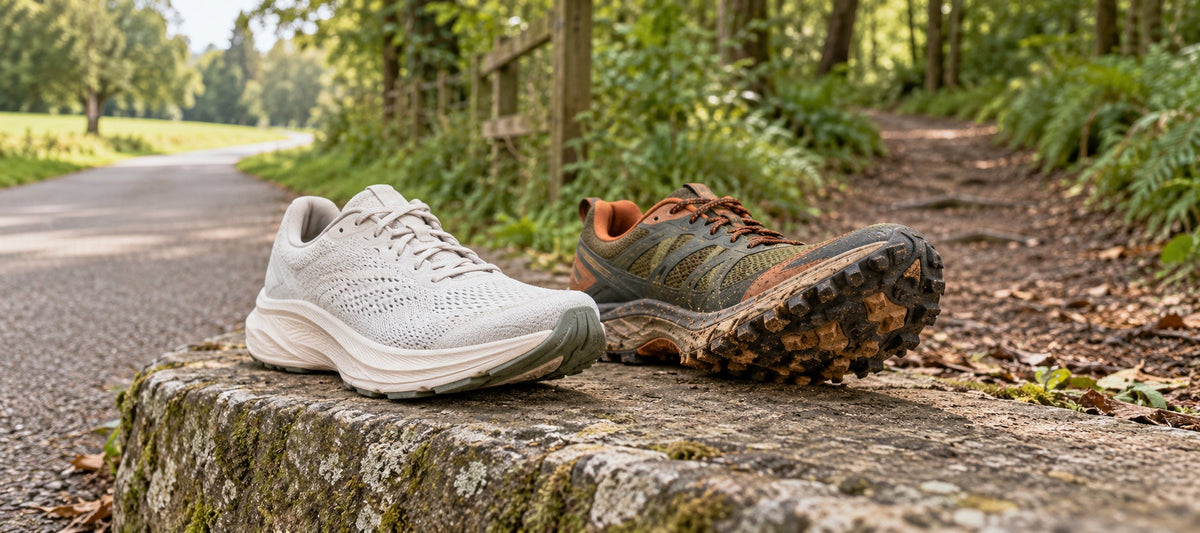
You are running through the park.
The path becomes gravel.
Gravel becomes dirt.
Dirt becomes something suspiciously muddy.
At exactly which point are your road shoes legally required to transform into trail shoes?
There isn't one.
Plenty of runners happily use road shoes on easy paths.
Trail shoes become useful when the surface starts asking more from the shoe.
Grip.
Protection.
Security.
Durability.
And occasionally the ability to emerge from a mud bath with some dignity.
Here is what actually changes.
The highlights
- You do not need trail shoes simply because the route is not paved.
- Trail shoes generally place more emphasis on grip, protection and stability on uneven surfaces.
- Lug depth matters, but rubber compound, tread pattern and the surface itself matter too.
- High cushioning is not automatically better or worse on trails.
- Waterproof shoes have advantages and disadvantages.
- Fit matters particularly on descents, where your foot needs to stay secure without your toes crashing into the front.
- Trail-footwear research remains surprisingly limited, especially in women.
What is a road-running shoe designed for?
Road shoes are primarily intended for relatively predictable surfaces such as:
- pavement
- tarmac
- track
- firm paths
They usually have comparatively smooth outsoles.
Manufacturers can reduce heavy tread because the shoe does not need to dig into soft ground.
That can allow them to prioritise:
- low weight
- smooth transition
- cushioning
- road durability
- running economy
Modern road shoes range from thin, flexible trainers to enormous stacks of responsive foam.
There is no single road-shoe design.
What changes in a trail shoe?
Trail shoes usually add features intended for less predictable terrain.
Depending on the shoe, that can include:
- deeper outsole lugs
- stickier rubber
- greater outsole coverage
- protective toe caps
- tougher uppers
- rock plates
- more secure midfoot fit
- different platform geometry
- drainage features
Not every trail shoe contains all of these.
A shoe designed for smooth summer forest tracks looks very different from one intended for steep British mud.
The biggest difference is usually underneath you
For most runners, grip is the most obvious reason to move from road shoes to trail shoes.
A road outsole may work beautifully on:
- dry gravel
- hard-packed dirt
- canal paths
- dry woodland tracks
Once the route becomes:
- muddy
- loose
- wet
- rocky
- steep
traction becomes more important.
Trail shoes use tread or lugs that can bite into softer ground.
Are deeper lugs always better?
No.
Imagine driving a tractor tyre around a smooth indoor floor.
Aggressive tread is designed for particular conditions.
Deep, widely spaced lugs can work brilliantly in mud because they penetrate soft ground and can shed material between steps.
On firm surfaces they may feel awkward.
On wet rock, lug depth alone tells you very little. Rubber compound, contact with the surface and the rock itself also matter.
In one laboratory study, changing the depth, width and orientation of outsole grooves changed grip on wet porcelain tiles.[1]
That supports the point that tread design matters. It does not tell us which trail shoe grips best on mud, roots or wet rock.
But science does not currently give runners a universal formula such as:
4 mm lugs = perfect trail grip.
Surface, rubber, tread geometry, speed and movement all interact.
Do you need trail shoes for gravel?
Usually not.
A firm gravel park path is often perfectly manageable in normal road-running shoes.
Ask whether your current shoe is giving you the grip and security you need.
If yes, carry on.
Buying trail shoes because one kilometre of your Sunday route passes through a park is unnecessary unless you particularly want them.
What about mud?
This is where specialised shoes can make a dramatic practical difference.
If your road trainer is collecting a centimetre of mud underneath it and sliding sideways on every corner, footwear designed to penetrate and clear soft ground is useful.
For genuinely muddy routes, fell-style shoes may be more appropriate than fashionable, highly cushioned trail shoes with relatively shallow tread.
Match the outsole to the terrain rather than assuming every product with the word "trail" is equivalent.
Do trail shoes provide more stability?
Sometimes, although stability here does not necessarily mean the same thing as a road "stability shoe".
Technical trails can involve:
- rocks
- roots
- cambers
- uneven ground
- sudden changes of direction
Some trail shoes therefore use a platform designed to feel more secure on uneven surfaces.
A lower stack can provide greater ground feel.
A wider base can increase perceived stability.
Other trail shoes are now extremely cushioned.
There is no single correct approach.
A 2026 scoping review of trail and hiking footwear found just 16 eligible studies. Biomechanics was the most commonly studied area, and the reviewers identified a gap in evidence about prolonged footwear use and fatigue.[2]
So be cautious of confident claims that one trail-shoe geometry is proven safest.
What is a rock plate?
A rock plate is a protective layer in the sole intended to reduce the pressure you feel from sharp rocks.
It may be made from:
- plastic
- composite material
- another firm protective layer
Not every trail runner needs one.
On smooth forest tracks it may add stiffness without providing much benefit.
On sharp rocky ground, it can make a shoe considerably more comfortable.
What about toe protection?
Trail running provides more opportunities to kick things.
Unfortunately, rocks are quite resistant to negotiation.
Many trail shoes therefore reinforce the front of the upper.
A toe bumper will not make your foot invincible.
It may make an accidental encounter with a root slightly less memorable.
Are trail shoes heavier?
Often, but not always.
Extra rubber, reinforcement and protection can add weight.
Modern trail shoes also increasingly use lightweight foams and performance technology borrowed from road racing.
A 2025 study in trained runners found that a more responsive trail-shoe foam modestly improved running economy compared with a traditional foam when results were pooled across three treadmill gradients. That does not establish the same benefit on every gradient.[3]
Interesting?
Yes.
A reason everybody needs trail super-shoes?
No.
The study involved just 14 well-trained male athletes.
A 2026 field study from the same research group, involving 14 male trail runners and a 90-minute run, found no significant difference in running economy or overall distance and elevation covered between the two foam conditions.[4]
Both studies had industry support, including shoes supplied by On. The results are useful, but they need to be read in context.
For a recreational trail runner choosing shoes, it makes sense to prioritise fit, grip and confidence on the actual terrain before chasing a laboratory percentage.
Should trail shoes be waterproof?
This depends enormously on where and how you run.
A waterproof membrane can be useful in:
- wet grass
- shallow puddles
- cold conditions
- slushy surfaces
But waterproofing has trade-offs.
Studies comparing more and less air-permeable running-shoe uppers found a warmer, more humid environment inside the less permeable shoes.[5]
Those studies compared upper permeability, rather than testing waterproof trail membranes. They support a ventilation trade-off, not a claim that every waterproof shoe will feel the same.
And water is impressively determined.
If it enters through the top of a waterproof shoe during a stream crossing or deep puddle, the membrane that kept water out can also slow its escape.
For very wet trail running, some runners prefer fast-draining shoes rather than trying to remain completely dry.
There is no universally superior choice.
Ask what sort of wet you are dealing with.
Fit matters on descents
A shoe can feel perfect standing in the kitchen and become deeply unpopular halfway down a steep hill.
On descents, your foot moves forward.
You therefore need:
- sufficient toe space
- secure heel fit
- good midfoot hold
Your toes should not repeatedly hit the front.
At the same time, sizing excessively large can allow your whole foot to slide around.
Fit should give your toes room while holding the rest of the foot securely.
Road shoes, trail shoes and heel-to-toe drop
Both categories come in a wide range of drops.
There is no requirement for trail shoes to be zero drop or low drop.
If you suddenly change to a dramatically different shoe geometry at the same time as introducing:
- hills
- technical terrain
- longer runs
you are changing several things at once.
Give yourself time to adapt.
When road shoes are probably enough
You may not need trail shoes if you mostly run on:
- roads
- pavement
- dry compact paths
- smooth park routes
- short sections of light gravel
provided your current shoe gives you enough grip.
When trail shoes become much more useful
Consider them when you regularly encounter:
- mud
- loose surfaces
- steep gradients
- wet rock
- technical paths
- sharp stones
- roots
- rough ground
or when you simply feel insecure in road footwear.
What about mixed road and trail routes?
This is where a less aggressive trail shoe or hybrid road-to-trail model can work well.
Look for enough outsole grip for your off-road sections without such deep lugs that several kilometres of pavement feel unpleasant.
Again, match the shoe to the route you actually run rather than the Instagram photograph you wish you ran.
Trail footwear research has a women problem
This deserves saying explicitly.
A 2026 scoping review of trail-running and hiking footwear found that female participants were underrepresented across much of the controlled research.[2:1]
That limits how confidently findings can be generalised to women.
Research specifically examining female trail runners includes a survey of 62 women about injuries during the previous year. That is useful background, but it was not a footwear trial and cannot identify which shoes prevent injuries. Its authors called for prospective, longer-term research.[6]
Running Woman will keep identifying those gaps rather than pretending male-dominated research automatically answers every question for women.
Don't forget the running skill
Grip helps.
Shoes help.
They do not replace learning how to move over uneven ground.
Trail running also requires:
- looking ahead
- adapting stride length
- changing pace
- controlling descents
- accepting that pace becomes less useful as a measure of effort
We cover those skills separately in our trail and downhill running guide.
The shoe is part of the system.
The runner still has to run.
The Running Woman verdict
Road and trail shoes are not two separate species.
There is a spectrum.
A road shoe may happily handle a dry park track.
A versatile trail shoe may happily cover short road sections.
The more demanding the surface becomes, the more useful trail-specific grip, protection and security become.
Choose for the ground underneath your feet.
That is far more useful than choosing for the category name on the shoebox.
Love RW x
General information only. Mountain, fell and remote trail running introduce additional navigation, weather and safety considerations beyond footwear.
More from Running Woman
- How to choose running shoes
- How running shoes should fit
- When to replace running shoes
- Preparing for trail and ultra running
- Explore Kit advice
Sources and further reading
-
Blanchette MG, Powers CM. The influence of footwear tread groove parameters on available friction. Applied Ergonomics. 2015;50:237-241. Laboratory tests of 27 groove combinations on wet porcelain tile, not a trail-shoe comparison. Back
-
Jackson A, Hong K, Frecklington M, Sheerin K, Carroll M. Exploring the role of footwear in trail running and hiking: a scoping review. Journal of Foot and Ankle Research. 2026;19(3):e70197. The review mapped 16 eligible studies and identified limited long-term evidence and underrepresentation of women in many controlled trials. Back Back
-
Muzeau M, Flood A, Tam N, et al. Influence of trail running footwear foam on running economy and perceptual metrics. European Journal of Sport Science. 2025;25(10):e70059. A treadmill comparison in 14 trained male athletes; the scholarship was partly funded by On and the company supplied the shoes. Back
-
Muzeau M, Flood A, Tam N, et al. Feeling the trail: physiological and affective responses to a prolonged trail run with advanced footwear technology foam. Footwear Science. 2026;18(1):47-58. A field comparison in 14 male trail runners, with scholarship support and shoes from On; no significant overall performance difference was demonstrated. Back
-
West AM, Schönfisch D, Picard A, Tarrier J, Hodder S, Havenith G. Shoe microclimate: an objective characterisation and subjective evaluation. Applied Ergonomics. 2019;78:1-12. See also Liu Z, Nie J, Yang F, Zheng Y, Ding L. Influence of shoe upper structure on shoe microclimate and human physiological characteristics during running. Technology and Health Care. 2024;32(S1):487-499. Both examine upper permeability; they are not direct tests of waterproof trail membranes. Back
-
Goodrum M, Viljoen C, Kaulback K. Incidence, severity, and risk factors for injuries in female trail runners: a retrospective cross-sectional study. Physical Therapy in Sport. 2025;71:1-7. Published online in 2024; a retrospective survey of 62 female trail runners. Back


