

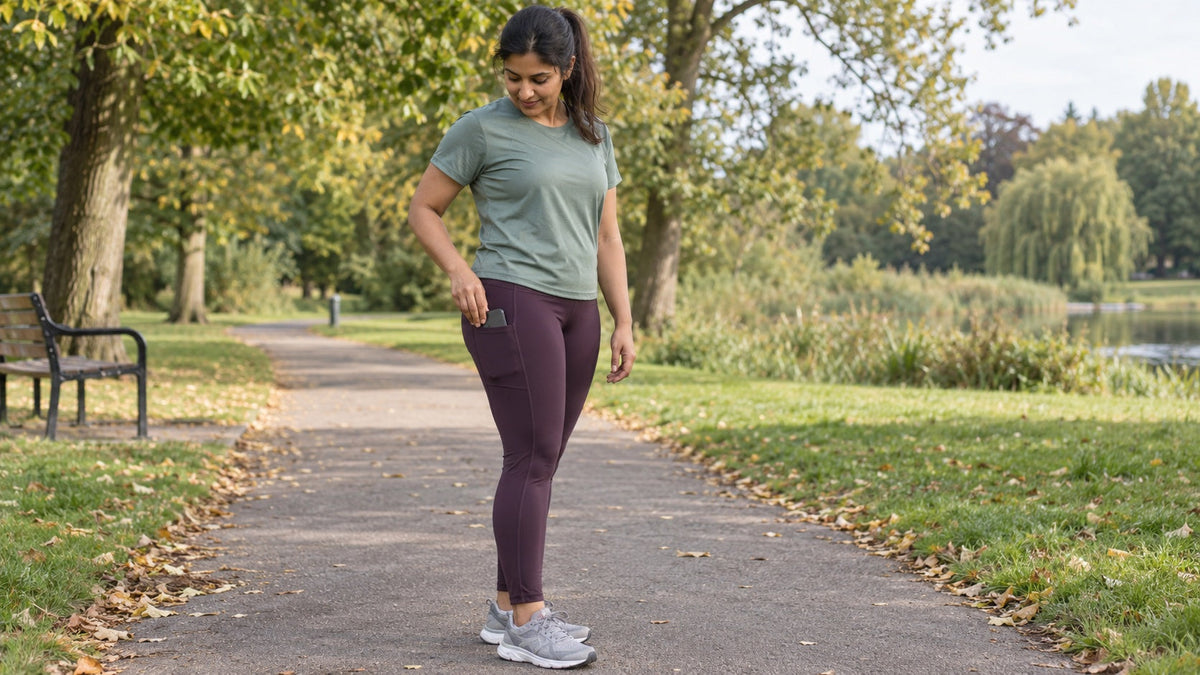
The most useful running leggings are the ones you can stop thinking about once you set off. They stay where you put them, allow you to move comfortably and have somewhere suitable for anything you want to carry.
That sounds straightforward until you meet a product page full of sculpting, support and performance promises. Some features are useful. Others tell you very little about whether you will spend the next half-hour pulling up the waistband.
You can run in leggings you already own if they work for you. England Athletics' RunTogether advice is clear that taking part does not require lots of expensive gear: comfortable clothes and suitable trainers are the starting point. RunTogether's runner questions.
If you are shopping, begin with the runs you actually do and the things your current pair gets wrong. Perhaps the waistband slips when you add a phone, or the fabric feels too warm after the first ten minutes. Those are useful starting points.
The highlights
- Judge the fit while moving and with your phone in the pocket.
- Choose coverage, warmth and length around your preferences and usual runs.
- A comfortable firm fit does not need a promise of faster running to be worthwhile.
Look at fit while you move
Leggings need to accommodate your waist, hips, thighs and leg length together. There is no obligation to fit neatly into one brand's size chart, and a poor match is not a problem with your body.
Use the measurements on the product page as a starting point. Then sit down, take a long step, lift a knee and jog gently on the spot if the fitting space allows. Notice whether the waistband rolls, the crotch drops or the fabric feels restrictive over your thighs.
Do not automatically size down to make a slipping pair stay up. A different rise, leg length or cut may suit you better. Equally, a waistband that digs in is not doing a better job simply because it feels secure. You should be able to breathe and move comfortably.
Make these checks while the garment is clean and unworn outdoors, within the seller's returns conditions. A fitting-room test cannot tell you everything about a long run, but it can identify an obvious mismatch before you commit.
Waistbands and drawcords: useful, with no universal winner
A wide waistband may spread the feeling of pressure comfortably. A narrower one may suit you better, particularly if you dislike extra fabric around your middle. High-waisted does not automatically mean secure, and low-waisted does not automatically mean it will slip.
Try the height you normally like, then judge what happens when you move. A waistband that feels fine standing up can feel quite different when you bend to tie your shoes.
A drawcord offers adjustment and can be useful when you add a phone to a pocket. Check that you can use it easily and that the fastening does not make an uncomfortable lump. Needing to pull it extremely tight is a reason to reconsider the fit, not a requirement for running leggings.
If you sometimes wear a belt over your leggings, try the combination. Waistband seams, a drawcord knot and a belt fastening can end up competing for the same small patch of space.
Test the pockets with your own phone
A “phone pocket” is only helpful if it fits the phone you carry, including its case. Put that phone into the pocket before deciding the leggings solve your storage problem.
Check how far it sits inside, whether the opening closes or grips securely, and whether you can take it out without a struggle. Walk and jog a little. A pocket can be a good size but badly positioned for you, or pull on the leggings when loaded.
Side pockets often appeal because they are accessible. A rear pocket may suit someone who dislikes weight on one thigh. We would treat these as preferences to test rather than declare one position best for every runner.
Use a separate secure compartment for a key if possible, and check the fastening. Do not assume that fabric pockets or a zip make the contents waterproof. If your favourite leggings have no useful storage, choosing a separate carrying option is perfectly reasonable. Pockets do not need to decide the entire purchase. Our phone-carrying guide compares the other options, including belts and armbands.
What should you look for in the fabric?
Start by asking whether it feels comfortable against your skin, stretches without restricting you and suits the conditions you run in. Smoothness, fabric weight and how the garment feels when damp are more useful questions than whether its technology sounds sophisticated.
Research on clothing in warm conditions has found mixed results when comparing natural, synthetic and treated fabrics. Fit and construction also matter, and many studies have used short tests, mild conditions and mostly male participants. The label alone cannot establish a real-world performance advantage. Review of sports clothing and thermal comfort.
There are useful distinctions between garments made from apparently similar materials. A 2023 wear study found differences in the temperature and humidity beneath different T-shirts, including different polyester constructions. It does not establish which leggings are best, but it helps explain why “polyester” is not a complete description of a garment. Garment construction wear study.
Choose fabric suited to your usual run, then test its comfort in use. A thick brushed pair may appeal for a chilly easy outing and feel excessive during a harder session. A lightweight pair may be your favourite for much of the year. You do not need a separate wardrobe for every forecast. For putting the layers together, see what to wear running in winter.
Seams, coverage and opacity
Run your hand over the inside seams, especially around the inner thighs and crotch. Look at where pockets, panels and waistbands join. Flat seams can be a useful feature to inspect, but the phrase “flatlock” does not guarantee that a garment will never irritate your skin.
Try the underwear you expect to wear for running when assessing the combination. If something feels uncomfortable during a brief fitting, take that seriously. Personal preferences around coverage and underwear vary, so there is no single correct arrangement to prescribe.
Check opacity in good light while bending and moving. Do this in a way you feel comfortable with, using a mirror or a trusted person if helpful. Fabric can look different when stretched, and your check is about the coverage you want, not passing judgement on your shape.
Choose leg length by where the hem actually finishes on you. A “7/8” pair may be full length on one runner and cropped on another. Check for unwanted bunching behind the knees or at the ankles rather than relying entirely on the name.
Reflective details are another feature to consider if you run after dark. Check their placement with your usual layers, and use our running-in-the-dark guide for the wider visibility advice.
Is compression worth paying for?
Close-fitting leggings and sports compression garments are not interchangeable research categories. A supportive feel does not prove a garment improves running performance.
A 2025 review of 51 studies found no significant overall improvement in race time or time to exhaustion from compression worn during running. Evidence certainty was low to very low, and women accounted for 184 of the 899 participants. That is a reason to be cautious about performance promises, not to insist that nobody can enjoy compression. Running compression review.
Recovery is a separate question. A 2026 review focused on compression after endurance exercise found very uncertain evidence for soreness benefits and unresolved effects on subsequent endurance performance. It does not justify buying ordinary leggings on a promise of faster recovery. Endurance recovery review.
If you like a firmer feel, that can be enough reason to choose it. Follow the garment's sizing guidance and do not pursue extra tightness as a shortcut to better results. There is no need to pay a compression premium if you simply want comfortable everyday running clothes.
What is worth paying extra for?
Make a short list based on your needs: perhaps an adjustable waistband, a pocket that holds your phone securely and an available length that fits. After those essentials, colour and design are perfectly reasonable preferences. It is your kit.
As one option, Running Woman sells its own Resilience leggings. The current product listing includes a high waist with drawcord, side pockets and a rear zipped pocket. We have a commercial interest in their sale, so use the same fit, pocket and comfort checks you would apply to any other pair. View the Resilience leggings and current specifications.
Check the care instructions before buying, particularly if you rely on a tumble dryer or need a quick laundry turnaround. Once you own a pair, follow its label and recheck seams, pockets and waistband stretch over time. Good value is a pair you can afford and regularly choose to wear. A higher price cannot settle that question for you.


