

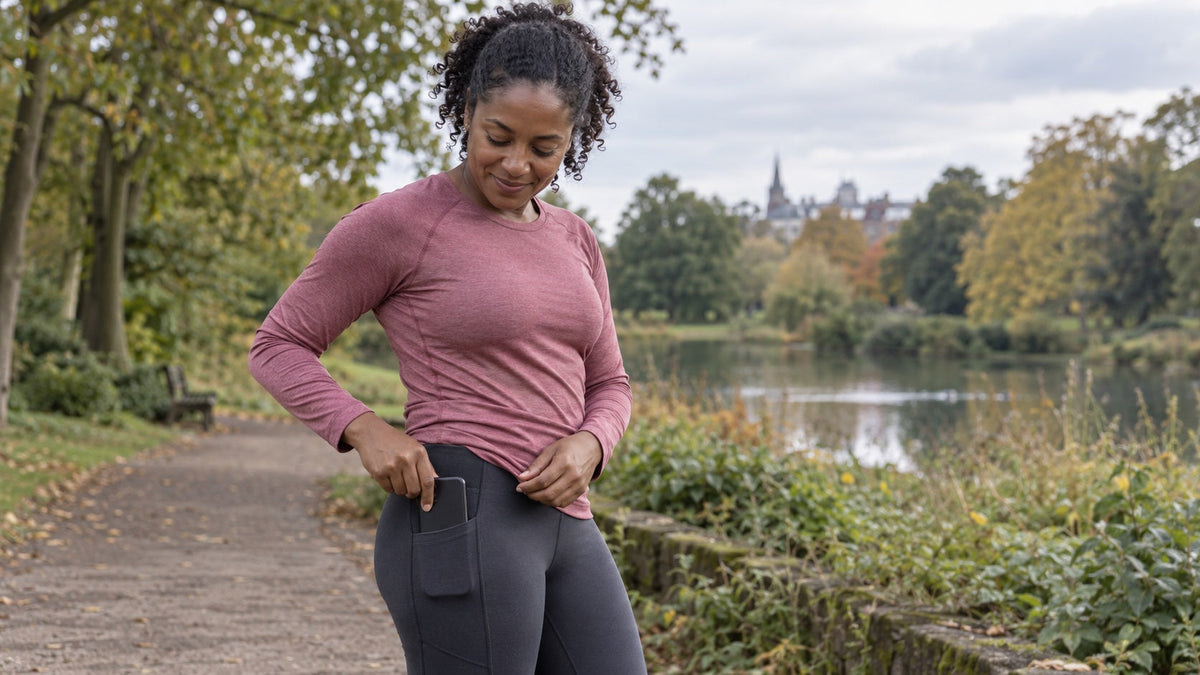
Your phone comes running for all sorts of reasons: music, a route you haven't quite memorised, being contactable, or knowing you can ring for a lift if plans change. Finding somewhere comfortable to put it ought to be straightforward. Sometimes it is. Sometimes the pocket that looked enormous in the shop turns out to be more optimistic than useful.
A secure pocket, running belt, armband or vest can all work. Start with the clothes you already have and the things you actually carry. You may not need another purchase.
There is limited research directly comparing the everyday ways runners carry a phone. Fit, access and your own comfort are useful places to start, without expecting a holder to fix your running form.
The highlights
- Try an existing pocket or carrier before buying another accessory.
- Include the phone case and any protective pouch in your fit check.
- Check security and comfort while moving, then practise access while stationary.
Start with your actual phone
Include its case, card holder, grip or any other attachment you normally leave on. A holder advertised for a particular screen size may still be awkward with your setup. The useful measurements are the phone's external length, width and thickness, plus the size of the pocket opening.
Then think about access. If your phone stays tucked away for the whole run, security and comfort may matter more than reaching it quickly. If you regularly stop to check a route, test whether you can get it out without taking off several layers. You should also be able to put it back securely without juggling your keys.
Try to separate what you need from what has simply accumulated in the case. Carrying less is a sensible first experiment when a pocket feels awkward, provided you keep what the run requires.
A pocket: worth trying first
A close-fitting pocket in leggings or shorts can be a simple option. Put the phone in and move around. Does the fabric hold it comfortably, or does the weight drag the garment down? Can you bend without the phone digging into your hip?
A side pocket may be easy to reach. A rear waistband pocket may feel less noticeable, but access can be fiddly under a top. Neither position wins automatically. The cut of the garment, depth of the pocket and shape of your phone all affect whether it works for you.
Check the opening as well as the space inside. A pocket that accepts the phone while you stand still also needs to retain it when you jog, bend and change direction. A zip offers a closure, but the zip must shut fully without strain. An open stretch pocket needs enough coverage and a secure fit in movement.
Loose jacket pockets deserve the same trial. If the phone swings about, that particular pocket is not doing the job comfortably. Our running leggings guide looks more closely at garment fit and pocket design.
A running belt: storage that comes with you
A belt is useful when your favourite running clothes lack suitable pockets or you want one carrying option that works across several outfits. It also gives your key somewhere separate to live if the design includes another compartment.
Load it before judging it. An empty belt can feel lovely and change character as soon as the phone goes in. Check whether it shifts, rolls, presses on your stomach or needs constant adjustment. You should be able to breathe and move comfortably.
Some people prefer the phone at the front; others find a rear position less obtrusive. Follow the product's intended use and try permitted positions rather than assuming there is one correct spot for every body. If a belt appeals, our guide to choosing a running belt covers sizing, pocket construction and the loaded fit test in detail.
An armband: useful if your waist is already busy
An armband can suit you if waist storage feels uncomfortable or you prefer your phone away from your clothing pockets. Check the stated arm-size range as well as phone compatibility. The strap needs to hold without pinching, and the edges should feel comfortable as you swing your arms.
Test it with the sleeves you actually run in. A fit that works on bare skin may need adjusting over a winter top. If the phone has a clear cover, try the controls you intend to use before leaving home. A visible screen is not much help if your particular phone cannot respond through it.
Think about putting it on and taking it off, too. If fastening a strap one-handed is difficult, a pocket or belt with easier access may be a better everyday choice. There is no obligation to persevere with an accessory that makes getting out of the door harder.
A vest: helpful when the phone is only part of the load
A running vest becomes worth considering when you already need room for other kit. Check its phone pocket with everything else packed, because neighbouring items can change the fit and ease of access.
It may be more equipment than you want for a short local run carrying only a phone and key. Equally, a vest you already own might be the most comfortable answer. You do not need to buy a smaller carrier merely because it looks more appropriate for the distance.
If choosing how much fluid or food to carry is the bigger question, our fuelling and hydration guidance covers that separately.
What about holding it?
Holding a phone is an option, particularly while you work out what suits you. It occupies a hand and asks you to keep gripping it, which may be inconvenient. That is a practical drawback, not proof that you are damaging your body.
A small treadmill study of 19 male recreational runners compared carrying nothing, keys, a phone and a water bottle. The phone changed one measure of lower-leg acceleration rate, while several other measures, including step length and stride frequency, did not change. It did not measure injuries or establish the effects of long runs in women. It cannot justify a blanket claim that holding a phone causes injury. Sanchis-Sanchis and colleagues, 2021.
If holding it makes your hand or shoulder uncomfortable, try storage instead. Comfort is a sufficient reason to change.
Keep weather protection separate from storage
A secure pocket is not automatically a waterproof pocket. Check what the carrier actually claims, including its closures, and consider a suitable sealed phone pouch when rain or sweat could reach the device. Include that pouch in your fit test.
Check your phone manufacturer's advice too. Apple, for example, says iPhone water resistance can diminish with normal wear. That is guidance about those devices, not a reason to assume another phone has the same protection. Apple's water-resistance guidance.
Cold can also affect a phone. Apple warns that very cold conditions outside its operating range can temporarily reduce battery life or cause shutdown. For hill outings, Mountaineering Scotland advises protecting the phone and keeping it close to the body when not in use, and carrying another way to navigate if it fails. A phone pocket alone does not solve those wider planning needs. Apple's temperature guidance; Mountaineering Scotland's phone guidance.
Try the whole setup before committing
For a useful first check, load your phone and usual essentials, put on your normal running clothes and jog gently at home or in a suitable trial area. Bend, move your arms and try taking the phone out while stationary. Check that it goes back in securely. Follow the retailer's trial and return conditions.
If the setup passes, try it on a short familiar run before relying on it for a longer outing. Notice whether you keep adjusting it and whether any edge rubs. The useful result is a phone you can carry comfortably and reach when you need it, with an ordinary run's worth of evidence from your own experience.


