

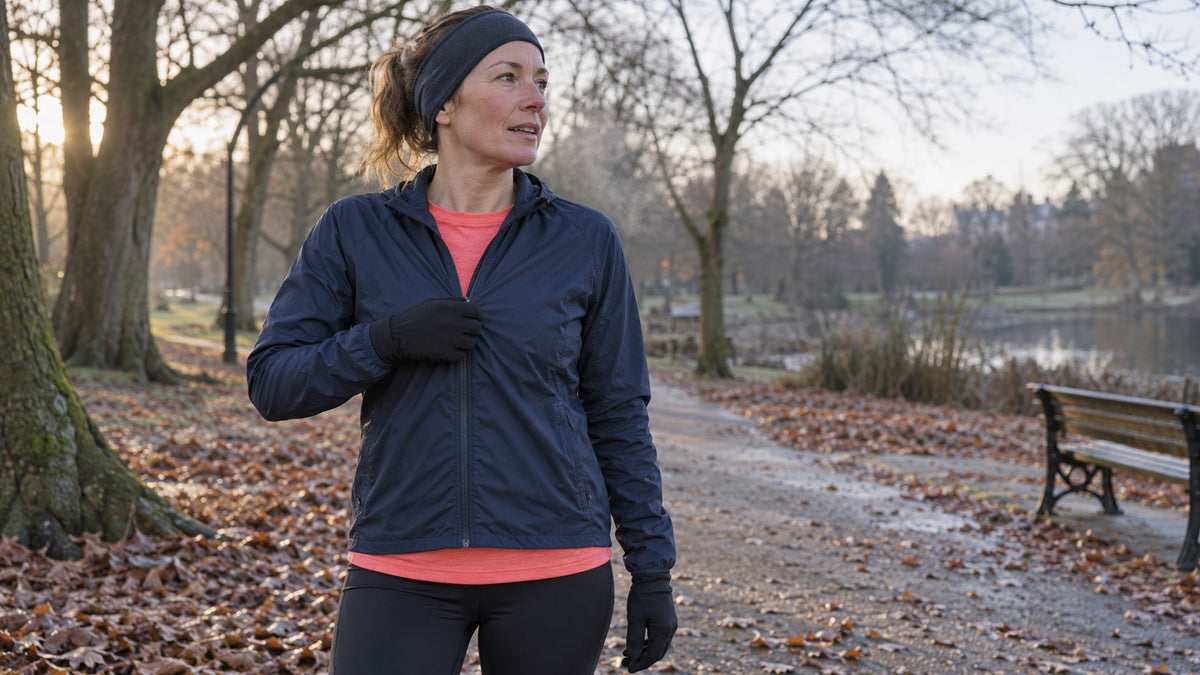
The difficult bit about dressing for a winter run is that the person standing by the front door and the person halfway up the first hill have rather different requirements.
Our starting point: choose clothes you can adjust, check the wind and rain as well as the temperature, and plan for any time spent walking or standing still. You may already own most of what you need.
There is no single correct winter running outfit. The American College of Sports Medicine advises adjusting clothing to conditions, intensity and the individual. A hard session and a gentle run-walk can call for different choices on the same morning. ACSM cold-exercise consensus
The highlights
- Choose an outfit with an easy way to adjust it.
- Think through the exposed, slower and stationary parts of your outing.
- Use familiar kit as your starting point and note what you would change next time.
Look beyond the number on the weather app
Before choosing your outfit, consider the whole outing: where you will run, how hard, how long and how easily you can get somewhere sheltered.
Wind matters because it increases heat loss. The Met Office's feels-like temperature provides useful extra context, although its wind-chill calculation is not a personalised prescription for a runner's clothing. Met Office explanation of wind chill
Rain changes the picture too. In a study published in 2025, eleven men ran for an hour at 10°C, with and without simulated rain and wind. The wet, windy condition produced greater cooling. This small laboratory study did not test jackets or establish clothing requirements, but it supports looking beyond air temperature alone. Ito and Yamashita, rain-and-wind running study
A sheltered loop close to home gives you different options from an exposed route with a long walk back. Ask yourself what you would wear if you had to slow down unexpectedly, rather than assuming you will keep running throughout.
Make the route easier to adapt while you are learning your preferences. A familiar short loop lets you return for a layer or finish early. Your first outing in new winter kit need not double as an expedition.
Think in three jobs, rather than three compulsory garments
The British Mountaineering Council describes three clothing roles: moisture management, insulation and weather protection. This is hillwalking guidance; runners need to adjust how they apply it. BMC layering guidance
Next to your skin: synthetic fabrics and wool blends are common choices for managing sweat. Cotton retains moisture, making it less useful for prolonged cold, damp outings. BMC layering guidance
For extra warmth: consider a light insulating layer you can remove easily when you no longer need it.
For the weather: add appropriate wind or rain protection. Our running jacket guide explains how to choose it.
These are roles to cover, not a shopping list. On a sheltered outing you might wear one top; on a colder, wetter run you might combine layers. Avoid choosing the thickest version of everything by default.
Merino or synthetic: you do not have to pick a side
If you already have a base layer that feels comfortable, begin there. Check whether it rubs under your arms, bunches under another top or feels unpleasant once damp. A fabric name cannot answer all of that.
A small laboratory study compared wool and polyester first layers, alone and with outer garments, during rest, running and walking in the cold. Layering changed responses, while differences measured between fabrics did not reliably translate into equally large differences for the wearer. It involved ten men in controlled conditions, so it cannot identify the ideal winter outfit for every woman. MacRae and colleagues, layering study
When buying, prioritise comfort against your skin, the garment's thickness, how it fits under your other clothes, washing requirements and cost. Merino is an option, not a compulsory upgrade. Nor does a technical label make a top automatically right for you.
Adjust before you are very sweaty or very cold
The familiar advice to start a little cool can be useful, but it is not an instruction to begin shivering. Give yourself enough protection for the actual conditions, then reassess as you warm up.
ACSM notes that people can become overdressed when they start exercising in clothes suited to standing still. It also warns that sweating can exceed a shell's ability to release moisture. ACSM cold-exercise consensus
Our suggestion is a quick clothing check early in the run and whenever the outing changes. Open a zip or remove an unnecessary layer if you are getting too warm. Close up or add protection before an exposed stretch or a longer pause. Put removable kit somewhere you can reach without emptying everything onto the pavement.
Do not make your running partner the temperature judge. If she is comfortable in shorts and you prefer leggings, both of you can be right about your own comfort.
Legs, hands and the small things you notice quickly
Choose leg coverage around your comfort and the conditions. Ordinary running leggings may be enough for your usual outings; a warmer pair is worth considering if your legs remain uncomfortable. Look at fabric weight and coverage rather than assuming the word 'winter' proves anything. Our leggings guide covers fit, seams and pockets in more detail.
For accessories, start with the problem you actually have. Cold ears suggest an ear-covering headband or hat. Cold fingers suggest gloves you can remove and store. If you want to operate a zip in gloves, try that combination before you leave.
For longer or more exposed outings, think about spare dry clothing as part of your route planning. Mountain Rescue England and Wales includes spare clothes, hats and gloves in its hill-safety advice. This is particularly relevant when help or shelter is a long way away. Mountain Rescue clothing advice
Avoid automatically adding thick socks inside already snug shoes. Use our running socks guide to check the sock-and-shoe combination instead of turning winter into an excuse for cramped toes.
Three outings, three different decisions
These examples give you a starting point to adapt to your own comfort and the conditions.
| Outing | Useful clothing decision | What to plan for |
|---|---|---|
| A short, sheltered, steady run | Start with familiar kit and one easy adjustment, such as a zip or removable gloves | How you feel after warming up |
| A gentle run-walk or session with standing recoveries | Choose coverage that remains comfortable during the slower sections | A layer you can add during pauses |
| A longer outing with wind or rain exposure | Carry appropriate weather protection and dry spare clothing for the route | A slower return or an unexpected stop |
You do not need a rigid rule such as 'below this temperature, wear exactly three layers'. A useful personal record is simpler: conditions, route, clothes and what you would change next time. After a few runs, your own notes become much more helpful than somebody else's perfect outfit.
Include the journey home in the outfit
Finishing the run does not necessarily mean finishing your time outside. You may be walking home, waiting for a lift or standing around after an event.
In a controlled study of 21 young adults, including 11 women, participants exercised and then rested in cold air wearing merino or polyester layers. The women cooled faster during recovery; the results did not establish one fabric as a universal answer. This was laboratory cycling, not outdoor running, but it is a useful reminder to consider the period after exercise separately. Cernych and colleagues, cold exercise and recovery study
Our practical recommendation is to have dry clothes and an extra layer ready wherever you finish. Choose a bag arrangement that keeps those clothes dry. A post-run top is not much help if rain has already soaked it.
When clothes are not the answer
Clothing cannot make every route or forecast suitable. Changing the route, moving the session indoors or choosing another time are reasonable decisions. Our guidance on training changes and bad weather can help you adjust the session.
Persistent shivering, slurred speech or confusion in someone who is cold need attention. If you suspect hypothermia, call 999. While waiting for help, get the person into shelter and replace wet clothes with dry coverings if possible. The NHS gives the full first-aid advice. NHS hypothermia guidance
For visibility and personal safety, use our running-in-the-dark guide. Try familiar layers on a short route, then adjust what did not work next time.


