

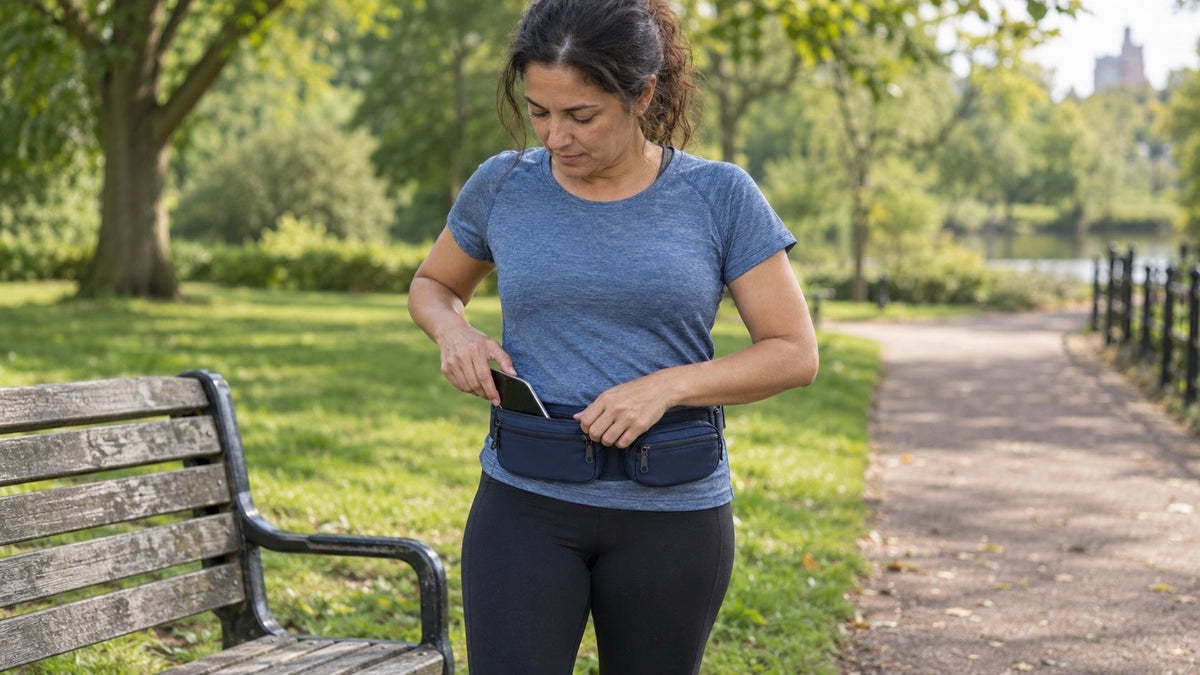
A running belt can be a handy solution to a small but persistent problem: you want to take your phone and key, and your running clothes haven't provided anywhere useful to put them. The right belt carries what you need without requiring much attention once you are moving.
Choosing one starts with the contents. A belt that works nicely with a small phone and single key may feel quite different with a large phone, chunky case and several extras. Fit it around the run you actually do.
A few checks with the belt fully loaded can help you spot an unsuitable design before you commit to a long run with it.
The highlights
- Start by laying out what you really need to carry.
- Distinguish a slipping belt from a phone moving inside its pocket.
- Look for comfortable security, useful access and closures that work without strain.
Decide what the belt needs to carry
Lay out your usual kit. Include the case on your phone, the key or fob you genuinely need, and any other essentials. If you plan to use a protective phone pouch, include that as well.
Look for capacity that comfortably accommodates this load, with the closures working properly. Stretch fabric should not need to be pulled to its limit, and a zip should close without a tug-of-war. The pocket opening matters as much as the advertised pocket size.
If the list includes a layer, substantial water storage or equipment required by an event, consider whether a vest or pack would be more suitable. A larger belt can work, but cramming everything into a minimal phone belt is a poor starting point.
For help choosing between storage methods, start with how to carry your phone while running. For decisions about food and fluid, use our fuelling and hydration guide. This guide is about carrying the load you have chosen.
Understand the main designs
An adjustable strap with a pouch usually fastens with a buckle or another closure. It can offer room to alter the fit over different layers. Check the complete adjustment range, whether the buckle presses anywhere, and how surplus strap is secured.
A continuous stretch belt pulls on and usually comes in specific sizes. Storage may be distributed around the band. Follow that product's measurement instructions carefully; your usual trouser size is not a reliable substitute. Consider how easily you can put it on and remove it, particularly once it is loaded.
A wider belt with several pockets may help you organise separate items, but width alone does not guarantee comfort. A narrow design is not automatically less comfortable either. Try the actual construction on your body. Labels such as women's or unisex cannot tell you whether its shape will suit you.
Our own Running Woman belts have an adjustable strap and two zipped compartments to keep your phone and smaller essentials separate. The same design is available without gel loops or with four gel loops, so you can choose whether you want dedicated space for gels.
Extras for longer runs and races
If you use gels, loops can keep them separate from your phone and keys. Try them with your usual sachets and practise taking a gel out during training. Leave room for the empty wrappers too.
If you want to carry a bottle, choose a design intended to retain that bottle and assess it with the bottle filled. Check its fit again as the contents change. This is about the carrying arrangement, not a recommendation for a particular amount to drink.
A race-number belt may be designed mainly to hold a bib, with little or no storage. Check both the product and the event's number-display requirements. Reflective trim can be a useful extra to inspect, but use our dark-running guide for visibility planning.
Measure where the instructions tell you to measure
Use the manufacturer's size guide, including its intended wearing position. Some designs are intended around the waist, others lower down. If you are between sizes, follow the product's advice or ask for clarification instead of automatically sizing down to prevent bounce.
Once loaded, the belt should feel secure while allowing comfortable breathing and movement. Bend forwards, sit briefly, swing your arms and jog gently. Notice whether it rolls, presses into a sensitive area or interferes with your waistband.
Try it with the clothes you expect to use. A belt over smooth leggings and a thin top may behave differently from the same belt over winter layers. If your waist measurements or clothing vary, useful adjustability may matter more to you than a very minimal design.
Diagnose movement before tightening everything
If the belt moves, first work out what is moving. Is the whole belt sliding around your body, or is the phone knocking about inside a pocket while the belt stays put?
For movement of the whole belt, revisit the sizing and intended position. Make a modest adjustment if the design permits it. For movement inside a pocket, try a more suitable compartment or reduce the unnecessary contents. A tighter strap will not necessarily solve a pocket that is the wrong shape for your phone.
Rearranging items may help, but follow the product's intended pocket use. Keep hard objects from pressing into your body and keep keys separate from the phone screen where possible. A key clip can stop a key becoming loose inside the compartment, provided it closes securely and is used as intended.
If the only way to stop movement is an uncomfortable squeeze, choose a different fit or design. Persistent discomfort is a reason to reconsider the fit.
Check access and security together
Try opening and closing every pocket you will use. Can you do it comfortably while standing still? Can you remove the phone without pulling out everything beside it? If you use gloves, repeat the check in gloves.
Zipped pockets provide an obvious closure, but check the zip reaches its stop. Fold-over or stretch openings rely on their particular construction, fit and orientation. Follow the instructions and check retention in movement rather than judging them by appearance alone.
Think about what happens when you take something out. If reaching the phone leaves your key exposed, the layout may be inconvenient even though everything technically fits. Separate compartments can be worth having for that reason. More compartments are only useful if you can reach and use them.
Pay attention to rubbing
Run your fingers along the seams, label, buckle and pocket edges. Test them where they sit on you, particularly if you prefer a belt next to the skin. A flat-looking seam can still be uncomfortable in the wrong place.
Skin irritation is not a sign that you need to toughen up. The American Academy of Dermatology notes that tight clothing or accessories can rub and irritate skin during exercise. That makes comfort against the skin a useful check alongside pocket size and adjustability. AAD guidance on exercise and skin.
Stop and adjust an irritating setup early. Try a different position permitted by the design or a clothing layer between belt and skin. If rubbing continues, reconsider the fit or design.
Protecting your phone in wet weather
For wet runs, check what protection the belt provides, including at the seams and closure. Water-resistant fabric alone does not guarantee a dry phone.
A suitable sealed phone pouch can provide a separate protective layer, but it must fit without straining the pocket. Follow its instructions. Your phone's own resistance also needs care: Apple says iPhone water resistance is not permanent. Apple's device-care guidance.
Buy for comfort and usefulness, not a performance promise
There is no sound basis in the research reviewed here to promise that a particular everyday belt will make you faster. A small study compared handheld, waist and backpack systems carrying 1 kg during hour-long treadmill runs in 12 men. It found no statistically significant difference in running economy between the systems. It did not establish equivalence, test women or rank phone belts for bounce and comfort. Scheer and colleagues, 2020.
Price is therefore best considered alongside usable sizing, construction, access, care and return options. Leave features you will not use off your shopping list.
Give it a realistic trial, then look after it
For a simple first check, pack the exact load, wear your normal running clothes, jog gently, bend and test the closures while stationary. A short trial cannot guarantee comfort over a longer run, but it can reveal an awkward fit. Follow the retailer's trial conditions, then use a short familiar run before a longer outing.
Afterwards, empty every compartment and follow the care label. Do not assume all belts can go through the washing machine. Let the belt dry before storing it, and periodically check stretched fabric, stitching, buckles and zips. A belt that used to work but now shifts or fails to close deserves another fit and condition check.

