

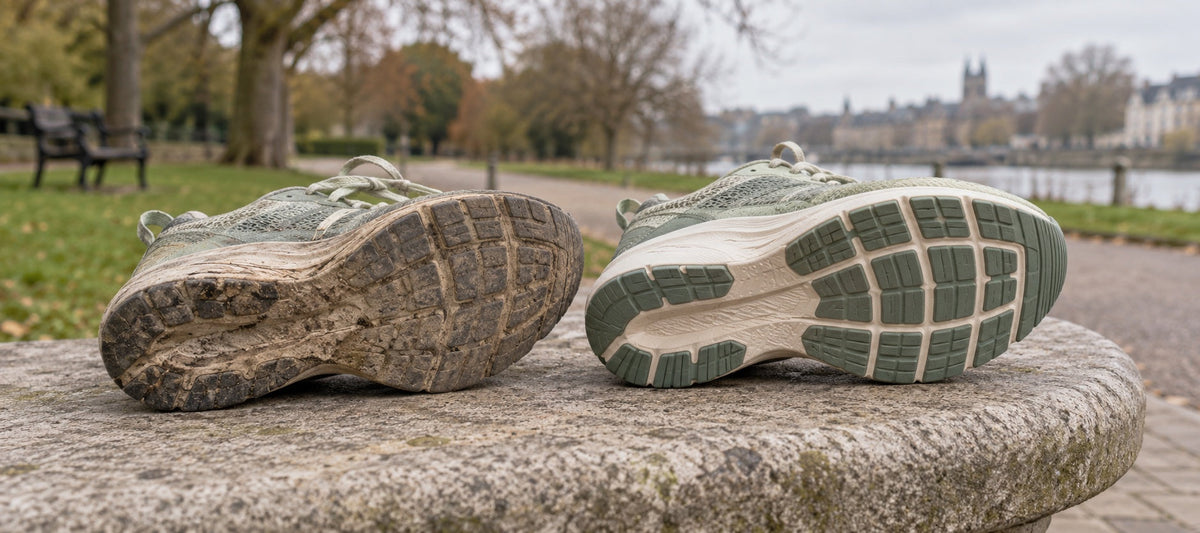
There is a wonderfully convenient answer to this question all over the internet:
300 to 500 miles.
Very tidy.
Unfortunately, your running shoes cannot count.
Different runners, foams, outsoles, surfaces, body sizes, foot strikes and shoe designs create very different wear.
So while mileage can be a useful reminder to inspect your trainers, there is no scientifically established distance at which every running shoe suddenly expires.
Let's look at what actually changes.
The highlights
- Shoe materials do change with repeated use.
- Research has measured substantial changes in cushioning after several hundred kilometres in some shoes.
- Runners may not reliably notice those changes themselves.
- There is no universal mileage threshold proven to prevent injury.
- Outsole wear, upper damage, changing fit and how the shoe behaves all matter.
- Use mileage as a prompt to inspect a shoe, not as an automatic bin date.
Why does the 300 to 500 mile rule exist?
Because running shoes genuinely do wear.
The foam is repeatedly compressed.
Rubber abrades.
Uppers stretch or tear.
The shape of the shoe changes.
It therefore makes sense that a heavily used trainer will eventually stop behaving like a new one.
The difficult part is identifying exactly when that matters.
Older mechanical research found large reductions in shock-absorbing capability with increasing simulated mileage.[1]
Real people running in shoes produced somewhat smaller changes than laboratory machines, which immediately tells us something important:
shoe ageing is complicated.
What happens to the midsole?
The midsole is the foam between your foot and the outsole.
Repeated loading can alter its mechanical properties.
One small study followed 15 recreational runners, each using the same pair of shoes from new to 640 km.
Researchers measured cushioning at:
- 0 km
- 160 km
- 320 km
- 480 km
- 640 km
By 480 km, the researchers reported a substantial reduction in heel cushioning in the rearfoot-striking runners studied.
Midsole hardness also increased.[2]
These findings concern the particular shoes, runners and measurements used. The study did not test whether replacing shoes at that distance prevented injuries.
That sounds like an excellent argument for a 480 km replacement rule.
Except there is another fascinating part.
The runners themselves did not reliably perceive the reduction in cushioning, even by 640 km.
So:
"They still feel fine"
does not necessarily mean the shoe is mechanically unchanged.
But neither does:
"They have reached 640 km"
prove the shoe is dangerous.
Does reduced cushioning automatically cause injury?
No.
This is where we need to avoid turning laboratory measurements into more certainty than they deserve.
Research can demonstrate that shoe properties change with age.
It is much harder to prove:
At exactly X kilometres, injury risk suddenly becomes unacceptable.
Runners also adapt.
A study of 24 runners comparing new shoes with shoes after 200 miles, about 320 km, found changes in running movement but relatively stable external loading, suggesting the runners altered their mechanics as the shoes changed.[3]
That does not mean old shoes last forever.
It shows that people and footwear interact.
Modern shoes complicate the mileage rule further
Much of the classic shoe-durability literature examined traditional EVA-based midsoles.
Modern running shoes may use:
- different EVA formulations
- TPU
- PEBA
- foams made using supercritical processes
- complex geometries
- plates
- multiple foam densities
We therefore should not assume a mileage rule derived from one material applies identically to every modern shoe.
A lightweight racing shoe designed around low mass and high energy return may age differently from a robust everyday trainer.
A trail shoe may lose useful outsole grip while the midsole still feels perfectly comfortable.
A shoe's job matters.
Use mileage as an inspection reminder
Tracking mileage is still useful.
If your running app says a pair has covered several hundred miles, take a proper look at it.
But do not imagine your app knows more about the physical shoe than you do.
Inspect four areas.
1. The outsole
Turn the shoe over.
Look for:
- rubber worn smooth
- lugs disappearing on a trail shoe
- one area worn dramatically more than the rest
- rubber peeling away
- rubber wearing through to expose foam that was previously covered
- reduced grip
Outsole wear can matter even when cushioning still feels good.
Some shoes have exposed foam from new, so compare with the original design rather than treating every visible patch as damage.
For trail shoes in particular, a shoe whose lugs have been polished away may no longer perform the job you bought it for.
2. The midsole
Look at the foam.
Signs worth noticing include:
- deep creasing
- obvious permanent compression
- asymmetry
- the shoe leaning noticeably
- foam cracking
- a change compared with the other shoe
Creasing alone does not necessarily mean the shoe is finished.
Many foams crease early.
What matters is the whole picture.
3. The upper
Check:
- holes
- torn mesh
- failing overlays
- stretched heel structure
- damaged eyelets
- internal lining wear
- exposed rough material that rubs your foot
A shoe can have plenty of foam life left and still be ready for retirement because the upper no longer holds your foot properly.
4. The way it behaves
Pay attention if a familiar shoe suddenly begins creating:
- new rubbing
- heel movement
- pressure points
- reduced grip
- an unstable sensation
- obvious differences between left and right
A change does not automatically mean the shoe is responsible for every niggle you experience.
But it is useful information.
What about new aches and pains?
Be careful here.
It is tempting to say:
My knee hurts. My shoes must be worn out.
Sometimes footwear may contribute.
Sometimes the explanation is:
- training load
- a new session
- recovery
- another activity
- illness
- previous injury
- something completely unrelated to shoes
Do not use a replacement pair of trainers as a substitute for investigating persistent pain.
If symptoms continue, get appropriate healthcare advice.
Compare old and new if you can
If you love a particular model and buy the same version again, comparing old and new can be surprisingly revealing.
Put one on each foot indoors.
Notice:
- cushioning
- heel security
- upper structure
- rocker feel
- flexibility
The difference may be much more obvious when you can compare directly.
Remember that manufacturers also update models.
Version 12 may not be identical to version 11 simply because the name on the side looks familiar.
Do shoes need a rest day to recover?
You'll sometimes hear that midsoles need 24 or 48 hours to "reinflate" between runs.
Foams do recover after compression.
That does not automatically mean every runner needs two identical pairs so the molecules can have Tuesdays off.
Shoe rotation may have practical advantages for people running frequently, including having different footwear for different tasks.
But buying additional shoes purely because somebody claims your trainers require a mandatory recovery day needs stronger evidence.
Should you rotate several pairs?
You can.
You don't have to.
For somebody running twice a week, one pair of suitable trainers may be completely adequate.
For somebody training six days a week, having more than one pair may be convenient.
A 22-week study of 264 recreational runners found that people using more than one pair had a lower injury rate. However, it was an observational study. It cannot establish that buying another pair prevents injury, or that allowing foam to rest explains the association.[4]
A rotation might also include different shoes for:
- trails
- road running
- racing
- faster sessions
Just introduce substantially different shoe types sensibly.
Moving suddenly between very different drops, stiffness levels or minimalist designs changes the loads your body experiences.
Don't introduce the new pair on marathon morning
Even if the replacement is the same model, test it first.
Walk in it.
Run easily.
Make sure the fit is right.
Then use it for longer or harder sessions.
New shoes do not necessarily need a mythical hundred-mile "breaking-in" period, but race day is an unnecessarily dramatic place to discover that the heel rubs.
What should you do with old running shoes?
A retired running shoe does not automatically need to go straight into household waste.
Depending on its condition, it may still be suitable for:
- walking
- gardening
- casual use
- appropriate footwear recycling schemes
But distinguish between a shoe that is no longer your preferred running trainer and a shoe that is genuinely falling apart.
Donation is only useful when the footwear remains usable.
Passing somebody else a collapsed, torn pair is not recycling.
It is outsourcing the bin.
A more useful replacement rule
Instead of:
Replace every shoe at exactly 400 miles.
Try:
Start paying closer attention as the mileage grows.
Track distance if it helps.
Inspect the shoe.
Think about its purpose.
Compare how it feels and functions.
Replace it when wear is meaningfully affecting the job you need it to do.
The Running Woman verdict
Running shoes wear out.
The science supports that.
The science does not give every shoe the same birthday.
The commonly quoted 300 to 500 miles, roughly 480 to 800 km, can be an inspection reminder, not a universal expiry date.
Check sooner if grip, fit or the shoe's structure changes. There is no need to wait for a mileage target before noticing damage.
Your shoes deserve a little more thought than a progress bar turning red in an app.
Love RW x
General information only. Persistent running-related pain or symptoms should not be diagnosed solely from the age of your footwear.
More from Running Woman
- How to choose running shoes
- How running shoes should fit
- Road vs trail running shoes
- Explore Kit advice
Sources and further reading
-
Cook SD, Kester MA, Brunet ME. Shock absorption characteristics of running shoes. American Journal of Sports Medicine. 1985;13(4):248-253. Mechanical and runner-wear tests of the shoes available at the time; not an injury-prevention trial. Back
-
Cornwall MW, McPoil TG. Can runners perceive changes in heel cushioning as the shoe ages with increased mileage?. International Journal of Sports Physical Therapy. 2017;12(4):616-624. A small study of rearfoot-striking recreational runners and specific midsole materials. Back
-
Kong PW, Candelaria NG, Smith DR. Running in new and worn shoes: a comparison of three types of cushioning footwear. British Journal of Sports Medicine. 2009;43(10):745-749. Published online in 2008; 24 runners tested before and after 200 miles in the same shoes. Back
-
Malisoux L, Ramesh J, Mann R, Seil R, Urhausen A, Theisen D. Can parallel use of different running shoes decrease running-related injury risk?. Scandinavian Journal of Medicine & Science in Sports. 2015;25(1):110-115. Published online in 2013; an observational cohort, not a randomised shoe-rotation trial. Back


