

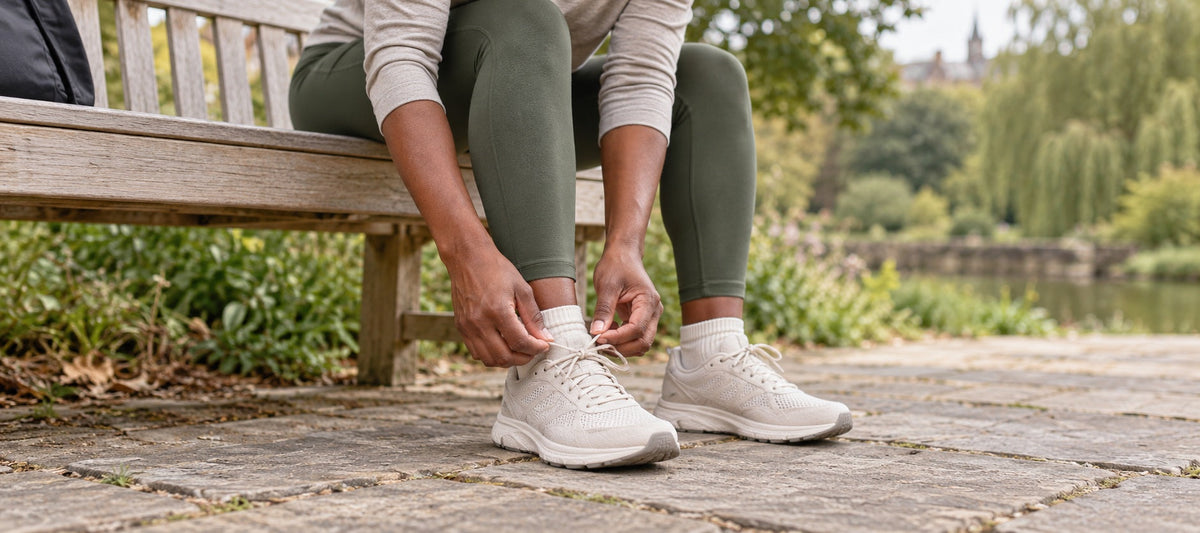
Running shoes are meant to fit your feet.
This sounds obvious.
Yet runners regularly tolerate numb toes, slipping heels, pressure across the top of the foot and black toenails because they assume discomfort is simply part of owning running trainers.
It isn't.
Your running shoe may feel different from your everyday footwear, but it should not require your toes to negotiate for living space.
Here's what to check.
The highlights
- Fit the shoe to your larger foot, because feet are rarely perfectly identical.
- You need clear room ahead of your longest toe.
- Width and depth matter just as much as the number printed on the box.
- Your heel should feel secure without painful pressure.
- Try shoes wearing your normal running socks.
- Feet and shoe interaction change during running, so a shoe that only just fits while standing still may become uncomfortable later.
- Women's feet vary enormously. A "women's fit" label does not guarantee that particular shoe matches your foot.
Forget your usual shoe size for a moment
Shoe sizes are helpful.
They are not universal measurements.
A UK size 6 in one brand can fit differently from a UK size 6 in another.
Even different models from the same manufacturer can use different shapes.
So begin with your usual size, then judge the actual fit.
If the shoe that fits you best carries a different number from the shoes in your wardrobe, nothing terrible has happened.
Your feet have not failed the sizing system.
The sizing system just isn't that precise.
How much room should there be in front?
You need space between your longest toe and the end of the shoe.
General footwear guidance from Guy's and St Thomas' NHS Foundation Trust suggests around a centimetre of space.[1]
Treat that as a useful starting point rather than a law.
Your longest toe might not be your big toe.
Some people have a longer second toe.
The shape of the toe box also changes how usable that space feels.
What matters is that your toes are not hitting the front while running, particularly when descending hills.
Too much room can be a problem too
The answer is not simply buying enormous shoes.
If your foot moves excessively inside the shoe, you can create rubbing elsewhere.
A shoe can be long enough while still being the wrong shape.
The goal is:
room where you need room, security where you need security.
That is why length, width, depth and heel shape all matter.
Check the width
Look down at your foot while standing.
Does it appear to spill over the edge of the shoe?
Do you feel obvious pressure against the sides of the forefoot?
Are your little toes being pushed inwards?
Does the upper bulge tightly around your foot?
Those are reasons to compare a wider fit or a differently shaped shoe.
Do not assume going up another full size is the only way to get extra width.
Many running shoes are available in different widths.
And different models can be dramatically different shapes even at the same labelled width.
Don't forget depth
Width is side to side.
Depth is the space above your foot.
Some runners need greater volume through the midfoot or toe area.
Signs of a shoe being too shallow can include:
- pressure over the top of the toes
- discomfort beneath the laces
- numbness
- the upper feeling stretched tightly
- toes pressing against the roof of the shoe
Sometimes changing the lacing can reduce a small local pressure point.
But lacing cannot turn the wrong shoe shape into the right one.
Your heel should feel secure
A small amount of movement is not necessarily disastrous.
Repeated lifting, sliding or rubbing is different.
Walk and jog in the shoe.
Notice whether your heel repeatedly pulls away from the rear of the trainer.
You can sometimes improve minor heel movement using the additional top eyelets and a heel-lock lacing technique.
But again, there is a limit.
If you have to tie the shoe brutally tight to stop your foot falling out, the shoe probably does not fit very well.
Try both shoes
Most of us are not perfectly symmetrical.
One foot may be:
- longer
- wider
- higher
- shaped slightly differently
Choose a shoe that accommodates the larger or more demanding foot.
Do not squeeze one foot because the other one looks particularly elegant in that size.
Try shoes later in the day if you can
The Royal College of Podiatry recommends trying footwear in the afternoon or early evening because feet can be larger later in the day.[2]
Running also changes what is happening inside the shoe.
A 2024 study measured changes in foot shape, temperature and foot-to-shoe interaction after running. It involved only ten male runners with a history of bruised toenails, so it cannot tell us exactly what happens to every runner's feet.[3]
The changes were not simply swelling: some measurements became smaller. The useful point is that fit during running can differ from fit while standing still.
The practical point is simple:
a shoe that is already tight before you begin is unlikely to become delightfully spacious twenty kilometres later.
Wear your running socks
Socks take up space.
A thick winter sock and a fine race sock can change the fit.
Wear something representative when trying shoes.
If you use orthoses or prescribed insoles, take those too, unless your clinician has told you otherwise.
The fit needs to work with the equipment you will actually use.
Women's feet are not simply smaller men's feet
This is particularly relevant for Running Woman.
Research using three-dimensional measurements has repeatedly found differences in foot morphology between women and men.
A study examining 424 feet and running-shoe lasts concluded that simply scaling down men's lasts did not adequately account for female foot shape.[4]
Other research similarly found that male and female foot shape differs in ways not explained by length alone.[5]
That gives manufacturers a good reason to consider sex-specific design.
But there is another important point:
women do not all have the same feet.
Research has identified substantial variation between women. A 2024 study of 374 women active in court sports also found differences in foot shape between age groups. It compared different women rather than following the same feet over time.[6]
So do not assume:
women's shoe = correct shoe for every woman.
Some women may fit a unisex design beautifully.
Others may need a wide women's model.
Others may need a narrow heel with a generous toe box.
Fit the person, not the category.
What should your toes be able to do?
Your toes should not feel crushed together.
The toe box should allow your natural forefoot shape to sit comfortably.
Research into toe-box design is still developing, but a 2024 crossover study demonstrated that changing toe-box geometry altered toe displacement and deformation inside running shoes.[7]
That particular study involved only 25 male marathon runners, so it should not be turned into a universal prescription.
It does reinforce something runners already notice:
toe-box shape genuinely changes what happens to your foot inside the shoe.
What about black toenails?
A black toenail can result from repeated trauma to the nail.
Running downhill, long distances and footwear interaction can all contribute.
If your toes repeatedly hit the front of your shoes, investigate fit rather than accepting lost toenails as evidence that you are now a serious runner.
Persistent nail problems or significant pain deserve proper medical or podiatry advice. See a GP if a nail changes colour or shape without an obvious reason, or if the surrounding skin becomes sore, red, swollen and warm.[8]
Not every dark toenail is simply a running badge of honour.
Red flags during a fitting
Be cautious if you immediately notice:
- numbness
- tingling
- obvious toe pressure
- heel rubbing
- painful arch pressure
- pinching at the forefoot
- pressure from seams or overlays
- the need to tie the shoe extremely tightly
- the sensation that your foot is sliding around
A new running shoe does not need to be tortured into submission before it becomes wearable.
The foam may soften.
The upper may relax slightly.
The fundamental shape is not going to transform into a different shoe.
Try some running movement
Standing in front of a mirror only tells you how a running shoe feels while standing in front of a mirror.
If the shop permits it:
- walk
- jog
- increase speed slightly
- turn
- go up and down a small incline if available
Notice what moves.
Notice what presses.
Notice what you immediately want to adjust.
Buying online
Online shopping gives you much greater choice, especially if you need a particular width.
Check:
- the retailer's size guide
- whether the model runs short, long, narrow or wide
- returns conditions
- whether running outside invalidates a return
- whether you can test the shoes indoors first
Keep the tags and packaging until you have made your decision.
Wear them around the house.
Make sure you genuinely like the fit before turning them into used running shoes.
Can lacing fix fit problems?
Sometimes.
Lacing can help fine-tune:
- slight heel movement
- pressure over a high instep
- localised pressure points
It cannot fix:
- a shoe that is much too short
- an unsuitable toe-box shape
- a genuinely inadequate width
- a heel shape that simply does not hold your foot
Do not use elaborate lacing as life support for a shoe your feet clearly dislike.
The Running Woman fit check
Before keeping a pair, ask:
Length: Is there clear room ahead of my longest toe?
Width: Is my forefoot comfortable rather than squeezed?
Depth: Is there enough space above my foot?
Heel: Does it stay reasonably secure?
Midfoot: Is it held without painful pressure?
Movement: Does it still feel comfortable when I jog?
Both feet: Does the fit work for the larger foot?
Overall: Am I already making excuses for something uncomfortable?
That final question is surprisingly useful.
The Running Woman verdict
A correctly fitting running shoe should feel secure without feeling restrictive.
Your toes get room.
Your heel gets held.
Your foot is not being crushed into somebody else's idea of the correct shape.
The size number is useful.
Your actual foot is more useful.
Love RW x
General information only. Persistent foot pain, numbness, recurrent blisters, nail problems or significant changes in foot shape may warrant advice from a podiatrist or other qualified healthcare professional.
More from Running Woman
- How to choose running shoes
- When to replace running shoes
- Road vs trail running shoes
- Explore Kit advice
Sources and further reading
-
Guy's and St Thomas' NHS Foundation Trust. Choosing shoes to reduce foot pain. General footwear guidance. Accessed 7 October 2026. Back
-
Royal College of Podiatry. Your walking kit. Guidance on fitting later in the day and wearing the socks used for the activity. Accessed 7 October 2026. Back
-
Song Y, Cen X, Sun D, et al. Influence of changes in foot morphology and temperature on bruised toenail injury risk during running. Scientific Reports. 2024;14:1826. Back
-
Krauss I, Valiant G, Horstmann T, Grau S. Comparison of female foot morphology and last design in athletic footwear: are men's lasts appropriate for women?. Research in Sports Medicine. 2010;18(2):140-156. Back
-
Wunderlich RE, Cavanagh PR. Gender differences in adult foot shape: implications for shoe design. Medicine & Science in Sports & Exercise. 2001;33(4):605-611. Back
-
Reeves J, Buckley R, Dixon S. Differences in Foot Morphology across Age Groups for Women Active in Sport. Gerontology. 2024;70(12):1267-1283. Back
-
Zhu C, Song Y, Xu Y, et al. Toe Box Shape of Running Shoes Affects In-Shoe Foot Displacement and Deformation: A Randomized Crossover Study. Bioengineering. 2024;11(5):457. Back
-
NHS. Nail problems. Guidance on unexplained nail changes and signs of infection. Accessed 7 October 2026. Back


