

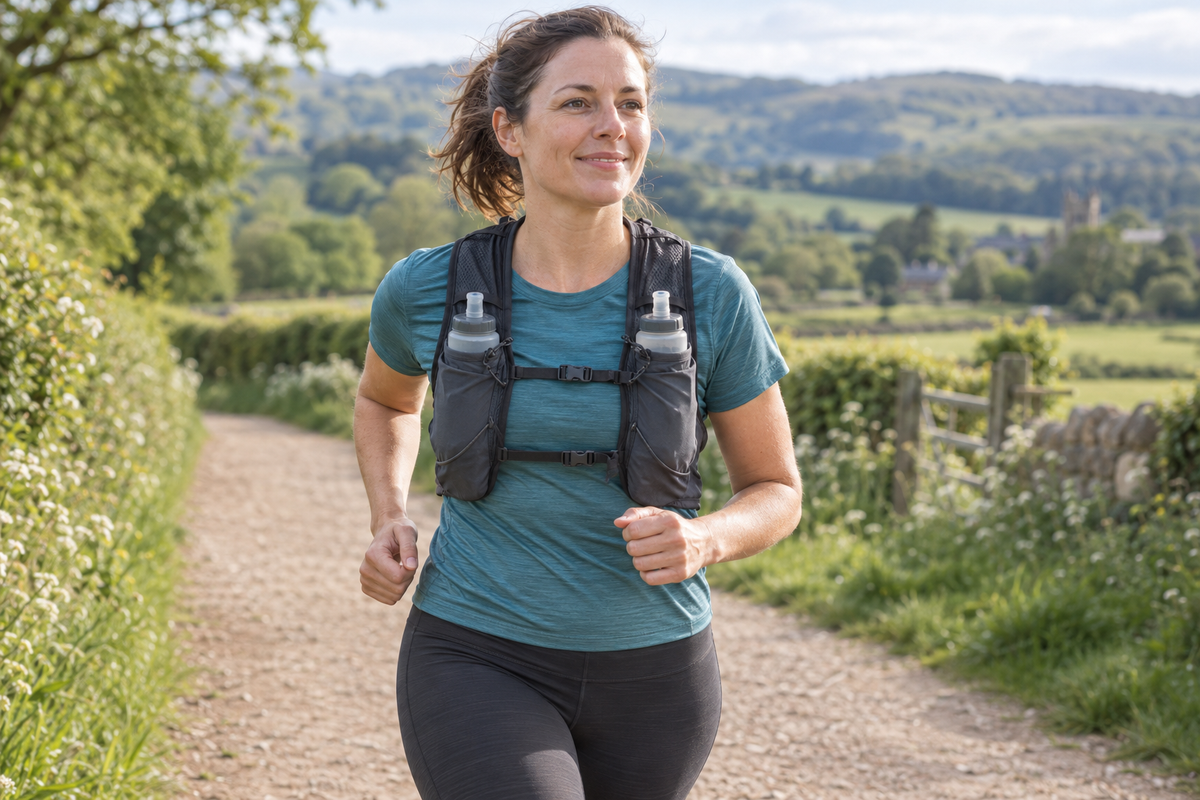
You have worked out that you want to carry a drink. Now you need somewhere to put it that does not spend the entire run reminding you it is there.
A bottle in your hand, a flask at your waist and a vest across your shoulders can all do the job. The useful question is which arrangement suits your route, your load and your body.
There is no mileage badge you have to earn before wearing a vest. Equally, buying one does not automatically make a run more comfortable. Sometimes the bottle you already own is perfectly useful.
The highlights
- Choose around access to refills and everything you need to carry, rather than distance alone.
- Compare the system when loaded. An empty vest hanging politely on a shop rail tells you very little.
- Storage volume and fluid capacity are different measurements. Check what bottles or reservoir are actually included.
- Fit should allow comfortable breathing and arm movement without repeated bouncing, rubbing or pressure.
- The evidence does not identify one universally superior carrying method. Your practical trial matters.
This is a guide to carrying equipment. For the food and drink plan itself, use our fuelling and hydration guidance.
Start with the load and the route
Lay out what you actually intend to take: fluid, phone, key, food, any medication and the clothing or equipment appropriate to the outing. Include mandatory race kit where relevant.
Then look at the refill opportunities. Are they confirmed, accessible and likely to be available when you arrive? A familiar loop past home offers different options from a remote route. Do not assume that every tap shown on a map will be working.
This determines the carrying problem. It does not determine how much you personally should drink. A large container is carrying capacity, not a target to empty on schedule.
Water adds about 1 kg per litre before the container, food and clothing are counted. Check the full load rather than comparing only the empty weights on the labels.
The main options
These are practical trade-offs, not results from a head-to-head Running Woman product test.
| Method | Why it might suit you | What to check |
|---|---|---|
| Handheld bottle or flask | Straightforward access; little equipment across your body | Comfortable grip or hand strap, arm movement, valve access and what happens when you need that hand |
| Hydration belt | Keeps your hands free with less upper-body coverage than a vest | Correct bottle compatibility, loaded movement, access and pressure at the waist or hips |
| Vest with front flasks | Drink within reach with space for additional kit | Flask position around the breasts, shoulder fit, underarm clearance and security as flasks empty |
| Vest or pack with rear reservoir | Fluid carried on your back, with a tube for drinking | Tube routing, refill access, ability to judge what remains and cleaning of every component |
A soft flask is a container, not a fourth way of wearing equipment. It may sit in your hand, a belt or a vest. Some vests accept both front flasks and a rear reservoir, but check the actual model rather than assuming.
Handheld: simple, provided you like holding it
A handheld can be an easy place to begin when fluid is the main item you need to carry. A purpose-made strap may let the bottle sit against your hand without a constant tight grip. Try it rather than assuming the strap will suit every hand.
Check whether the cap or valve is easy to use and whether the bottle feels awkward as you swing your arm. If you prefer swapping hands, make sure the design allows that comfortably. There is no need to force yourself to tolerate it because the bottle was inexpensive.
Think about the rest of the run too. Opening a gate, checking a map or putting on a jacket becomes a little more involved when a hand is occupied. Stop when you need to organise yourself.
Belt: hands free, but bottles change the fit
A hydration belt needs to support its intended bottles. A general phone belt is not automatically suitable for a full flask, even if you can squeeze one into a pocket.
Test removal and replacement with the belt on. Can you reach the bottle without twisting uncomfortably? Does it seat securely? Can you tell that the retaining loop or closure is engaged?
Try the intended position and adjustments with the actual load. If a belt bounces, check bottle compatibility, sizing and load placement before simply pulling it tighter. Pressure that feels tolerable standing still may become annoying when you breathe more deeply.
Our running-belt guide covers general sizing and pocket construction. Here the extra test is whether the belt handles the fluid containers throughout the run.
Vest: useful storage, with more fit to get right
A vest gives you space across the torso for fluid and other equipment. That can be useful when a jacket, food and additional kit need to come too. It also places material against more of your upper body, so include warmth and wet fabric in your trial.
Check the manufacturer's sizing method. Dress size alone may not capture chest shape, shoulder width or torso length. A design marketed for women is an option to compare, not proof that it fits every woman.
Put it on over the sports bra and top you expect to wear. Load the front pockets and rear compartment as intended, then adjust the permitted straps. Try a deep breath and a normal arm swing.
Notice whether flask bases press into breast tissue, valves sit inconveniently close to your face or straps cross somewhere uncomfortable. Check for contact near the neck and underarms. Movable chest straps can help only if their available positions work for you.
A vest should not need to squash your chest to stay put. Nor should its compression be treated as a replacement for a sports bra that suits you. If the combination is uncomfortable, try another adjustment, size or design. Our sports-bra fit guide handles bra support in detail.
These are fit checks based on editorial judgement. We do not have evidence that one strap layout prevents breast pain or chafing in all runners.
Front flasks or a reservoir?
Front flasks let you handle the containers separately and see what remains. Soft flasks collapse as they empty, which changes how they sit in their pockets. Check retention when partly empty as well as full, and whether refilling and replacing a soft flask is fiddly with cold or wet hands.
A rear reservoir usually feeds a drinking tube. Check that you can reach the valve without stretching your neck and secure the tube without it flicking about. Work through a refill at home: do you have to remove the pack, move other kit or disconnect the tube?
Do not assume a listed 5-litre vest holds 5 litres of fluid. The number may describe storage volume. Read the stated fluid capacity, included containers and compatible reservoir size separately.
Neither design earns a universal convenience prize. The useful one is the arrangement you can drink from, refill and pack again without an argument.
Does one option use less energy?
There is some research, but it is not a scientific league table of modern running vests.
A 2020 study compared handheld, waist and backpack systems carrying 1 kg during hour-long treadmill runs. It found no statistically significant differences between systems in running economy and several physiological measures. However, it involved just 12 young men. A small study finding no clear difference is not proof that every system is equivalent for women, heavier loads or long trail outings.[1]
An earlier study of 42 runners also found no significant difference in oxygen use or energy expenditure with the tested handheld and belt arrangements over short runs, although some movement and joint measures changed.[2]
Our practical judgement is to choose a workable, comfortable system and rehearse with it. These findings do not justify claims that handheld bottles damage your running form or that a particular vest makes you faster.
Race rules: check your event, not someone else's
Read the current kit list before deciding what to buy. A race can specify container capacity, compulsory equipment and the pack used to carry it. For example, Bucovina by UTMB distinguishes required container capacity from the pack requirement for particular races.[3] That is an event-specific example, not a universal trail-running rule.
Check whether a personal cup is required, what refilling involves and whether the organiser distinguishes capacity from fluid that must be carried at a particular point. Clarify ambiguous wording with the organiser. A screenshot from last year's group chat is a fairly fragile equipment plan.
Give it a proper rehearsal
Begin with a short, convenient outing and build towards representative use. Include a safe stretch with the kinds of turns or slopes you expect. Stop to adjust anything that hurts or restricts movement.
Test the system both full and partly empty, keeping any route or event requirements in mind. Check for movement, leakage, pressure and whether you can still reach your phone without unpacking everything. Our phone-carrying guide covers that separate decision.
Keep a simple note afterwards: what rubbed, what moved, what was difficult to reach and whether an adjustment helped. Change one thing next time. A single comfortable ten-minute jog is encouraging, but it cannot establish all-day comfort.
Choose something you can clean
Before buying, look at how the opening, valve and tube come apart, how they dry and whether replacement parts are available. Cleaning instructions differ between materials and products.
For example, HydraPak's reservoir instructions include cleaning the tube and bite valve and allowing components to dry fully.[4] That is manufacturer guidance for its own equipment, not a reason to apply its dishwasher or cleaning-product instructions to every flask on the market.
Follow the instructions for yours, including after carrying a drink mix. Inspect valves, seams and closures, and deal with leaks or damage before relying on the system away from home.
The Running Woman verdict
Choose the simplest arrangement that carries what your outing requires and feels comfortable when you use it.
That might be a handheld, a belt or a vest. Your shoulders, waist and breasts are allowed an opinion, even when the internet has already declared a winner.
Love RW x
Sources and further reading
-
Scheer V et al. (2020). The Optimal Weight Carriage System for Runners: Comparison Between Handheld Water Bottles, Waist Belts, and Backpacks. Frontiers in Physiology. DOI: 10.3389/fphys.2020.571221. Back
-
Vincent HK et al. (2018). Running Mechanics and Metabolic Responses With Water Bottles and Bottle Belt Holders. International Journal of Sports Physiology and Performance, 13(8), 977-985. DOI: 10.1123/ijspp.2017-0184. Back
-
Bucovina by UTMB. Race regulations: mandatory equipment. Event-specific organiser information checked 7 October 2026; check again for the relevant race edition. Back
-
HydraPak (2023). Hydration reservoir cleaning guide. Manufacturer care instructions, not independent performance evidence. Back

