

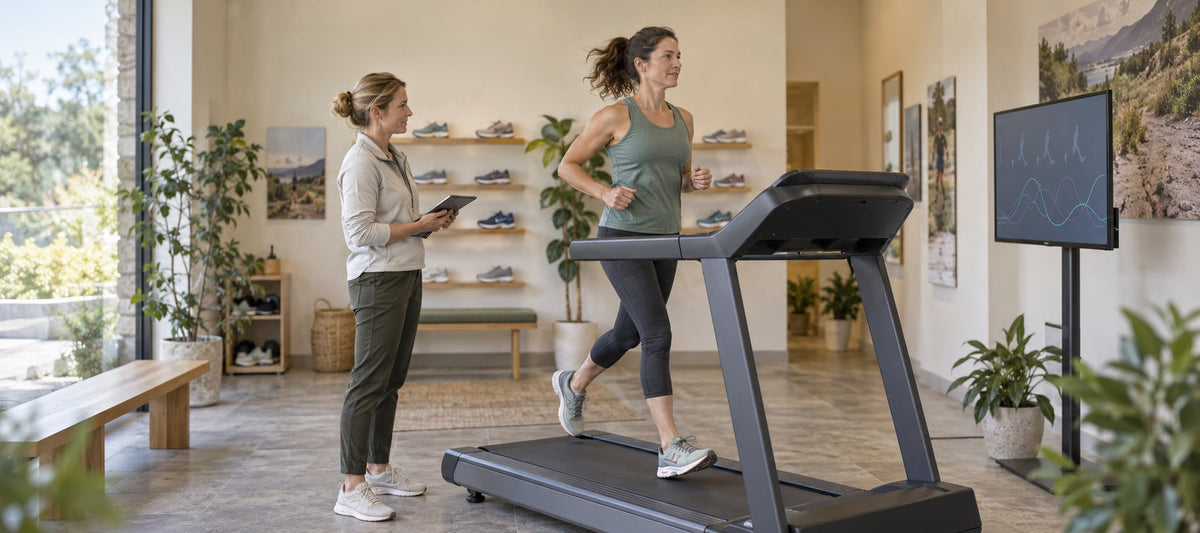
You've probably seen it in a running shop.
You jog on a treadmill while somebody films your feet from behind.
The video stops.
A line appears on the screen.
Your ankle moves inwards.
You are told that you pronate.
Then you are shown a wall of running shoes that apparently fixes the problem.
That is one version of gait analysis.
It is not the only one.
And there is quite a large difference between using video to look at how somebody runs and using that video to claim there is one scientifically correct shoe for them.
Let's separate the useful bit from the mythology.
The highlights
- Gait analysis simply means examining how you move while walking or running.
- Retail treadmill analysis and clinical biomechanical assessment are not the same thing.
- Two-dimensional video can measure some things reliably, particularly foot-strike pattern and step rate.
- Some joint-angle measurements are much less precise than a sophisticated three-dimensional laboratory assessment.
- A gait assessment can contribute useful information, especially for an injured runner, but it does not reveal one perfect shoe.
- You do not need gait analysis before you are allowed to buy running shoes.
What exactly is running gait?
Your gait is your pattern of movement.
When you're running, that includes things such as:
- where your foot contacts the ground
- how quickly you take steps
- where your foot lands relative to your body
- how your ankle moves
- knee movement
- hip and pelvic movement
- stride length
- time spent on the ground
A proper analysis can look at some or all of these.
It may use nothing more complicated than a smartphone video.
At the other end of the spectrum, a biomechanics laboratory may use multiple high-speed cameras, markers attached to the body, force plates, pressure sensors and specialist software.
Both can be called gait analysis.
They are not equivalent.
What happens during retail gait analysis?
A typical running-shop assessment involves:
- a conversation about your running
- a short treadmill run
- video from behind or from the side
- slow-motion playback
- observation of foot or ankle movement
- trying different shoes
There is nothing inherently wrong with that.
Seeing yourself run can be fascinating, and an experienced member of staff may use the information sensibly alongside fit, comfort and your previous footwear experience.
The problem begins when a very brief assessment is treated as a diagnostic machine.
Can two-dimensional video measure anything accurately?
Yes.
A systematic review involving 702 participants found strong evidence that two-dimensional video can reliably identify foot-strike pattern and measure step rate.[1]
Here, reliably means that repeated assessments tend to agree. Evidence about how accurately the measurements match a reference system was more limited.
Foot-strike pattern and step rate are comparatively clear features to observe.
Measurements of joint angles are more complicated.
A 2023 systematic review comparing two-dimensional video with three-dimensional motion-analysis systems found good to excellent reliability for many measurements when the same method was repeated.
Validity, meaning agreement with the three-dimensional reference measurements, was a different story.
For many joint-angle measurements, agreement with three-dimensional systems was poor to moderate.[2]
So a video can be genuinely useful without being infinitely precise.
That distinction matters.
What can gait analysis tell you?
Depending on the setup and expertise involved, gait analysis may help identify:
- foot-strike pattern
- cadence or step rate
- obvious asymmetries
- where the foot lands
- movement patterns at the ankle, knee or hip
- how those patterns change with speed
- how they change in different shoes
For somebody dealing with a running-related injury, this information may form one part of a wider clinical assessment.
A clinician can combine it with:
- symptoms
- injury history
- training load
- strength
- range of movement
- previous footwear
- running goals
That is very different from looking at your ankle for fifteen seconds and announcing your shoe destiny.
Does an unusual gait mean something is wrong?
Not necessarily.
Humans are beautifully inconsistent.
Two successful runners can look very different.
A movement that looks unusual is not automatically an injury waiting to happen.
Running-related injuries are multifactorial. Training load, previous injury, recovery, health, strength, sleep and plenty of other things may contribute.
Biomechanics can matter, but they are part of that picture rather than the whole picture.
This is one reason gait analysis is more useful when there is a specific question.
For example:
Why does this runner's knee hurt during longer runs?
is a much more useful clinical question than:
Is this person's running form correct?
Can gait analysis help with injury treatment?
Potentially.
Gait retraining deliberately changes a particular aspect of somebody's running, often with feedback.
A 2022 systematic review of 19 trials found that gait-retraining interventions could alter variables including step rate, knee movement and how quickly force builds after landing.[3]
That shows movement can be changed.
Two trials in that review also reported fewer injuries over a year, but too few reported pain outcomes to draw firm conclusions about treatment. Evidence that gait retraining prevents or treats every running injury is much more limited.
For example, a small 2024 trial involving 30 runners with patellofemoral pain, felt around or behind the kneecap, found that retraining focused on impact or step rate improved pain during running at six months compared with no intervention. That is encouraging, but it does not establish which approach works best for everyone.[4]
For many other running injuries, evidence remains less developed. Gait retraining should be considered alongside the rest of rehabilitation, with changes introduced gradually.[5]
Changing someone's gait therefore needs a reason.
You should not rebuild the way you run simply because a video looks untidy.
What about gait analysis for choosing shoes?
This is where things become particularly interesting.
The traditional retail idea is:
- analyse gait
- identify movement type
- select shoe category
- reduce injury risk
Research does not support that process as neatly as the diagram suggests.
An interesting illustration of how expectations affect shoe choice arrived in a 2025 study involving 21 women runners.[6]
Each woman underwent gait analysis.
She was then given two experimental shoes.
The shoes were physically identical apart from their colour.
One was presented as a basic running shoe.
The other was presented as a shoe specially selected to match her gait analysis.
The runners rated the supposedly gait-matched shoe more favourably for comfort, expected performance and expected injury reduction.
But it was the same shoe.
The gait analysis had not actually discovered anything about which of those two shoes suited her better.
The description changed her expectations.
This was a short treadmill experiment about perceptions. It did not test whether gait-matched shoes prevent injuries over months of running.
That does not mean gait analysis is fake.
It demonstrates how powerful the story around an assessment can be.
A technical-looking video can make a recommendation feel much more certain than the underlying evidence really is.
Does that mean specialist running shops are pointless?
Not at all.
A good running shop can be extremely useful.
Staff may help you:
- try several appropriate options
- understand differences between models
- compare sizes and widths
- identify heel movement or obvious fit problems
- run briefly in the shoes
- discuss the type of running you actually do
That service has value.
The gait video should be treated as one piece of information rather than a verdict.
Questions worth asking during a gait analysis
If somebody recommends a particular shoe because of your analysis, ask:
What exactly did you see?
Was it foot-strike pattern? Foot posture? Ankle movement?
How does that lead to this particular shoe recommendation?
Ask them to explain the reasoning.
Can I try a neutral option as well?
Comparison is useful.
Which one feels most comfortable when I run?
You are still allowed an opinion about your own feet.
Are you suggesting I have an injury or medical problem?
If the answer is yes, a retail shoe fitting is not the correct place to diagnose it.
Do you need gait analysis as a beginner?
No.
If you are healthy, pain-free and beginning to run, you can choose running shoes without undergoing gait analysis.
Start with shoes appropriate for your surface.
Make sure they fit.
Compare several options.
Choose something comfortable.
You are allowed to go running.
When might clinical gait analysis be worthwhile?
It may be useful when there is a more complicated question, for example:
- recurrent injury
- persistent running-related pain
- difficulty returning after injury
- a particular movement-related symptom
- rehabilitation that includes gait retraining
- performance analysis at a higher level
In that situation, look for an appropriately qualified professional who can assess the whole runner rather than selling a shoe at the end of the appointment.
Don't diagnose yourself from a slow-motion video
Once you know what pronation looks like, it is quite tempting to film your ankles and become your own biomechanics department.
Be careful.
Angle, camera position, treadmill running, speed and footwear can all change what the video appears to show.
And even a correctly observed movement does not automatically tell you whether that movement matters.
A video can answer:
What seems to be happening?
It may not answer:
Why?
or:
Does it need changing?
The Running Woman verdict
Gait analysis can be useful.
It can help us observe running.
It can measure some things surprisingly well.
In a clinical setting, it can contribute to understanding and sometimes changing movement.
But it is not a footwear crystal ball.
If your analysis helps somebody ask better questions about your running, great.
If it ends with:
"Your ankle moved four degrees, therefore this is the only shoe you can wear"
we would ask a few more questions.
Love RW x
General information only. Running-related pain, persistent symptoms or recurrent injury deserve individual assessment by an appropriately qualified healthcare professional.
More from Running Woman
Sources and further reading
-
de Oliveira FCL et al. (2019). Validity and Reliability of 2-Dimensional Video-Based Assessment to Analyze Foot Strike Pattern and Step Rate During Running: A Systematic Review. Sports Health. DOI: 10.1177/1941738119844795. Back
-
Leporace G et al. (2023). Validity and reliability of two-dimensional video-based assessment to measure joint angles during running: A systematic review and meta-analysis. Journal of Biomechanics, 157, 111747. Back
-
Doyle E, Doyle TLA, Bonacci J and Fuller JT (2022). The Effectiveness of Gait Retraining on Running Kinematics, Kinetics, Performance, Pain, and Injury in Distance Runners: A Systematic Review With Meta-analysis. Journal of Orthopaedic & Sports Physical Therapy, 52(4), 192-206. DOI: 10.2519/jospt.2022.10585. Back
-
de Souza Júnior JR et al. (2024). Effects of two gait retraining programs on pain, function, and lower limb kinematics in runners with patellofemoral pain: A randomized controlled trial. PLOS ONE, 19(1), e0295645. DOI: 10.1371/journal.pone.0295645. Back
-
Gaudette LW et al. (2022). Clinical Application of Gait Retraining in the Injured Runner. Journal of Clinical Medicine, 11(21), 6497. DOI: 10.3390/jcm11216497. Back
-
Fife A, Esculier JF, Ramsey C and Hébert-Losier K (2025). Running Shoe Recommendations Based on Gait Analysis Improve Perceptions of Comfort, Performance and Injury Risk: A Single-Blind Randomised Crossover Trial. Translational Sports Medicine, 2025, 1419641. DOI: 10.1155/tsm2/1419641. Back


