

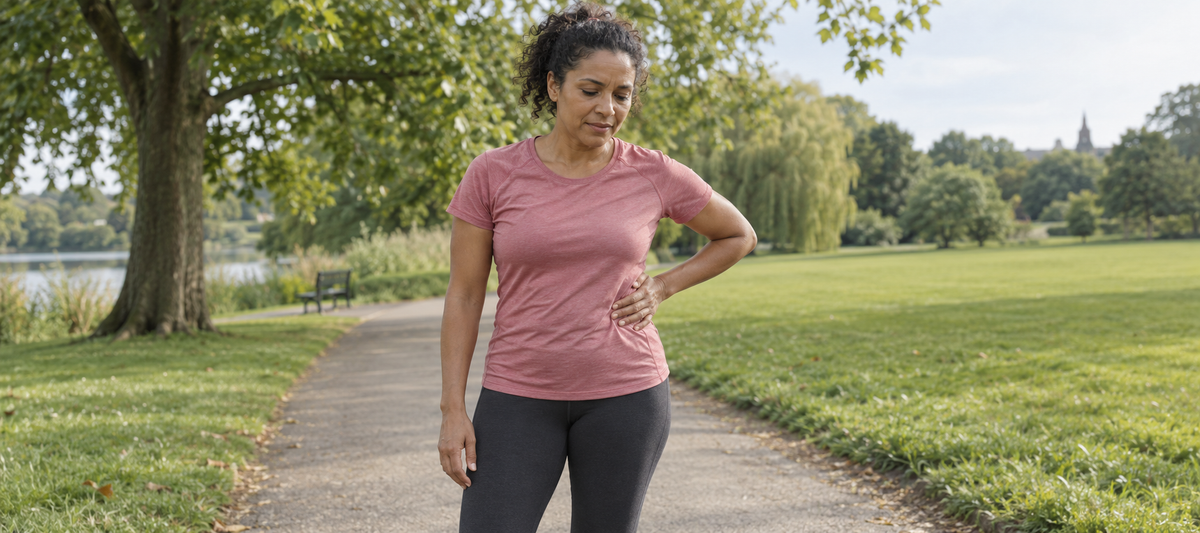
You have finally settled into a run, a friend is halfway through her story, and a small patch beneath your ribs starts complaining. It may feel like a tug at first, then a sharper pain that makes carrying on distinctly unappealing.
A familiar side stitch can interrupt an otherwise comfortable outing. Slow down or stop rather than trying to prove you can run through it. If the pain is severe, unusual or does not settle, treat it as abdominal pain needing attention, rather than assuming this article has named it for you.
What is a running stitch?
The medical term is exercise-related transient abdominal pain, usually shortened to ETAP. It commonly feels localised around the lower ribs or middle of the abdomen, on either side. Descriptions include pulling, aching or cramping, and sometimes a sharper sensation. A typical episode appears during activity and eases with rest. American Medical Society for Sports Medicine
That pattern is a useful description, not a home diagnostic test. Feeling pain near the ribs does not establish its cause. Persistent pain, discomfort outside running or something markedly different from your usual stitch needs a different decision.
You can also be working hard enough to breathe noticeably without having a stitch. Our guide to breathing when you start running covers that separate experience.
Why does a side stitch happen?
The precise mechanism remains uncertain. A major review discusses several explanations and considers irritation of the lining of the abdominal cavity a plausible one. It has not been confirmed as the cause of every stitch. Morton and Callister’s review
So a confident explanation that your diaphragm has simply run out of oxygen goes further than the evidence. The same applies to an instruction to correct your breathing to cure the problem.
Uncertainty does not make your discomfort imaginary. It means advice should offer reasonable ways to respond without turning one theory into a diagnosis.
Is it something women experience differently?
A survey of 965 people across several sports found that stitch prevalence and severity were not related to sex. It was observational research, and other studies have not always agreed. There is no established women-specific cause or guaranteed remedy. Morton and Callister’s survey
For a woman fitting a run around work, family or an early alarm, the useful questions are practical: what happened, what did you eat or drink beforehand, and did the discomfort settle? It does not become a hormonal explanation merely because you are a woman.
What can you do when a stitch starts?
For a mild, familiar episode, ease into walking or stop. Move clear of traffic or other runners first. Let yourself rest rather than immediately testing whether the pain has disappeared at your original pace.
Some runners report relief from gentle pressure on the uncomfortable area, bending slightly forwards or controlled deeper breathing. Sports-medicine guidance describes these as reported techniques. They are options, not proven cures. Avoid pressing or stretching forcefully, and leave out anything that worsens the pain. AMSSM side-stitch advice
There is no need to count an exact breathing rhythm or choose a particular foot for every exhalation. Evidence for the many proposed manoeuvres is limited; stopping exercise remains the most reliable way of relieving ETAP described in the review. Morton and Callister
If it settles fully and you feel well, a gentle restart is an option. Finishing with a walk is also a perfectly useful decision.
Could food or drink be involved?
A community-running study linked eating a large meal one to two hours before the event with a greater likelihood of a stitch. That is an association, not a rule that every meal causes pain. City to Surf study
If you notice that pattern, try leaving more time after a substantial meal. Keep food in your day; repeatedly skipping meals is not a sensible stitch-prevention plan.
Drink composition may matter too. In a trial of 40 stitch-prone participants, the concentrated fruit juice tested provoked more stitch symptoms than the other conditions. That small study cannot tell you that every sweet drink is unsuitable or that sports drinks cause stitches in everyone. Morton and colleagues’ fluid trial
Do not respond by avoiding fluids. Make any changes alongside a sensible eating and drinking plan. Our long-run fuelling and hydration guide covers that wider preparation.
Make the next run easier to learn from
Note when the pain started, where it was, the preceding meal or drink, and whether stopping helped. A short note is enough. Change one practical detail on a later comfortable outing rather than replacing breakfast, drinks and your entire running style together.
A familiar gradual beginning can make it easier to settle into the run, but it is not a proven stitch shield. Our warm-up guide covers preparation without adding a compulsory ritual.
When abdominal pain needs medical help
Call 999 or go to A&E for abdominal pain that is sudden or severe, pain when touching the abdomen, vomiting blood, bloody or black sticky stools, chest pain, breathing difficulty or collapse. Do not drive yourself to A&E. NHS stomach-ache guidance
Seek an urgent GP appointment or NHS 111 advice if abdominal pain gets worse, does not go away or keeps returning. The NHS also advises urgent help for abdominal pain during pregnancy or with unusual vaginal bleeding or discharge. NHS
If recurring exercise pain limits your running, discuss it with a clinician rather than continually experimenting around it. A stitch is not a judgement on your fitness, and walking home is not a failed run.
Love RW x
