

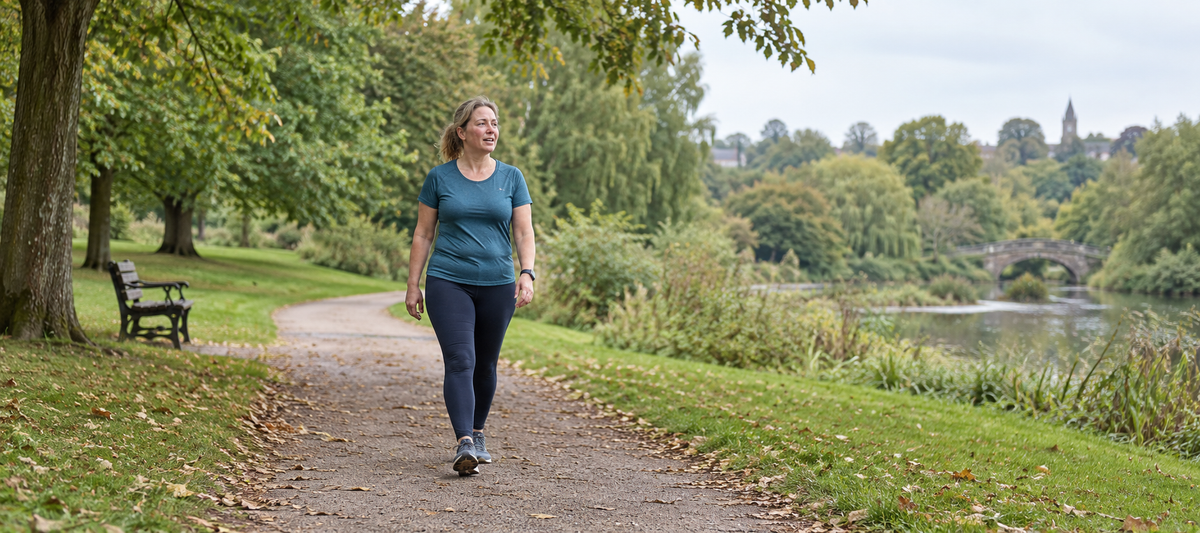
You can walk to the shops, climb stairs and get through a busy day. Then you try a little running and your breathing becomes the loudest thing in the neighbourhood.
It can feel surprisingly discouraging, especially when the advice is to run at an easy pace and you have yet to locate one.
There are physical reasons for that jump in effort. There is also the unfamiliar business of deciding what the sensations mean. Understanding both can help you make the next outing more manageable, without treating every uncomfortable feeling as something to push through.
Running asks a different question of your body
Running changes the way your legs support and propel you. It is not simply walking with more enthusiasm. Studies of walking and running show different patterns of joint work and energy use as speed changes. Moving from your usual walking speed into a run generally raises the demand, although the precise comparison depends on the speeds being compared. Research on walking and running mechanics.
Your working muscles need more energy. Your heart, circulation and breathing respond to support oxygen delivery and remove the carbon dioxide produced during metabolism. These systems work together; feeling puffed does not identify one particular part as the problem. The oxygen cascade during exercise.
For someone beginning, even a modest-looking jog may be a demanding intensity relative to current fitness. A pace can be slow on a watch and hard for the person doing it. That is useful information about today's effort, not a judgement on your potential.
Why breathing changes so quickly
Breathing responds from the start of exercise through signals from the brain and working body, as well as chemical feedback. It does not wait for you to feel as though you have done enough running to deserve being out of breath. As effort rises, ventilation can rise sharply too. Harbour and colleagues' breathing review.
This helps explain why a slightly overenthusiastic start can become uncomfortable quite quickly. If the pace is too demanding, concentrating harder on breathing will not make that workload easy. Slowing down or walking changes what you are asking your body to do.
Why it is so easy to start too fast
Perhaps your idea of running comes from watching other people. Perhaps slowing further feels awkward, or you think you should run until you need to stop. These are understandable ways to begin, but none gives you a reliable pace for your own body.
Our practical suggestion is to let the opening minutes be a check-in. You are finding an effort you can repeat, rather than seeing how long you can tolerate the first speed you happened to choose.
For the actual effort cues, including the talk test, use our Easy Runs guide. It is fine if keeping an outing manageable currently means combining running and walking.
Nose or mouth: you have options
You do not need to keep your mouth closed to run correctly. People commonly move towards combined nose-and-mouth breathing as ventilation increases. Nasal breathing is possible for some runners, but evidence that it improves exercise capacity in healthy people is limited. Restricting breathing to the nose can also feel uncomfortable. Review of respiratory interventions.
Let air move in the way that feels comfortable. There is no need to buy a breathing aid or turn an ordinary outing into a test of nose-only discipline. If you have an airway condition, follow your own treatment advice rather than substituting an internet technique.
Do your breaths have to match your footsteps?
Breathing and steps can fall into a rhythm. Some people like noticing that rhythm; others find counting irritating. Research has explored this coordination, but it does not establish one best step-to-breath pattern for every runner. The running-specific evidence for deliberately changing breathing remains limited. Breath Tools review.
If a gentle rhythm feels helpful, you can use it. If it makes you hold your breath, strain or worry about getting the count wrong, leave it alone. Your outing already has enough moving parts.
The unfamiliarity matters too
Noticeable breathing, warm muscles and the thought of being seen can make the whole experience feel like a lot to process. That does not make the physical work imaginary.
Exercise psychology research finds that intensity affects how pleasant or unpleasant exercise feels, with substantial differences between people. An outing that becomes unpleasant is not proof that you lack the right attitude. Ekkekakis and colleagues' review.
Try giving yourself less to solve at once: a familiar route, a manageable outing and permission to head home. That is our practical suggestion, not a treatment programme or a promise that every run will feel lovely.
Why walking helps, and what can change with practice
Walking breaks let you reduce the immediate demand and reassess before the next running section. The NHS Couch to 5K plan deliberately starts with short runs separated by walking. Our Run-walk guide explains how to organise that approach without turning the running parts into sprints.
Over repeated training, muscles can develop more of the machinery that uses oxygen to release energy, and changes in their capillary supply help support that work. A large review found adaptation across different training approaches, with starting fitness influencing the response. It does not give an individual deadline for running to feel easy. Mølmen and colleagues' review.
You may also become more familiar with the route, pacing and sensations. Notice whether a comparable outing is becoming more manageable. You do not have to run faster every time to demonstrate progress.
Ordinary effort and symptoms to take seriously
Breathing faster with exertion can be expected. It should ease as the demand drops. For new or unusual breathing difficulty, or symptoms that do not settle after stopping, seek urgent advice, such as NHS 111 in the UK. Recurring wheeze also deserves a GP assessment. Being new to running does not explain every symptom.
Stop and seek emergency help for severe breathing difficulty, a tight or heavy chest, pain spreading to the arm, back, neck or jaw, or sudden confusion. In the UK, call 999; elsewhere use the local emergency number. NHS advice on shortness of breath.
Pain that makes you change how you move is also a reason to stop and reassess. You do not need to prove that you can tolerate it before asking for help.
For your next outing, the useful question is simply whether you can make the effort more manageable. A shorter run, more walking or repeating something familiar can all be sensible answers.
