

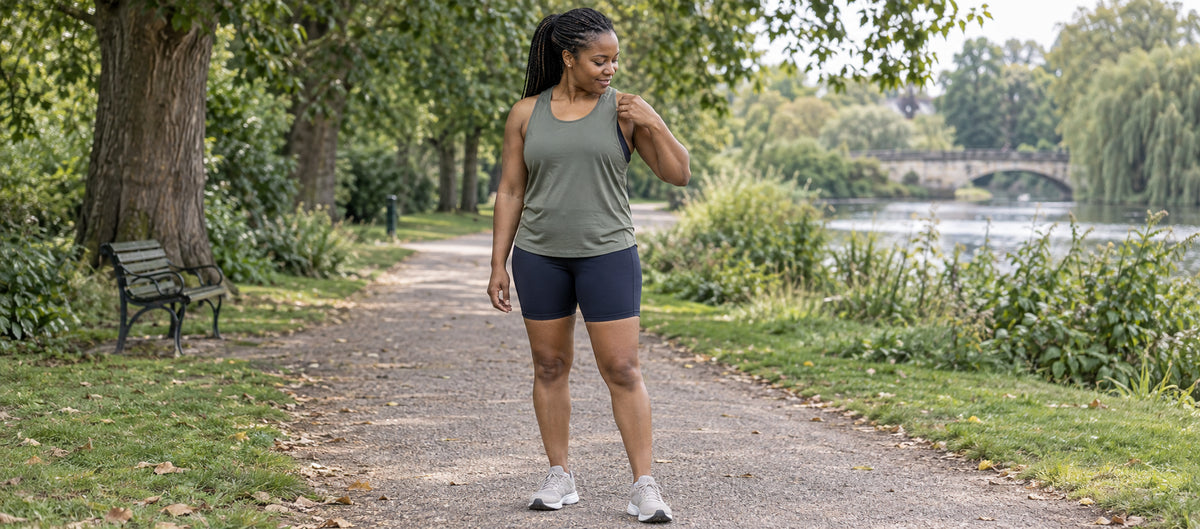
The run was going quite nicely until a small patch of skin decided to become the main event. An inner thigh, an underarm or the line beneath your sports bra can make a modest outing feel very long indeed.
Chafing is familiar to plenty of women who run. It is not a criticism of your body, a sign that you chose the wrong length of shorts or something you must endure to count the session. The useful response is to reduce the rubbing, care for irritated skin and notice when the problem needs more than a change of kit.
The highlights
- Check the precise contact point: skin, seam, hem, strap or another piece of kit.
- Clothing and a suitable barrier can help reduce friction, but no setup guarantees it will never happen.
- Stop rubbing already sore skin; treat a small graze as a small wound.
- Persistent irritation or signs of infection need appropriate help.
Why does chafing happen when running?
Repeated contact between skin surfaces, or between skin and clothing, can irritate the area. Sweat and damp clothing can be part of the picture. The American Academy of Dermatology describes thigh friction and rubbing from tight clothing or accessories as workout skin problems. Read its workout skin guidance.
The rubbing may be obvious, or only become noticeable once the outfit is damp and you have been moving for a while. That makes the exact situation worth remembering: where was the sore patch, what touched it, and had you changed anything?
This guide concerns thighs, underarms and bra lines. Our socks and blisters guide keeps the separate foot, sock and shoe questions together.
Inner thighs: look at where the fabric ends
If the contact is skin against skin, you might prefer fabric between those surfaces. A longer fitted short or a two-in-one design is one option to compare. It is a choice about comfort, not a rule about which bodies should wear which shorts.
Look at where the inner hem actually finishes as you move. Does it stay in place, or roll into the exact patch you hoped to protect? Does a bulky seam sit there instead? Adding coverage is only useful if the whole arrangement feels better.
If the contact is already fabric against skin, more layers may not answer the problem. Check the liner, underwear and seams together. Our running-shorts guide covers that fitting decision.
You are allowed to prefer loose shorts, fitted shorts or leggings. Keep the attention on what rubs, rather than negotiating with your thighs as though they are the faulty component.
Underarms: check the edge and what moves beside it
Swing your arms gently in the top you intend to wear. Notice whether the armhole edge meets the sore area, whether a sleeve seam feels bulky or whether a close-fitting layer pulls across the underarm.
Then include the other kit. A bag strap or a hydration-pack edge can create a different contact point from the one you checked when standing in a top alone.
A sleeveless top is not automatically the solution; its bound armhole may land in the same place. Another cut, a smoother edge or an arrangement with less contact may suit you better. There is no prize for finishing a run with your arms held awkwardly away from your sides to protect an irritating seam.
Bra lines: support should not require sore skin
Notice the underband, straps, fastening and the edges near your underarms. Does the mark match a particular seam? Is a strap repeatedly moving across it? Does your chest strap add another layer of pressure?
A paper in the 2026 issue of JEADV Clinical Practice discusses bra-related chafing in female athletes, including irritation where fabric, seams and straps contact skin. Its authors note that standard prevention guidelines and evidence-based treatment protocols are lacking; their suggestions are expert opinion, rather than a tested universal solution. Read the bra-chafing paper.
Use our sports-bra fit guide for the fuller fitting checks. Do not assume the answer is always a smaller, tighter bra.
Can petroleum jelly or an anti-chafing product help?
A suitable barrier is a reasonable option for an area prone to friction. AAD guidance includes petroleum jelly to reduce rubbing between skin and clothing or between skin surfaces. It also advises stopping activity when pain or discomfort develops. See the friction-prevention advice.
Read the instructions for the particular product, including where it can be used and any warning about damaged skin. A product sold for prevention is not automatically a treatment for an open sore.
Try one change at a time on comfortable, intact skin during a short familiar outing. If a new product irritates you, stop using it. Choose a product you tolerate and follow its instructions. Price alone cannot tell you how well it will suit your skin.
What if the skin is already sore?
End the rubbing first. Shortening the run, changing out of damp kit and letting the area recover are useful decisions. Covering a sore patch should not become permission to keep aggravating it.
For a small graze, the NHS advises rinsing with clean tap or bottled water, drying carefully and covering with a suitable sterile dressing or plaster. Keep the dressing clean and change it when needed. Read the NHS small-wound guidance.
For minor skin injuries, dermatologists also recommend gentle cleaning, petroleum jelly and a dressing to support healing. AAD explains minor-wound care. Ask a pharmacist for help choosing an appropriate dressing if the position makes this awkward.
When does it need more than a kit adjustment?
A recurring rash is not necessarily friction alone. The bra-chafing paper notes other possibilities, including contact dermatitis and infection. If irritation keeps returning, is not healing or leaves you uncertain about the cause, ask a pharmacist or GP rather than adding more products.
Get an urgent GP appointment or NHS 111 advice if skin becomes painful, hot and swollen. These can be signs of cellulitis. Redness may be less obvious on brown or black skin, so include heat, swelling and how the area feels when deciding to seek help. Read the NHS infection guidance.
A wound with pus, increasing pain and swelling, or a high temperature also needs urgent advice. Breast changes or pain that do not clearly match a rubbed patch should not be explained away as your sports bra.
Make the next outing a useful check
Once the skin has recovered, choose a familiar, manageable route and change one thing: the short length, a troublesome top or a suitable barrier. Keep the rest of the outfit familiar where possible.
Afterwards, note whether the same contact point returned. “Inner hem rolled on the right” is more useful than “these shorts are hopeless”. It gives you something specific to adjust.
The goal is an outfit you can largely forget about. You do not need a complete new wardrobe, a drawer full of creams or tougher skin to deserve a comfortable run.
Love RW x


