
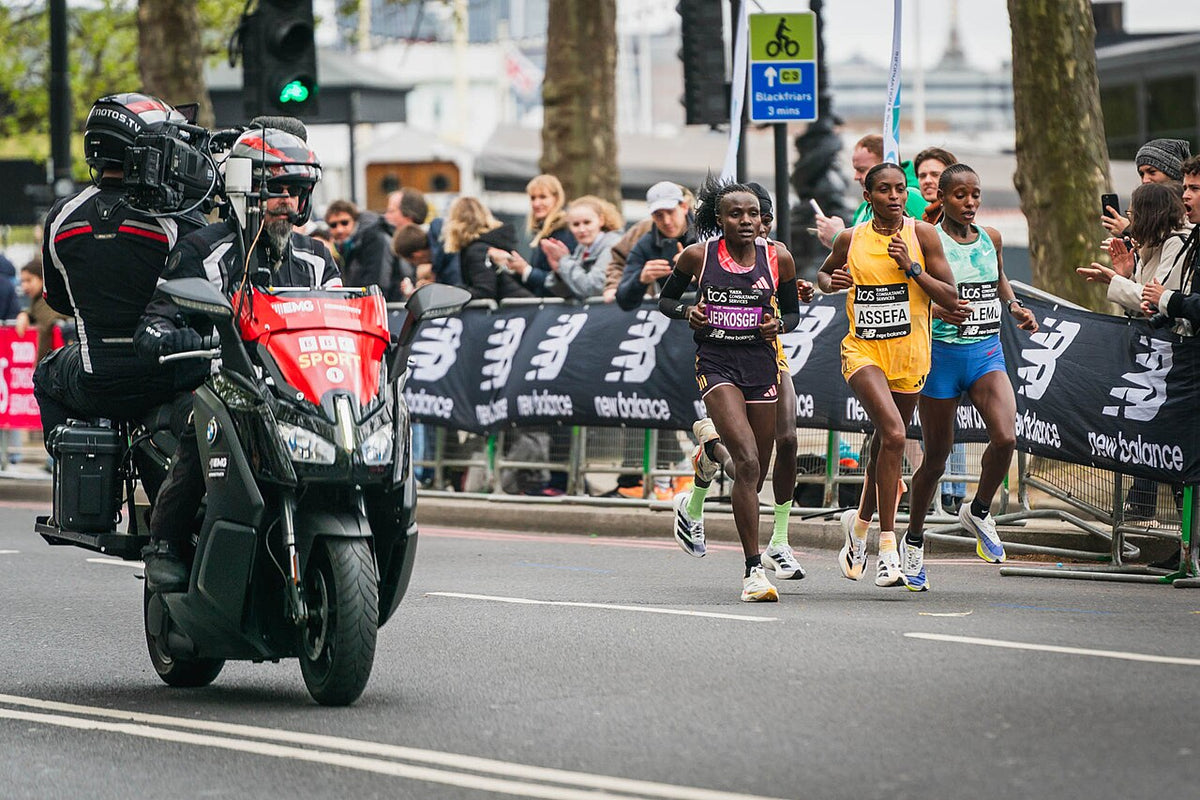
Tigst Assefa’s Berlin Marathon victory was followed by confirmation of a serious injury. We can recognise an exceptional performance without turning it into an instruction for every runner to push through pain.
News and comment. Reporting checked on 3 October 2026. The race took place on 27 September. This article discusses the public reporting and what it means for everyday runners.
The highlights
- Assefa won the 2026 Berlin Marathon in 2:11:04; subsequent reporting and an organiser statement confirmed a ruptured right Achilles tendon and surgery.
- A remarkable elite result is not evidence that continuing with an injury is safe or appropriate for someone else.
- Stopping, getting assessed and changing a plan can be responsible running decisions when something is wrong.
There is a version of a sporting story that fits neatly into a motivational caption: an athlete encounters a problem, refuses to stop and reaches the finish.
When the problem turns out to be a serious injury, the story needs more care than that familiar arc allows.
Tigst Assefa won in Berlin on 27 September 2026 in 2:11:04. Two days later, the organiser published an update confirming that she had ruptured the Achilles tendon in her right leg and undergone surgery.
The achievement deserves accurate reporting. So does what happened afterwards. For the rest of us, the useful conversation is not whether we could show the same determination. It is how we understand the result without treating it as advice for our own running.
What has actually been reported?
The 29 September statement from SCC EVENTS described a sudden problem around the 40-kilometre point, followed by a visible limp. It said subsequent examinations identified the rupture and that surgery had taken place at a hospital south of Munich.
In Associated Press reporting by Ciarán Fahey, Assefa’s representative Gianni Demadonna confirmed the seriousness of the injury. The report distinguished the later diagnosis from early descriptions that suggested cramp. The linked article is a republication of Fahey’s AP report on iNFOnews.
A short message released through the organiser included this update:
“My surgery went well.”
Tigst Assefa, in a message published by SCC EVENTS, 29 September 2026. Source
The public reports do not tell us everything Assefa knew during the race or what advice she received at the time. They also cannot tell us how her recovery will unfold.
Admiration and concern can exist together
It is possible to recognise the significance of a performance and still feel concern for the person who produced it.
Both responses have a place in the coverage. We do not have to choose between celebrating women’s elite sport and treating an injured athlete as more than an inspiring finish-line image.
Our view is that coverage should leave space for both the result and the consequences, without pretending a reader has been given a medical lesson by watching a race.
There is also no need to turn concern into a judgement of Assefa. We were not inside her experience. The question for a general running community is what message we choose to pass on to one another now. Judging her decisions from a distance adds little to that conversation.
Where “never give up” stops being helpful
As encouragement, the phrase can mean something generous: keep believing in yourself, take another manageable step, do not let one disappointing session define the whole journey.
But it becomes a different instruction when it means continuing regardless of an injury or a concerning symptom.
We would rather be specific. Keep working towards a goal when it is appropriate. Ask for help when you need it. Change the plan when the circumstances change. Being specific leaves room to respond when something is wrong.
An injury does not become harmless because the event matters deeply. Equally, needing to stop does not tell us that someone lacked commitment.
The support offered to a runner shouldn’t depend on whether she reaches the finish.
An injury does not become harmless because the event matters deeply.
What an Achilles rupture can look like
This is general health information, not a description of every detail of Assefa’s injury.
Cambridge University Hospitals explains that an Achilles rupture can involve sudden pain near the heel or calf, a popping sensation, swelling and difficulty walking or pushing off. The pain can reduce after the initial event, so a reduction in pain does not rule out a serious injury.
Mersey Care’s guidance advises urgent assessment when sudden pain at the back of the leg, a snap and difficulty walking or rising onto the toes suggest a rupture. Stop exercising and seek urgent medical help rather than trying to run home or repeatedly testing the leg. Its guidance directs people with these warning signs to A&E.
This is not an exhaustive checklist, and you don’t need to reproduce every symptom before seeking help. A clinician should assess suspected injury; an article, watch score or other runner cannot diagnose it for you.
Do not turn somebody else’s treatment into your recovery plan
Public news that an elite athlete had surgery does not establish what treatment another person needs.
The Cambridge University Hospitals information describes both surgical and non-surgical management, with decisions depending on individual circumstances. Assessment and a treatment plan come before any meaningful discussion of a return to running.
There is no individual recovery timetable for readers to take from this report. A possible return date in a news report is not a rehabilitation programme for readers.
When you are injured, ask your treating team what the next stage involves, what you should avoid and how progress will be assessed. Those answers should come from the people responsible for your care, not a comparison with an athlete whose full circumstances you do not know.
Make room for a sensible decision before race day
Try to think about support before you need it.
Alongside your travel and kit plan, know where the organiser explains medical help, withdrawal arrangements and how participants can get assistance. Discuss your circumstances with a healthcare professional when illness or injury affects whether you should take part.
You can also tell a supporter what you need from them if the day does not go to plan. Perhaps the most useful role is helping you seek assistance, contact someone or manage the journey home. Ask them to support that decision rather than urge you on because of the training you’ve done.
This is not a medical rule for deciding which sensations are safe. It is a way of making help part of the plan rather than treating it as an embarrassing exception.
The hours spent training do not create an obligation to ignore a new problem.
Not finishing does not erase the work
A missing finishing time says very little about the months of preparation before race day.
A run that ends early may still contain weeks of preparation, a meaningful personal goal and a difficult decision. None of that disappears because there is no finishing time beside a name.
We would encourage you to separate disappointment from self-criticism. You may be upset about missing the experience you wanted. You don’t need to add a story about being weak or letting everyone down.
You don’t have to find a positive lesson immediately, either. Sometimes the first useful step is getting the help you need, followed by a quiet conversation with someone who does not demand an uplifting ending.
A different plan can come later, with appropriate advice. You don’t have to announce a comeback while you are still processing what happened.
How to support a runner whose day has changed
Start with the person, not the performance.
Our suggested questions are ordinary ones: “What would be helpful right now?” and “Would you like company?” Let their answer guide what you offer next.
Offer practical help you can genuinely provide. Let them decide how much they want to discuss. Avoid diagnosing the injury, setting a recovery deadline or comparing it with the fastest return you have heard about.
There is also room to maintain the friendship without making every message about running. Someone can remain part of your life and your community while their activity looks different.
A lift home, a meal or a message a few days later can help far more than trying to find something inspiring to say.
Encouragement that leaves room to stop
Assefa’s Berlin performance and subsequent injury are important sporting news. They are not a universal instruction to carry on at any cost.
We hope her recovery goes well. We can hold that wish alongside respect for her achievement, without pretending to know the outcome or turning her experience into a test for anyone else.
At Running Woman, we want encouragement to help someone make a sensible decision, even when that means stopping. A runner who has had to leave the course needs the same welcome and concern as the one coming through the finish.
Love RW x
General information only, not diagnosis or individual treatment advice. Seek urgent medical assessment for a suspected acute tendon injury or other concerning symptoms. Recovery and return-to-running decisions should be made with an appropriate healthcare professional.
More from Running Woman
Read starting again without chasing your old self or putting your running watch in perspective.
Sources and further reading
- SCC EVENTS: Assefa’s post-surgery message: organiser statement dated 29 September 2026 covering her result, injury and surgery.
- The Associated Press, via iNFOnews: Assefa’s Achilles injury: Ciarán Fahey’s independent report dated 29 September 2026, quoting her representative. Syndicated publication, not a second independent investigation.
- Cambridge University Hospitals: Achilles tendon rupture: symptoms, assessment and individual treatment pathways.
- Mersey Care NHS Foundation Trust: Achilles guidance: urgent warning signs suggesting a rupture, distinguished from routine tendinopathy advice.

