

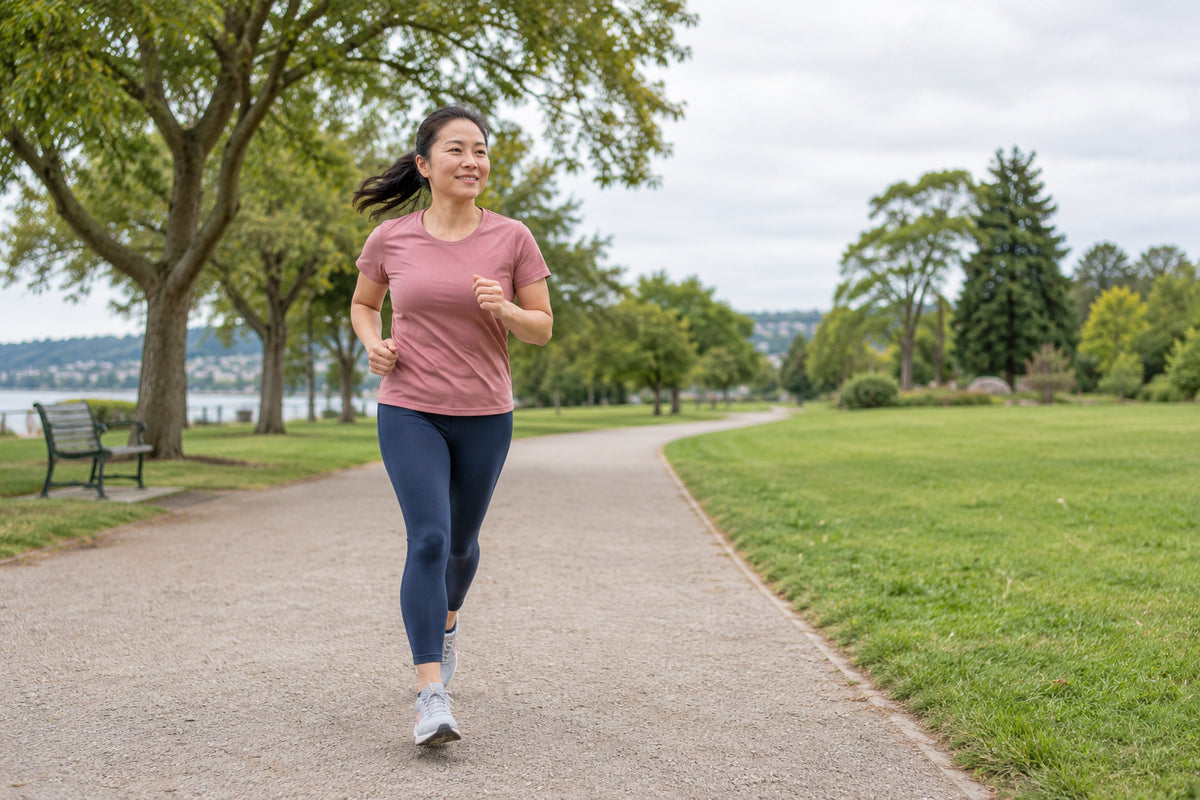
There is something appealing about a run that needs no group message. You choose the time, the route and whether the hill is happening today.
There can also be something daunting about it. Without a friend beside you, the first few minutes might feel awkward, your thoughts might be louder than expected, or you might wonder whether you will enjoy yourself at all.
Solo running is an option you can explore at your own pace. It does not need to become your preferred way of running, and enjoying company does not make you less independent.
Being on your own can be part of the appeal
Running research sometimes concentrates on clubs, shared identities and the benefits of company. That can miss people who value being able to get on with an activity in their own way.
A qualitative study of 20 recreational runners in London found that participants did not all want a stronger running-group identity. Their relationships with company and community were varied. The small, locally recruited sample cannot speak for everyone, but it helps explain why a club is not automatically the answer for every runner. Hitchings and Latham, 2017.
In another small interview study, some runners described enjoying the freedom to choose their own pace and route when alone. Others valued company. The study explored rewarding experiences rather than testing whether solo running was better. Jackman and colleagues, 2021.
You are allowed to find your own mixture. A sociable person can enjoy a quiet run. Someone who loves solitude can still want a companion on Tuesday. If time on your own is part of what you want from running, that is a useful starting point for goals beyond racing and PBs.
Start with the part you want to feel easier
“Get better at running alone” is a rather large task. Make it more specific.
Are you unsure how to choose a route? Worried that everyone will be watching? Used to a friend deciding the pace? Concerned about your surroundings? Bored without conversation?
Those questions need different answers. A familiar route might reduce planning uncertainty, but it cannot promise personal safety. A more comfortable pace may make an outing more pleasant, but it will not resolve every worry about being outside.
Begin with what is actually bothering you. You can change one manageable part without turning the next run into an examination of your courage.
Give your first few outings less to organise
Our practical suggestion is a familiar route, a manageable amount of time and permission to shorten the outing.
You might begin with a route you have walked before or a short loop you already know. Choose a time and setting that work for you. Check the arrangements that matter, such as access, crossings and getting home, instead of trying to discover them while also learning what solo running feels like.
Keep the session within your current ability. The new part is going on your own; it does not also need to be your longest or fastest run.
These are options for making an ordinary outing easier to organise, not a treatment programme or a guarantee that a route is safe. If a location or situation feels wrong, choose something else. You do not owe an unfamiliar path a second chance.
Let your own effort set the pace
A companion can make decisions almost invisible. You follow her route, match her speed and keep going because she does.
On your own, you get to notice what you would choose. Perhaps that means slowing down sooner, walking a section or turning back before you feel wrung out.
Use our easy-run guide for the effort question. If alternating running and walking suits your plan, run-walk is a proper strategy.
The aim is not to prove that you can manage without help. It is to discover an outing you can make comfortable and useful for yourself.
Give your attention somewhere pleasant to go
A solo run does not have to produce deep thoughts. It is fine to notice the trees, enjoy an ordinary stretch of pavement or think about what is for lunch.
If boredom is the problem, try a small change: a familiar route in a different direction where appropriate, a landmark to look forward to, or a short outing with no pace target. Pay attention to your surroundings and how you feel, rather than insisting that every minute should be wonderfully peaceful.
Some people enjoy music or an audiobook; others prefer quiet. Make that choice around the setting and your ability to hear what you need to hear. Audio is optional, and no headphone design removes the need to pay attention. Our headphone guide covers the practical differences.
You can enjoy a run that is slightly uneventful. Uneventful has a lot going for it.
Keep confidence and safety as separate questions
Feeling more confident does not make every situation safe. Feeling nervous does not make another person's behaviour your fault.
Practical planning matters, and so do the conditions around you. For visibility, route choices, phone arrangements, personal safety and changing a run after dark, use our detailed dark-running guide. It gives those subjects the space they need.
You can choose daylight, an indoor setting, a companion or a different outing. None of those choices creates responsibility for somebody else's harassment or abuse. That responsibility belongs to the person behaving that way.
If something changes during the run, you can stop or leave. A planned distance is not an obligation.
Company can stay in the picture
Solo running and community are quite compatible.
You might enjoy most of a week's runs alone and meet a friend occasionally. You might run a short solo route before meeting someone for a coffee, or prefer company whenever life feels particularly full.
If you would like a group option, choose one whose arrangements suit you. You can keep both possibilities available without making either one your identity.
You can also run on your own and still have people to chat to afterwards. Running Woman Chat is our supportive Facebook group, where you can share an outing, ask a question or enjoy a little encouragement, whatever your pace.Join Running Woman Chat
After a solo outing, ask a simple question: what would make the next one nicer? Perhaps less distance, a different time, or company after all. That is useful information, not a disappointing result.
When the worry needs more support
This article is about everyday choices and enjoyment. It cannot assess anxiety, trauma or risk in your circumstances.
If fear or anxiety is affecting your life, you are finding it hard to cope, or things you have tried are not helping, speak to a GP or an appropriate mental-health professional. NHS guidance explains how to find support.
You do not need to force yourself through a solo run to earn that help.
For now, choose one outing that suits the person you are today. Company is welcome. So is a little time to yourself.
Love RW x


