

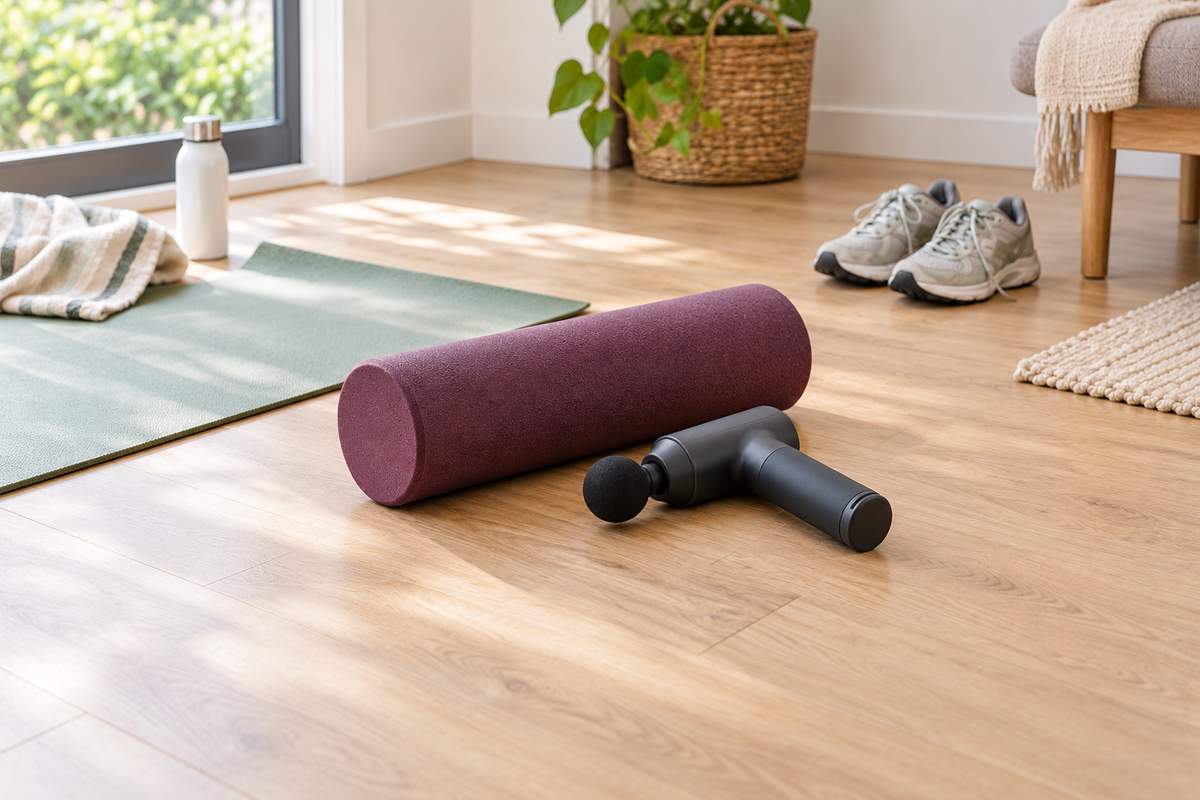
A foam roller can be a useful little purchase. It can also become a very firm ornament beside the sofa. A massage gun adds a battery, several attachments and rather more opportunities to spend money.
Before choosing either, decide what you want it to do. Feeling more comfortable after a run is a reasonable aim. Being ready for another hard session sooner is a much bigger claim.
The research does not give us a dependable shortcut from the first to the second. There is some support for changes in movement and discomfort, but much less reason to promise faster recovery or better running.
The highlights
- Foam rolling may ease post-exercise soreness, although reviews disagree about how reliably it helps.
- Massage guns may temporarily improve range of motion. Their recovery benefits remain uncertain.
- Less soreness does not prove that strength has returned or that an injury has healed.
- There is no convincing basis here for promising injury prevention or declaring one tool the recovery champion.
- You can choose a tool because you enjoy using it. You can also choose neither.
What do we mean by recovery?
Imagine your thighs feel easier after a few minutes with a roller. That is useful information about comfort. It does not tell you whether you could produce the same force as before yesterday's session, or whether another hard run is a good idea.
Research measures several different things:
| What is measured | What it can tell us | What it cannot establish on its own |
|---|---|---|
| Self-rated soreness or fatigue | How someone feels at that moment | That damaged tissue has repaired |
| Range of motion | How far a joint moves in a particular test | Better running technique or fewer injuries |
| Strength or jump performance | Recovery of that specific task | A faster next run |
| A blood marker such as creatine kinase | One indirect response to exercise | An individual runner's readiness to train |
Our existing guide to strength, cross-training and recovery covers the wider training picture. This article is about what the equipment can reasonably add.
Foam rollers: what does the evidence say?
Soreness may feel easier, but the findings are mixed
A 2024 review of 16 trials reported lower self-rated soreness with foam rolling at several points after exercise. That is encouraging for comfort, although it does not establish faster tissue repair. Zhou and colleagues, 2024.
A more narrowly focused 2023 review reached a less positive conclusion. Its five studies did not show a clear soreness advantage over doing nothing, and the included research had substantial limitations. It also found no convincing recovery benefit for the muscle-function measures examined. Medeiros and colleagues, 2023.
The reviews used different eligibility criteria and collections of studies. We should not pretend that the larger, more positive result settles everything. The fair shopping message is that rolling might make soreness more manageable, but a reliable recovery benefit has not been established.
More movement is possible, but it is a separate outcome
Regular foam-rolling programmes can improve measured range of motion in some joints and muscle groups. A 2022 meta-analysis supported that possibility, while finding considerable variation between studies. It did not establish that the resulting flexibility prevents running injuries. Konrad and colleagues, 2022.
There are other ways to work on movement, too. A 2024 review did not find that rolling or stretching produced superior immediate flexibility changes compared with other warm-up approaches. You do not need a roller simply to have a worthwhile warm-up. Warneke and colleagues, 2024.
If warming up is your main concern, start with our warm-ups and cool-downs guide. A shopping trip need not be step one.
Massage guns: more expensive does not mean more recovery
A massage gun repeatedly taps the area beneath its attachment. The appeal is easy to understand: you can use it while sitting down, and you do not have to balance on a cylinder on the floor.
A 2023 systematic review found more encouraging evidence for short-term flexibility and range of motion than for strength or sporting performance. The studies were generally small and at risk of bias. That makes “may help you move more freely for a while” a more defensible claim than “gets your legs race-ready”. Ferreira and colleagues, 2023.
The newer recovery evidence remains cautious. A 2026 review of 12 trials found no clear benefit for soreness or maximal-strength recovery. There was a possible benefit for jump recovery, but confidence in that finding was low. A change in a blood marker was supported by very-low-certainty evidence. These results do not justify a general promise of faster recovery after running. Zhu and colleagues, 2026.
A useful study in actual runners
A 2025 trial involving 84 runners found better pain, fatigue and perceived-recovery ratings after percussive massage than after a sham treatment. There was no clear advantage in vertical-jump performance. That is a helpful example of a tool making people feel better without demonstrating improved performance on the test used. The study did not establish a faster next run. Alves and colleagues, 2025.
Other trials are less encouraging. A study of 65 active adults, including 34 women, found no clear recovery advantage after treating one calf with a massage gun following strenuous calf exercise. It tested a particular protocol, so it cannot settle every use of every device. Leabeater and colleagues, 2024.
A smaller, mostly female trial found short-lived soreness relief and improved movement after treatment, without better strength. However, it involved 17 people doing an upper-arm exercise, not women recovering from a long run. That distinction matters. Roberts and colleagues, 2024.
Are you breaking up knots or releasing fascia?
Those phrases are common in product descriptions. They sound satisfyingly mechanical, as though your legs are a tangled necklace and the right attachment will sort them out.
The studies discussed here measure movement, symptoms or performance. Those findings do not demonstrate that a consumer tool physically breaks up adhesions, remodels fascia or removes “toxins”. We would not use those explanations to justify a purchase.
You do not need a dramatic mechanism to enjoy a massage. “It feels pleasant and helps me unwind” is already an honest description of personal usefulness.
Is a roller better than a gun?
There is not enough directly relevant evidence to name a universal winner for recovery after running. Do not compare effect sizes from unrelated reviews as though the devices competed in the same trial.
There are direct comparisons in other settings, but context matters. In a small 2025 study, adding a relatively long roller or gun session after a dynamic warm-up did not improve performance; some jump and sprint results worsened. That was a particular warm-up experiment in team-sport athletes, not a post-run recovery contest. It also does not mean a brief, comfortable session will spoil your next run. Ormeno and Driller, 2025.
For choosing equipment, our practical judgement is to focus on whether you can use it comfortably and whether you want it enough to justify the cost.
| Option | A practical reason to consider it | A reason to leave it |
|---|---|---|
| Simple foam roller | You like rolling and want a straightforward tool without charging | Getting onto the floor or supporting your bodyweight is uncomfortable |
| Hand-held massage gun | You prefer seated use and can comfortably hold and position it | Weight, vibration, reach or noise makes it awkward |
| Neither | You would rather spend the time or money elsewhere | There is no recovery-kit requirement to fulfil |
These are usability judgements. They are not a ranking of clinical effectiveness. A massage ball creates another option for applying pressure, but results for rollers or guns do not automatically validate every ball or attachment.
What to check before buying
For a roller, consider its size, surface and firmness. Our practical suggestion is to try a simple, less aggressive surface first if you have the opportunity. Deep ridges are not proof of a better result. Check that you can position yourself without straining your wrists, shoulders or back.
For a gun, try holding it in the positions you expect to use. A device that seems light for ten seconds in a shop can feel less manageable at an awkward angle. Check the lowest setting, controls, reach, cleaning instructions and whether the sound is acceptable in your home.
Battery life, warranty, returns and replacement attachments are sensible comparison points. More speed settings, greater advertised force or a longer list of attachments do not establish better recovery.
We have not tested specific products for this guide. A recommendation for the quietest, easiest-to-use or best-value model needs hands-on comparison, not just a specification table.
How to try a tool without turning it into an endurance event
There is no well-established universal recovery dose. Study timings are research protocols, not instructions for every runner.
As a cautious practical starting point, follow the device instructions, use light pressure on a healthy muscle and try a brief pass before deciding whether it feels helpful. Keep a gun moving rather than pressing it hard into one spot. Stop for pain, irritation, tingling or numbness. Clinical guidance from the Hospital for Special Surgery also advises avoiding newly injured areas and seeking advice when health conditions or medicines may affect safe use.
For rolling, reduce the bodyweight you place on the tool if the pressure feels excessive. Do not use bruising or grimacing as a measure of success. You are allowed to finish because you have had enough.
If you are experimenting for comfort, notice how you feel afterwards and later that day. Keep the rest of your routine reasonably familiar. This is a personal preference check, not proof that the device caused a physiological change.
When to leave the kit alone
Do not press or roll directly over a fresh injury, wound, known or suspected clot, or significantly bruised or swollen area. With a massage gun, avoid bones, joints, the spine, chest, head and neck, and areas over superficial nerves or blood vessels. Seek individual advice before use if you have reduced sensation, a bleeding disorder, take blood-thinning medication, have fragile bones, an implanted device, recent surgery or are pregnant. These are precautions requiring context, not a claim that every condition rules out all gentle massage. Massage-gun safety review.
Unexplained pain and swelling in one leg need urgent medical advice, especially with warmth or skin-colour changes. Contact your GP urgently or NHS 111. If leg symptoms come with chest pain or breathlessness, call 999. Do not massage the area while trying to decide whether it is a clot. NHS guidance on DVT.
Severe muscle pain, marked weakness or dark urine after exercise also warrant urgent assessment. Serious muscle injury has been reported after percussion treatment, although a case report cannot tell us how common that is or isolate the device as the cause. Chen and colleagues, 2021.
Persistent, worsening or sharply localised pain deserves assessment rather than a more powerful setting. Feeling temporarily better is not clearance to train through an injury.
So, is either worth it?
If you enjoy a little self-massage, can use the tool comfortably and can afford it, that can be enough. A simple roller is a reasonable first option if you already like rolling. A gun may suit your preferences better. Neither has to earn its place through a promise of extra speed.
If you are buying because you feel you ought to do more recovery, pause before paying. Our guides to recovery runs and rest and cutback weeks can help you think about the training decision. There is no need to add another job to your evening just because it comes with a charger.
Love RW x
General information for adult runners, not individual diagnosis or treatment advice. Seek professional advice for an injury or a health condition that affects safe use.
