
The warm-up and cool-down can feel like the bits between you and the actual run. But the beginning deserves a little thought, and the ending does not need a collection of dramatic promises about flushing everything out.
A useful approach is simple: prepare for the task you are about to do, then finish in a way that feels comfortable and practical.
The highlights
- A warm-up prepares you for the coming session; it should not exhaust you before it starts.
- A gentle cool-down may be pleasant, but it is not a proven cure for tomorrow’s soreness.
- Count preparation and finishing time when deciding whether a workout fits your routine.
At a glance
Main purpose: Prepare for the planned activity and finish in a comfortable, orderly way.
Effort: Mostly easy, with brief controlled preparation for faster work where appropriate.
Where it fits: Included within the session total, rather than hidden outside the training log.
When in a training cycle: Relevant throughout the year; more purposeful preparation for more demanding sessions.
The examples below are original coaching illustrations, not protocols tested in the cited studies or personalised prescriptions. Effort numbers use an informal 0–10 guide, not a laboratory zone conversion. Choose an option within your current capacity; you never have to progress because a calendar says so.
What is a warm-up?
It is a short preparation period before the main activity. For an easy outing, the first few very gentle minutes may provide much of that preparation. Before faster running, you may include more deliberate easy movement and some brief, familiar changes of pace.
The content should match the task. A first run–walk session does not require the same preparation as an experienced runner’s interval session.
A warm-up is also a useful moment to notice whether today’s plan still seems appropriate. Feeling unexpectedly unwell or uncomfortable is information, not an inconvenience to be ignored because the faster block is already loaded on your watch.
What does warm-up research show?
A systematic review and meta-analysis covering 32 studies found that performance improved in 79% of the criteria examined. That means the proportion of outcomes showing improvement—not a 79% increase in performance. The authors concluded:
“performance improvements can be demonstrated after completion of adequate warm-up activities” — Fradkin and colleagues, 2010.[1]
The studies involved varied activities. This supports sensible preparation, not one universally perfect running routine or a guarantee that warming up prevents every injury.
Our application is to make the beginning progressive and familiar, with enough preparation for the intended effort but no need to turn it into another workout.
An easy-run warm-up
For a planned 30-minute easy outing, you might spend the first 5 minutes walking and moving into very gentle running, the next 20 minutes comfortably running or run–walking, and the last 5 minutes easing down.
Those opening minutes are already inside the 30-minute total. A beginner can keep them entirely as walking. An established runner may begin with very gentle jogging instead.
Choose an approach that feels comfortable and gives you time to settle. There is no need to force the same opening pace in every season or on every route.
A more deliberate preparation for faster work
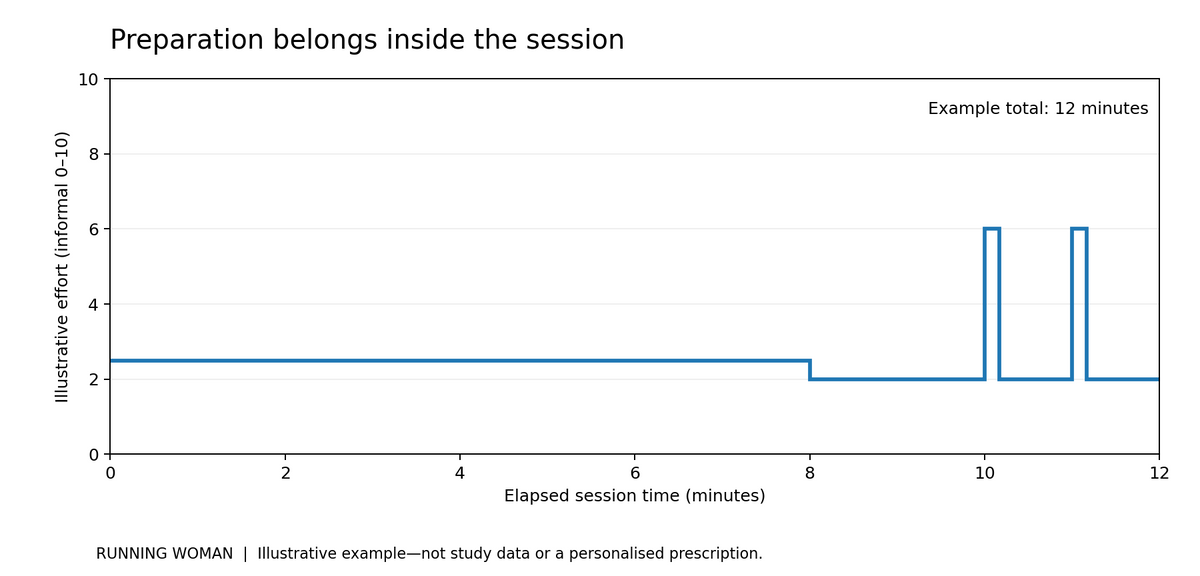
An experienced runner might use 12 minutes before a suitable faster session: 8 minutes very easy running, 2 minutes of familiar comfortable movement such as marching and controlled leg movements, then two cycles of 10 seconds smoothly quicker running and 50 seconds easy.
That is an illustration, not a mandatory warm-up length. More easy time may suit some runners; others need a different approach. The short quicker portions are controlled, not maximal sprints.
If a plan already includes 15 minutes of preparation, do not silently add this entire routine on top. Decide what the preparation contains and count the whole session once.
What about drills and stretching?
Running drills might include familiar marching, skipping or controlled coordination movements. Their place here is preparation and practice, not proof that everybody has a defective running style to correct.
Do not learn an unfamiliar hopping sequence immediately before important intervals. Choose a version you know, use appropriate instruction when needed and remove anything that is uncomfortable.
This guide does not prescribe a universal stretching sequence. A separate flexibility or rehabilitation programme may have a clear purpose, but it should not be confused with a compulsory ritual every runner must complete to make a run legitimate.
What is a cool-down?
It is a period of gentler activity after the main effort. You might jog easily for a few minutes, walk home or gradually slow the treadmill before stopping it safely.
A review of active cool-downs found limited evidence for many commonly claimed recovery benefits. Faster blood-lactate clearance did not reliably translate into better later recovery, and reduced soreness was not consistently demonstrated.[2]
That review mainly concerns activity immediately after exercise. It should not be presented as proof about every next-day recovery run, massage routine or rehabilitation programme.
A sensible finish
After an established runner’s interval session, 5–10 minutes of very easy movement may be a practical way to finish, provided it remains comfortable and fits the planned workload.
After a short easy outing, simply slowing to a walk may be enough for your routine. Do not add distance solely because you believe it must eliminate next-day soreness.
If something feels wrong, the instruction is not to keep jogging until a cool-down target is complete. Stop safely and seek appropriate help when symptoms warrant it.
The closing minutes should be the gentle part of the session, not a final attempt to improve the average pace on the way home.
Where these bookends fit in the week
They belong inside the workouts they support. A session advertised as six one-minute efforts is not a six-minute appointment once preparation, recoveries and finishing time are included.
If time is short, reduce the main set rather than automatically deleting every preparatory minute. That is a planning choice, not a demand that every short easy run becomes a long production.
In a busy week, simplicity helps: familiar route, familiar preparation, one clear main purpose and a straightforward finish.
What matters after the run?
Think beyond the final jog. Sleep guidance for athletes emphasises individual needs rather than a one-size-fits-all approach.[3] The IOC’s REDs consensus also highlights the health and performance consequences of problematic low energy availability.[4]
Those findings are a reminder not to let a detailed cool-down ritual distract from ordinary rest and adequate nourishment. They do not turn this article into a personalised sleep or nutrition plan.
Common questions
Can a warm-up be too much? A preparation that leaves you unnecessarily tired has lost sight of its purpose. Keep it appropriate to the coming task.
Must I stretch until I stop feeling tight? No. Do not force a sensation away or treat pain as a stretching challenge.
Does skipping a cool-down ruin the run? No. You can enjoy a gentle finish without believing it is the switch that makes training work.
A thoughtful beginning and a comfortable ending are enough. Your run does not need a complicated ceremony to count.
Keep exploring
- Strides: a small dose of quicker running, not a secret sprint workout
- Interval training: faster running, sensible recoveries and no need to sprint
- Recovery runs: when a gentle jog helps—and when rest is better
Sources and further reading
This guide is general education for adults, not an individual medical, rehabilitation or pregnancy/postpartum training plan. Seek qualified advice when symptoms, a health condition or a return from injury make exercise decisions uncertain.
-
Fradkin AJ, Zazryn TR, Smoliga JM (2010). Effects of warming-up on physical performance: a systematic review with meta-analysis. Journal of Strength and Conditioning Research. DOI:
10.1519/JSC.0b013e3181c643a0. ↩︎ -
Van Hooren B, Peake JM (2018). Do We Need a Cool-Down After Exercise? A Narrative Review of the Psychophysiological Effects and the Effects on Performance, Injuries and the Long-Term Adaptive Response. Sports Medicine. DOI:
10.1007/s40279-018-0916-2. ↩︎ -
Walsh NP et al. (2021). Sleep and the athlete: narrative review and 2021 expert consensus recommendations. British Journal of Sports Medicine. DOI:
10.1136/bjsports-2020-102025. ↩︎ -
Mountjoy M et al. (2023). 2023 International Olympic Committee’s (IOC) consensus statement on Relative Energy Deficiency in Sport (REDs). British Journal of Sports Medicine. DOI:
10.1136/bjsports-2023-106994. ↩︎