
Plyometrics has a rather intimidating name for a family of movements that includes jumping and hopping. Unfortunately, social media has also made it look as though the entry requirement is leaping onto furniture taller than your kitchen table.
It is not. For a runner considering this kind of training, small, controlled movements and sensible decisions are a much better starting point.
The highlights
- Plyometrics means rapid loading and push-off through movements such as jumps and hops.
- Research suggests potential running-economy benefits, but it does not identify one perfect routine for everyone.
- Readiness, landing control and total weekly load matter more than jump height or exhaustion.
At a glance
Main purpose: Introduce controlled jumping and hopping as a possible complement to running and strength work.
Effort: Brief, crisp efforts with generous rest; not a breathless circuit.
Where it fits: A small familiar dose within a manageable strength or skills session.
When in a training cycle: Introduce gradually during stable training, not immediately before an important race.
The examples below are original coaching illustrations, not protocols tested in the cited studies or personalised prescriptions. Effort numbers use an informal 0–10 guide, not a laboratory zone conversion. Choose an option within your current capacity; you never have to progress because a calendar says so.
What is plyometric training?
It involves movements that quickly link a landing or loading action with a push-off. Examples range from gentle two-footed jumps to demanding single-leg hops and drop jumps.
Those examples are not equivalent. A low jump in place is a different task from repeatedly dropping off a high platform. This guide focuses on small introductory options and explains why more demanding versions deserve coaching.
Plyometric work is also different from doing ordinary strength exercises quickly. The intent is controlled, brief jumping or hopping, with enough rest to preserve the movement rather than letting it dissolve into a tired circuit.
Why might a runner include it?
The practical aim is to complement running and strength with a small amount of controlled jumping work. It should have a clear place in the plan rather than appearing as a surprise finisher after an already exhausting session.
A 2024 meta-analysis found that plyometric training:
“may improve running economy” — Llanos-Lagos and colleagues, 2024.[1]
Across the review, 652 participants included 180 women. Certainty was moderate to low. Some findings varied with the running speeds tested; these are group-level results, not a personal speed threshold that determines whether you are allowed to jump.
The evidence supports considering this method. It does not justify promising a particular race-time improvement or prescribing the most demanding exercises to a beginner.
How is it different from strength training or sprinting?
Strength work can use slower controlled movements against resistance. Sprinting involves running very fast. Plyometrics sits alongside these methods, not above them as a more advanced badge.
A broader strength-training review considered several methods, including plyometrics.[2] That variety is a reason to choose an appropriate approach, rather than assume every runner needs all the methods at once.
Sprint practice also emphasises adequate recovery between high-quality efforts.[3] The coaching application here is similar in spirit: rest enough to perform the next movement well. A breathless collapse is not the target outcome.
Before adding jumps
First consider whether ordinary running and basic strength movements are currently comfortable. Existing pain, a recent injury, uncertainty about bone health or symptoms during impact are reasons to seek individual advice rather than test yourself with internet hopping challenges.
Choose a clear, non-slip area with enough room, and a movement you understand. Do not start with a box simply because the exercise has become associated with one.
If you cannot confidently explain how to stop the movement and step away, choose something simpler or get coaching. Readiness is about the actual task, not your willingness to be brave.
An introductory illustration
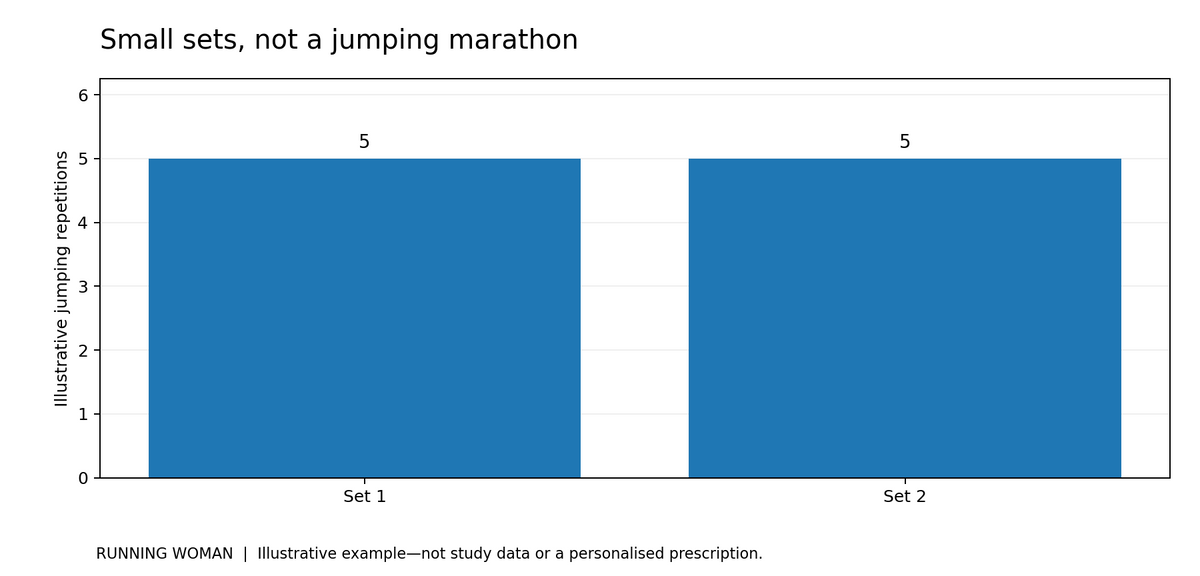
For a runner already comfortable with impact and cleared for it where necessary, one modest introduction is two sets of five small two-footed jumps, with each landing controlled and a pause to reset. Rest for at least a comfortable minute between sets, longer if needed.
Warm up with familiar easy movement first. The jumping itself contains only ten repetitions; the point is to explore a small, manageable dose, not to fill twenty minutes.
This is not suitable for everybody and is not a rehabilitation prescription. Someone not ready for jumping can use familiar non-jumping strength movements instead. There is no need to progress immediately to a continuous bouncing version.
A familiar-runner example
A runner who already tolerates jumping and has appropriate coaching might use two sets of five low continuous two-footed jumps and two sets of five small forward jumps, resting generously between sets.
That gives twenty jumping repetitions in total. Keep the movements small enough to remain controlled and stop before tiredness changes the pattern. If quality is not there, reduce the number or return to the simpler version.
The exact contact count is an illustration, not an evidence-based universal starting dose. Advanced single-leg, bounding and drop-jump programmes need choices based on the individual rather than a progression ladder everyone is expected to climb.
Where it fits in a week
Treat jumps as training load, even when they take only a few minutes. They are not free because your watch records little distance.
A small familiar dose may sit near the beginning of a strength or skills session, after preparation and before fatigue makes control difficult. Leave room in the running week to see how you respond.
Do not add plyometrics, hill sprints and a new heavy lifting routine simultaneously. Keeping one new element at a time makes it easier to judge what is manageable and what needs changing.
A runner with limited training time may reasonably prioritise ordinary running and a simple strength routine. Optional methods should not crowd out the basics they are supposed to support.
When in the training cycle?
Use a stable training period to introduce the method. Repeat a modest familiar dose before deciding that more is needed.
Near a race, familiarity matters more than novelty. This is not the week to discover how demanding twenty drop jumps can be. During a difficult week, removing the jumping component can be a straightforward way to simplify the plan.
Returning after a break also calls for a fresh look at the dose. Previously completing a workout is not a permanent guarantee that it still fits today.
Common questions
Do I need a box? No. Floor-level movements can be enough for an introduction. Height is not a measure of training wisdom.
Should I land silently? A quiet, controlled landing can be a coaching cue, but no single cue should override your comfort or individual movement guidance.
What if impact causes pain or pelvic-floor symptoms? Stop and seek advice from an appropriately qualified clinician, including a pelvic-health physiotherapist where relevant. Do not treat symptoms as something to earn your way through.
Is this essential for every runner? No. It is a possible supporting method, not a requirement for being a committed runner.
Small, well-chosen work is allowed to stay small. The floor does not award bonus points for ambition.
Keep exploring
- Strength training for runners: useful work that does not need to take over your life
- Sprint training for distance runners: quick feet, full recovery, careful choices
- Strides: a small dose of quicker running, not a secret sprint workout
Sources and further reading
This guide is general education for adults, not an individual medical, rehabilitation or pregnancy/postpartum training plan. Seek qualified advice when symptoms, a health condition or a return from injury make exercise decisions uncertain.
-
Llanos-Lagos C, Ramirez-Campillo R, Moran J, Sáez de Villarreal E (2024). Effect of Strength Training Programs in Middle- and Long-Distance Runners’ Economy at Different Running Speeds: A Systematic Review with Meta-analysis. Sports Medicine. DOI:
10.1007/s40279-023-01978-y. ↩︎ -
Blagrove RC, Howatson G, Hayes PR (2018). Effects of Strength Training on the Physiological Determinants of Middle- and Long-Distance Running Performance: A Systematic Review. Sports Medicine. DOI:
10.1007/s40279-017-0835-7. ↩︎ -
Haugen T, Seiler S, Sandbakk Ø, Tønnessen E (2019). The Training and Development of Elite Sprint Performance: an Integration of Scientific and Best Practice Literature. Sports Medicine – Open. DOI:
10.1186/s40798-019-0221-0. ↩︎