
Sometimes the best way to support your running is to do something that is not running. That might be a bike ride, a swim, an elliptical session or some deep-water running. It might also be a day off rather than any of those things.
The trick is knowing which problem you are trying to solve. Cross-training is a tool, not a requirement to stay busy whenever you are not in trainers.
The highlights
- Choose the activity for its purpose: variety, aerobic work or an individually agreed substitute.
- Lower-impact does not mean zero effort, zero fatigue or appropriate for every injury.
- There is no universal conversion from cycling or pool minutes to running kilometres.
At a glance
Main purpose: Add variety or substitute some running with another form of exercise while managing the overall workload.
Effort: Depends on the chosen activity; a hard bike session is still hard training.
Where it fits: Usually replaces an outing or fills an agreed supporting role, rather than automatically adding more.
When in a training cycle: Useful during stable training, busy periods and individually managed return-to-running plans.
The examples below are original coaching illustrations, not protocols tested in the cited studies or personalised prescriptions. Effort numbers use an informal 0–10 guide, not a laboratory zone conversion. Choose an option within your current capacity; you never have to progress because a calendar says so.
What does cross-training mean here?
In this guide, it means using another exercise mode to support a running routine. Cycling, swimming, an elliptical trainer and deep-water running are common examples.
Strength training is also a form of complementary training, but it has its own guide because its aims and session design differ from an aerobic bike or pool workout.
A cross-training session should have a named purpose. Are you replacing an easy run, seeking some variety, or following a clinician’s plan while running is limited? Those are different situations and may call for different choices.
What can it be used for?
It can provide exercise on a day when a different movement suits your circumstances better. It may also be a practical way to maintain a routine when your usual running setting is unavailable.
The important distinction is between changing the movement and removing the workload. A demanding indoor cycling class can be a substantial session, even though your running log stays empty.
Do not count every non-running activity as recovery. Start with what the session asks of you, not which shoes it requires.
What does the research say?
A systematic review of deep-water running included 11 trials and 287 participants across varied healthy and clinical groups. The authors concluded:
“DWR appears to be comparable to land-based training for improving CRF.” — Kwok and colleagues, 2022.[1]
DWR means deep-water running; CRF means cardiorespiratory fitness. The studies were too heterogeneous for a pooled meta-analysis. This is encouraging evidence for an option, not proof that every pool workout can replace a specific road session or that all injuries respond similarly.
Separate research on maintaining physical performance suggests reduced training doses can preserve some adaptations in certain circumstances.[2] Maintenance and improvement are different goals, and neither finding says that every spare day needs another workout.
What cross-training cannot promise
Running includes the particular demands of moving on land. A bike or pool session does not reproduce the whole experience of a long road run, a technical descent or race-day footwear.
Laboratory interval research has often used cycling.[3] Its findings should not be treated as a precise recipe for how much running to replace, especially when the reason for the change is pain or injury.
A sensible plan may combine different movements while preserving enough relevant running for the goal. The balance is individual; this article does not offer a universal miles-to-minutes exchange rate.
Choosing an activity
Start with something you can do safely and comfortably. An activity that requires unfamiliar technique may need instruction before it becomes a useful training substitute.
For cycling, select an appropriate setting and bike setup. For swimming or deep-water running, use a supervised pool environment and seek instruction if water confidence or technique is uncertain. Pool running is not an invitation to practise alone in open water.
Existing symptoms matter. An activity being described as lower-impact does not establish that it suits your particular injury. Let the professional overseeing a rehabilitation plan help choose the movement and dose.
A gentle introductory session
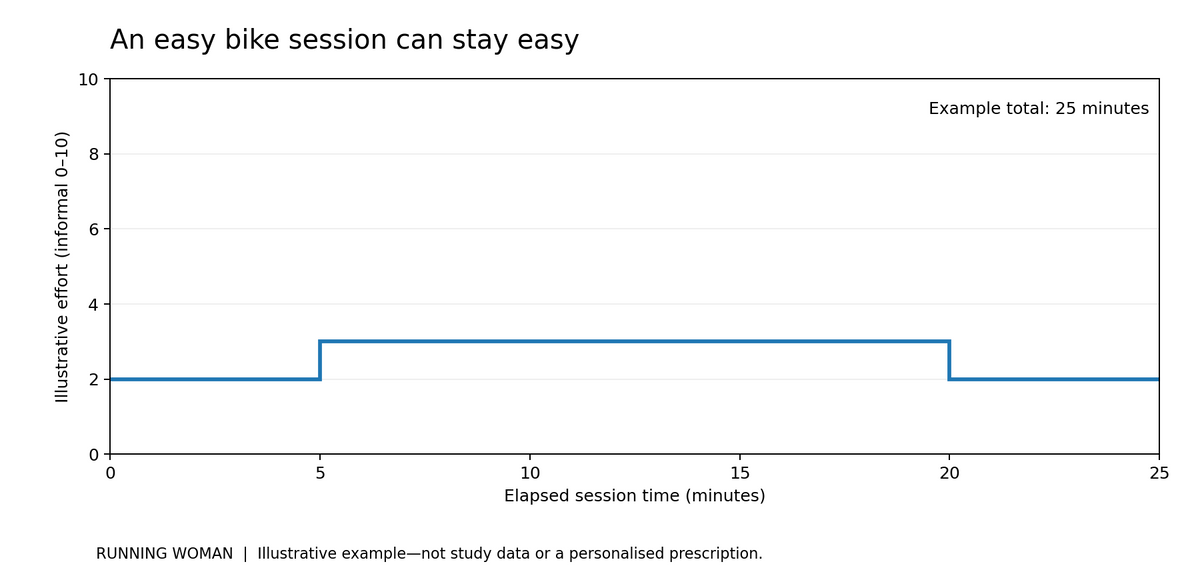
For someone comfortable on a stationary bike, 25 minutes might comprise 5 minutes very easy pedalling, 15 comfortable minutes, then 5 very easy minutes.
Keep the resistance manageable and the purpose easy. Stop or change the setting if the movement is uncomfortable. A beginner in the activity may need a shorter session than their running fitness would suggest.
For a pool alternative, begin with familiarisation and instruction rather than treating a timed prescription as more important than confidence in the water. Using the right environment is part of the session, not an optional extra.
An established-runner example
A familiar cyclist might replace an easy run with 40 comfortable minutes: 5 minutes easy, 30 minutes at a conversational effort and 5 minutes easy.
There is no claim that this equals a particular running distance. Log the activity, duration and perceived effort separately so you can see the whole week honestly.
If a coach deliberately prescribes harder cross-training, count it as a harder session. Do not place a demanding bike workout between intervals and a hard long run and still describe the day as recovery.
Where it fits in a week
On a three-run routine, you might replace one easy outing with a gentle bike session when that suits the week. Another runner may keep all three runs and use occasional short cross-training, but that is an addition to the workload, not a neutral swap.
Begin by replacing rather than adding when your purpose is to reduce running load. Keep at least some genuinely undemanding time in the week.
A runner following a return-to-running plan should distinguish the prescribed running exposure from the allowed supporting activity. Feeling fit in the pool does not automatically mean the next run should become longer.
When in a training cycle?
Cross-training can fit throughout the year, especially when it supports a routine you can sustain. During event preparation, consider how much event-specific practice remains after substitutions.
Near a race, familiar sessions are usually easier to manage than a completely new sport. During an illness or injury, first decide whether exercise is appropriate at all; substituting another movement is not always the right response.
In a busy life period, maintenance can be a reasonable aim. You are allowed to choose a smaller routine rather than compensate for every missed run with something equally demanding.
Common questions
Can I use my running heart-rate targets on the bike or in the pool? Do not assume they transfer exactly. Exercise mode and the aquatic environment can change the response.[1:1] Use suitable guidance for the activity.
Is walking cross-training? It can be a useful different activity, but decide whether today needs ordinary movement or genuine rest rather than chasing another label.
Does it still count if I enjoy it more than the run I replaced? Certainly. Enjoyment is not a sign that you have accidentally stopped training properly.
Keep exploring
- Recovery runs: when a gentle jog helps—and when rest is better
- Strength training for runners: useful work that does not need to take over your life
- Rest days and cutback weeks: the parts of training that do not need a GPS trace
Sources and further reading
This guide is general education for adults, not an individual medical, rehabilitation or pregnancy/postpartum training plan. Seek qualified advice when symptoms, a health condition or a return from injury make exercise decisions uncertain.
-
Kwok MMY, So BCL, Heywood S, Lai MCY, Ng SSM (2022). Effectiveness of Deep Water Running on Improving Cardiorespiratory Fitness, Physical Function and Quality of Life: A Systematic Review. International Journal of Environmental Research and Public Health. DOI:
10.3390/ijerph19159434. ↩︎ ↩︎ -
Spiering BA, Mujika I, Sharp MA, Foulis SA (2021). Maintaining Physical Performance: The Minimal Dose of Exercise Needed to Preserve Endurance and Strength Over Time. Journal of Strength and Conditioning Research. DOI:
10.1519/JSC.0000000000003964. ↩︎ -
Gibala MJ, Little JP, MacDonald MJ, Hawley JA (2012). Physiological adaptations to low-volume, high-intensity interval training in health and disease. The Journal of Physiology. DOI:
10.1113/jphysiol.2011.224725. ↩︎