
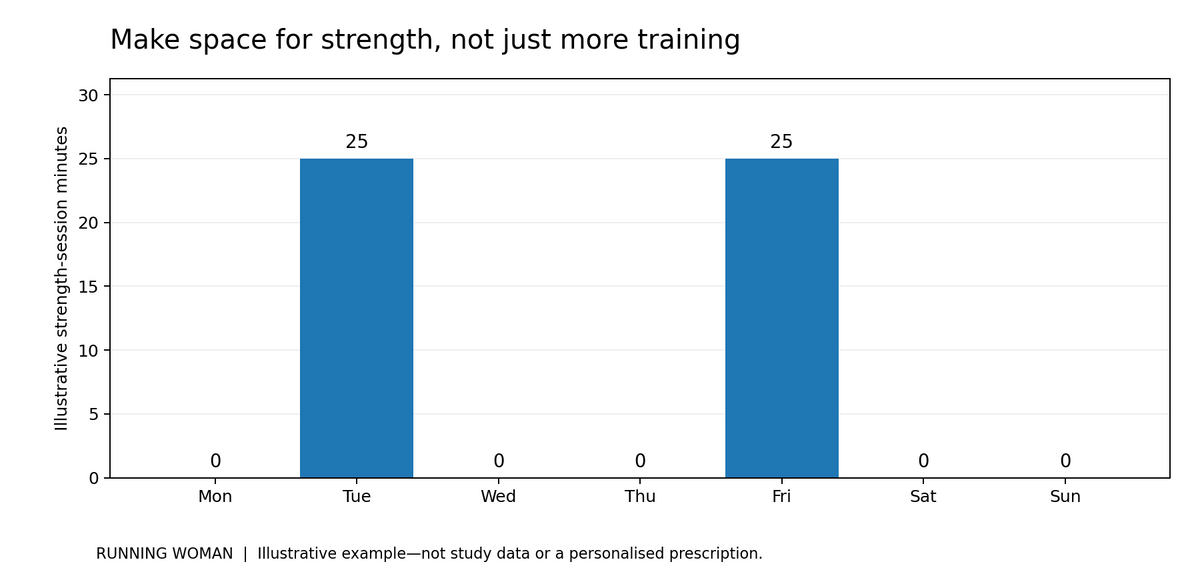
Strength training does not need to become a second full-time hobby. A few well-chosen movements, practised regularly, can be a more useful starting point than an elaborate circuit saved on your phone and never actually attempted.
For runners, the aim is not to leave the gym unable to sit down. It is to build useful strength alongside the running you enjoy.
The highlights
- Research supports strength training as a potential way to improve running economy and performance.
- Better economy is not the same as an identical percentage improvement in race time.
- Begin with manageable exercises and leave room in the week for the new demand.
At a glance
Main purpose: Build strength that supports running performance and everyday physical capability.
Effort: Controlled muscular effort; start with technique and manageable resistance.
Where it fits: One introductory session, then potentially two familiar sessions within a manageable week.
When in a training cycle: Introduce during a stable period; maintain familiar work rather than chasing soreness near races.
The examples below are original coaching illustrations, not protocols tested in the cited studies or personalised prescriptions. Effort numbers use an informal 0–10 guide, not a laboratory zone conversion. Choose an option within your current capacity; you never have to progress because a calendar says so.
What counts as strength training?
It means working against resistance to develop muscular strength. That resistance might come from body weight, a machine, a dumbbell, a barbell or another suitable tool.
A demanding resistance session and a fast circuit that mainly leaves you breathless are not necessarily the same thing. Both may be exercise, but the label should match the purpose. If your aim is controlled strength work, rushing through repetitions to win the circuit can work against it.
For this guide, begin with movements you can perform confidently and a resistance you can control. Heavier training may become appropriate later; it is not a first-session entrance requirement.
What is it used for in running?
The running-specific aim is to support performance through strength and movement capacity, rather than trying to replace running altogether.
A 2018 systematic review of 24 studies found that adding strength training often improved running economy, with reported improvements commonly around 2–8%. Running economy is the energy or oxygen cost of running at a given speed, not a direct promise of equivalent race-time gains. The authors qualified the results:
“although this was not always the case” — Blagrove and colleagues, 2018.[1]
That small qualification matters. The effect depends on the programme and runner; a gym membership alone is not the intervention.
What does newer research add?
A later meta-analysis examined different strength methods and running speeds. Its findings supported potential economy benefits, while rating the certainty of the evidence as moderate to low.[2]
The sensible conclusion is that strength work deserves a place among useful options. It is not proof that one exercise is indispensable, that every runner should lift maximally, or that a generic routine prevents every running injury.
For someone new to resistance training, learning the movements and establishing a repeatable routine are practical starting goals. The heavier protocols in research should not be copied without considering your experience.
What might a simple session include?
Think in movement families rather than collecting exercises: a squat or sit-to-stand, a hip-hinge movement, a step or split-stance movement, calf work and an upper-body push or pull.
Choose versions that suit your equipment and current ability. A controlled sit-to-stand and supported calf raise are perfectly legitimate starting exercises. A coach or physiotherapist can help select alternatives when pain, balance or previous injury complicates the choice.
You do not need to perform every possible variation. Keep the menu short enough that you can remember how the exercises felt and whether the resistance was appropriate.
An introductory example
Allow about 20–25 minutes, rather than treating the clock as a target. Begin with several minutes of comfortable movement and easy practice repetitions.
Then perform one controlled set of five suitable movements: sit-to-stand, supported hip hinge, low step-up, supported calf raise and a wall push-up or supported row. Start around 6–8 comfortable repetitions per movement; for a single-leg exercise, that means per side. Rest as needed.
Stop each set while you could still do several good repetitions. The exact number is less important than control and an appropriate level of difficulty. This is an original introductory example, not a tested treatment or a requirement to complete every exercise.
An established-runner example
A runner familiar with resistance exercise might use two sets of a squat variation, hip hinge, split squat or step-up, calf raise and row. Select a manageable repetition range—perhaps 6–10 for the main movements—and leave roughly two or three good repetitions available at the end of a set.
Allow about 30–40 minutes, including preparation and unrushed rests. Add resistance only when the current version is well controlled and the whole week remains manageable. Seeking individual coaching is particularly useful before moving into genuinely heavy lifting.
A session is not unsuccessful because it does not produce dramatic soreness. Record the movement, resistance and repetitions; that is more useful than recording how difficult the stairs felt afterwards.
Where it fits in a running week
Start by finding room for one session, not by dropping two demanding workouts into a full schedule. Once familiar, a second session may fit, but it should be a deliberate choice.
On a three-run week, you might run easily on Tuesday, complete a purposeful run on Thursday and a longer easy outing on Sunday. A short strength session could sit after Tuesday’s run or on a separate suitable day. Its placement should leave you able to approach the important run sensibly.
Combining running and strength on one day can preserve another day without training, but it also creates a larger day. There is no universal arrangement that solves every job, school-run and recovery constraint.
When in a training cycle?
Introduce unfamiliar strength work during a stable period, when you can judge its effect without simultaneously increasing running distance or intensity.
Once the exercises are familiar, maintaining a manageable amount may be more practical than continually adding new variations. Research on reduced-dose training distinguishes maintaining adaptations from maximising improvement.[3] It does not mean training hard through illness or injury.
Near an important race, avoid experimenting with a new demanding routine. Familiar, reduced work and arriving comfortable are more useful priorities than one last attempt to become dramatically stronger.
Common questions
Can I start at home? Yes, with suitable movements and enough space to use the equipment safely. Your first goal can be learning and consistency rather than buying more kit.
Should every set be to failure? That is not the default in this guide. Keep the technique controlled and end the set before it deteriorates.
What if something hurts? Stop the provoking exercise and seek appropriate guidance if pain persists or the choice of movement is uncertain. Pain is not proof that you have found a weakness worth attacking.
Must I love it? No. It is fine to choose a simple routine you tolerate because it supports the running you love. Useful does not have to mean all-consuming.
Keep exploring
- Plyometric training: small jumps, careful landings and no need for a giant box
- Rest days and cutback weeks: the parts of training that do not need a GPS trace
- Base-building: making running fit before making it harder
Sources and further reading
This guide is general education for adults, not an individual medical, rehabilitation or pregnancy/postpartum training plan. Seek qualified advice when symptoms, a health condition or a return from injury make exercise decisions uncertain.
-
Blagrove RC, Howatson G, Hayes PR (2018). Effects of Strength Training on the Physiological Determinants of Middle- and Long-Distance Running Performance: A Systematic Review. Sports Medicine. DOI:
10.1007/s40279-017-0835-7. ↩︎ -
Llanos-Lagos C, Ramirez-Campillo R, Moran J, Sáez de Villarreal E (2024). Effect of Strength Training Programs in Middle- and Long-Distance Runners’ Economy at Different Running Speeds: A Systematic Review with Meta-analysis. Sports Medicine. DOI:
10.1007/s40279-023-01978-y. ↩︎ -
Spiering BA, Mujika I, Sharp MA, Foulis SA (2021). Maintaining Physical Performance: The Minimal Dose of Exercise Needed to Preserve Endurance and Strength Over Time. Journal of Strength and Conditioning Research. DOI:
10.1519/JSC.0000000000003964. ↩︎