
A recovery run should not need recovering from. It sounds obvious, but this is the session most easily hijacked by a watch, a running streak or a friend who says she is taking it easy and then disappears up the road.
There is a place for a very gentle jog. There is also a place for putting the kettle on and not running at all. The trick is choosing the option that supports the rest of your week.
The highlights
- A recovery run is shorter and gentler than your usual easy run, not an extra workout in disguise.
- Feeling less stiff afterwards is not proof that muscle repair happened faster.
- Rest, walking and a short jog are different options; none needs to be earned.
At a glance
Main purpose: Keep a familiar running rhythm on a low-demand day without adding another substantial training challenge.
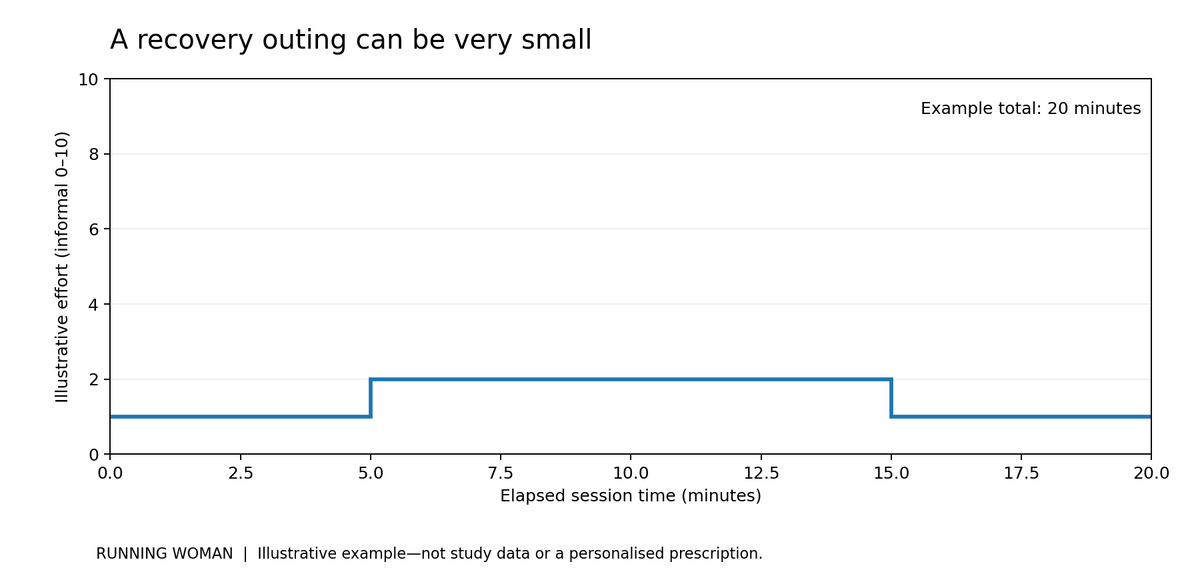
Effort: Very comfortable; roughly 1–3 out of 10, with no pace target.
Where it fits: An optional short outing after a demanding day, usually replacing rather than adding mileage.
When in a training cycle: Throughout training when tolerated; not a compulsory post-race ritual.
The examples below are original coaching illustrations, not protocols tested in the cited studies or personalised prescriptions. Effort numbers use an informal 0–10 guide, not a laboratory zone conversion. Choose an option within your current capacity; you never have to progress because a calendar says so.
What is a recovery run?
Coaches generally use the term for a short, low-intensity run on a day when keeping demand down is the priority. Unlike a normal easy run, its duration is deliberately restrained. Unlike a long run, it is not intended to extend your endurance.
The name can be misleading. Running still asks your body to do work. Calling it recovery does not make that work disappear. If the outing becomes an hour, includes several hills or finishes with a hard kilometre, it may no longer serve the role you intended.
Here we use recovery run as a coaching label, not a claim that a particular jogging protocol has been proven to repair yesterday’s training damage.
What might it be useful for?
An established runner may like the familiar movement, the fresh air or the chance to check how her legs feel without asking much of them. A very short outing can preserve a routine while keeping the day lighter than a standard session.
Those are reasonable personal reasons. They are not reasons to prescribe the same outing to someone new to running, someone with pain, or someone exhausted after a race. When you run only two or three times a week, your non-running days already offer space between sessions. You do not need to fill them with recovery miles.
Does it actually speed recovery?
Van Hooren and Peake’s review found that active cool-downs generally:
“do not significantly reduce muscle soreness”
— Van Hooren and Peake, 2018.[1]
Crucially, that review mainly concerns activity soon after exercise, not a jog the following morning. It therefore cannot settle the separate question of next-day recovery runs. It does, however, challenge confident claims that light movement automatically accelerates all aspects of recovery.
The same review distinguishes faster clearance of blood lactate from meaningful recovery benefits.[1:1] “Flushing out yesterday’s lactic acid” is not a sound reason to force a run today. Feeling looser can be pleasant without proving that you have restored full readiness.
Our practical interpretation is to judge the outing by its cost and usefulness for you, rather than by the reassuring word in its title.
Run, walk or rest?
Before leaving, ask three things. Is ordinary movement comfortable? Is your tiredness within the familiar range after this sort of training? Would a short outing fit without stealing sleep or making the day more stressful?
A yes is not medical clearance, but it can help you make a sensible everyday decision. Sharp or localised pain, a limp, dizziness, illness or unusually heavy fatigue changes the question: do not use running as a test of whether you can push through. Stop and seek appropriate advice when symptoms warrant it.
Sleep deserves a seat at this table. An athlete-sleep consensus recommends individualised attention to sleep needs, rather than assuming one fixed target suits everyone.[2] Our application: a recovery jog that means cutting an already short night even shorter is rarely the first thing to prioritise.
Two deliberately small examples
The walking option: 20 minutes. Take a comfortable walk with no distance target. Turn back earlier when that is enough. This is not a “failed” version of the running example; it is a different choice.
A short recovery run: 20 minutes. Walk for 5 minutes, jog very gently for 10, then walk for 5. Use a flat route close to home so there is no obligation to complete a distant loop. An established runner accustomed to more frequent running might instead choose 15–25 continuous gentle minutes, but that is an adaptation, not a universal upgrade.
Keep conversation easy. The talk-test literature supports comfortable speech as an intensity cue, not an exact measure of recovery status.[3] You should not need to watch the clock to see how much suffering remains.
Where it fits in a routine
Suppose Tuesday is your main interval session and Sunday is your longer run. An established four-day runner might use Wednesday for a short recovery outing and Friday for normal easy running. A three-day runner might simply rest on Wednesday and run easy on Thursday or Friday instead.
The difference is training history and available capacity, not commitment. Do not bolt a fourth run onto a three-run week because you have heard that recovery running is what serious runners do.
After a particularly long event, a painful downhill outing or unfamiliar strength work, the appropriate break can be longer. There is no universal rule that the day after a marathon should contain running. Follow a return plan suited to the event and your symptoms.
Keeping it honest
Choose a route without tempting segments. Avoid arranging the outing with someone whose easy effort is much faster than yours. Decide on a modest time limit before leaving, and retain permission to shorten it.
When the legs begin to feel better, resist interpreting that as an invitation to turn the run into a steady session. You set aside the day for a reason. The goal is not to prove how much you can do once you are warmed up.
Also look at the pattern afterwards. Does a recovery jog usually leave the next planned run feeling normal, or do you repeatedly feel more drained? That personal observation is useful for deciding whether the habit deserves a place in your week; it is not a diagnostic test.
Frequently asked questions
Can a recovery run be too slow? There is no required running speed. When very slow jogging feels awkward or effortful, walking may be the clearer choice. Keep the purpose rather than defending the label.
Should I add strides to it? Not by default. Strides are a separate, faster-running stimulus. Put them on an appropriate day when you feel fresh rather than quietly making your lightest run more demanding.
A recovery day is successful when it supports what comes next—and your life outside running. Sometimes the best session is the one you sensibly leave out.
Keep exploring
- Easy runs: the everyday miles that deserve more credit
- Rest days and cutback weeks: the parts of training that do not need a GPS trace
- Cross-training for runners: keeping the purpose, changing the movement
Sources and further reading
This guide is general education for adults, not an individual medical, rehabilitation or pregnancy/postpartum training plan. Seek qualified advice when symptoms, a health condition or a return from injury make exercise decisions uncertain.
-
Van Hooren B, Peake JM (2018). Do We Need a Cool-Down After Exercise? A Narrative Review of the Psychophysiological Effects and the Effects on Performance, Injuries and the Long-Term Adaptive Response. Sports Medicine. DOI:
10.1007/s40279-018-0916-2. ↩︎ ↩︎ -
Walsh NP et al. (2021). Sleep and the athlete: narrative review and 2021 expert consensus recommendations. British Journal of Sports Medicine. DOI:
10.1136/bjsports-2020-102025. ↩︎ -
Reed JL, Pipe AL (2014). The talk test: a useful tool for prescribing and monitoring exercise intensity. Current Opinion in Cardiology. DOI:
10.1097/HCO.0000000000000097. ↩︎