
Intervals can sound like something that happens to people in spikes while somebody shouts from the middle of a track. They can be much simpler: run a controlled harder section, recover, repeat an appropriate number of times.
The recovery is not an embarrassing pause between the important bits. It is one of the important bits. And despite what the word speedwork suggests, most distance-running intervals are not all-out sprints.
The highlights
- Interval describes a work-and-recovery format; the work can have several different purposes.
- A repeatable first repetition is more useful than a spectacular one you cannot reproduce.
- Warm-up, recoveries and cool-down all count towards the session’s total time.
At a glance
Main purpose: Practise repeated higher-intensity running with recoveries that make the planned work manageable.
Effort: Hard but repeatable for the aerobic examples here; roughly 7–8 out of 10.
Where it fits: Usually one quality-session slot; alternatives include tempo, hills or fartlek.
When in a training cycle: After consistent easy running, often in 5K–10K or broader race preparation.
The examples below are original coaching illustrations, not protocols tested in the cited studies or personalised prescriptions. Effort numbers use an informal 0–10 guide, not a laboratory zone conversion. Choose an option within your current capacity; you never have to progress because a calendar says so.
What counts as an interval session?
An interval session alternates work periods with planned recovery. In this article, the examples use relatively hard aerobic running, with easy jogging or walking between repetitions. Threshold intervals and very short sprints are related formats, but they are different sessions and have separate guides.
Buchheit and Laursen describe high-intensity interval training as involving:
“repeated short-to-long bouts”
— Buchheit and Laursen, 2013.[1]
Their review highlights that work intensity, duration, recovery and the number of repetitions all affect the response. “Six intervals” therefore tells you almost nothing without the rest of the prescription.
A set of six one-minute efforts differs from six five-minute efforts. Six one-minute efforts with generous recovery also differs from the same work with a few hurried seconds between repetitions. More compressed does not automatically mean better.
What is interval training used for?
Harder aerobic intervals are used to develop the capacity to sustain higher-intensity running and to rehearse the effort associated with shorter distance races. They allow that work to be divided into manageable pieces rather than attempted as one continuous maximum effort.[1:1]
Reviews of interval-training physiology show that useful adaptations can occur with several formats, although much laboratory work uses cycling rather than running.[2] That matters: a successful bike protocol is not automatically a safe prescription for repeated running sprints.
Our practical interpretation is to choose a session you can execute well within your existing routine. The goal is not to find the most exhausting possible combination of speed and short rests.
VO2 max intervals: useful label, imperfect shortcut
VO2 max describes maximal oxygen uptake. Sessions described as VO2 max intervals aim to challenge high aerobic output, but a watch estimate or a hard effort is not direct measurement of oxygen uptake.[1:2]
Do not assume you must hit a particular heart rate immediately or spend an exact number of seconds above a watch threshold. The simple field target in these examples is controlled, repeatable hard running. A coach or laboratory assessment can individualise more precise targets where appropriate.
Breathing should be clearly harder than during easy running, but you should not be sprinting from the first step. The last repetition can require concentration without demanding a desperate final surge.
Two workable starting points
A modest introduction for an established runner: 32 minutes. Run easily for 10 minutes. Complete 4 × 1 minute at a controlled harder effort, with 2 minutes of easy walking or jogging between repetitions. Finish with 12 easy minutes. There are three between-repetition recoveries: 10 + 4 + 6 + 12 = 32 minutes.
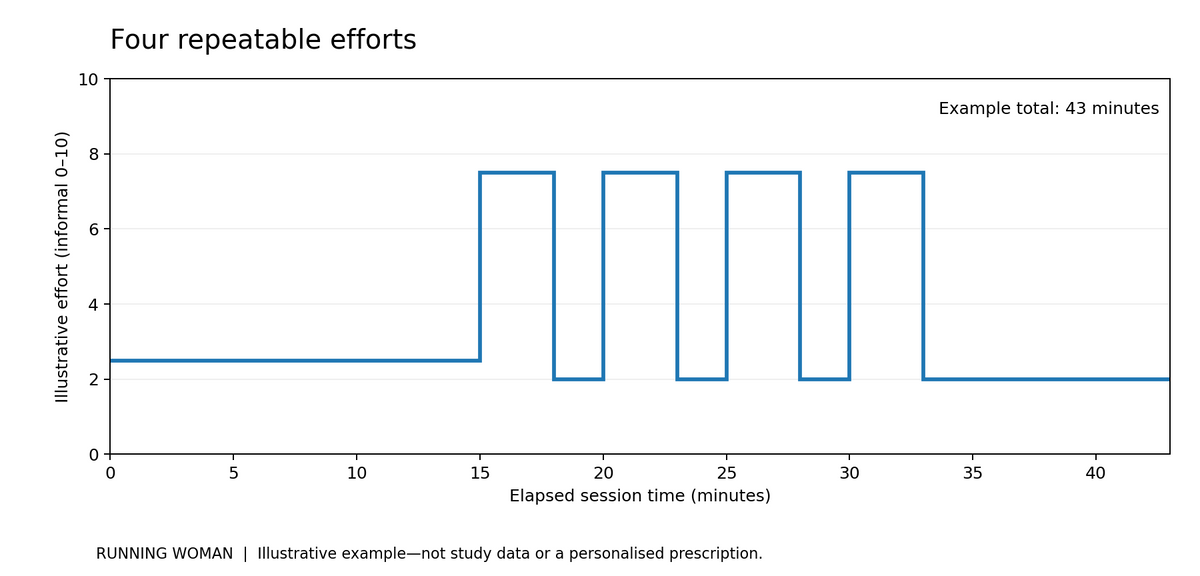
A familiar aerobic-interval format: 43 minutes. Warm up for 15 minutes. Complete 4 × 3 minutes of hard but repeatable running, with 2 minutes of easy recovery between repetitions. Finish with 10 easy minutes. The total is 15 + 12 + 6 + 10 = 43 minutes.
These are different doses, not consecutive instructions. Before selecting the second, the total duration and harder-running volume should already fit your experience. A complete beginner can alternate easy running with walking instead; faster intervals can wait.
If you need extra warm-up or recovery, take it and update the session total. The arithmetic is there for planning, not to prevent sensible adjustments.
How to run the recoveries
Use a very easy jog or walk. You do not have to earn the next repetition by refusing to walk. The recovery should serve the next piece of work, not become a second contest.
If you are repeatedly unable to regain enough control, slow the work or end the set. Avoid “saving” the session by sprinting the final repetition. Ending after three good repetitions can be more appropriate than completing four deteriorating ones.
Warm up on safe ground, then use a route with enough space to accelerate and slow gradually. A track is convenient, but a flat traffic-free path can work. Busy crossings and unpredictable foot traffic are poor companions for time-based efforts.
Where it fits in a week
For an established three-run routine, consider easy running on Tuesday, intervals on Thursday and a familiar conversational longer run on Sunday. If extending the long run is already the big challenge, keep Thursday easy instead.
Do not place intervals, threshold work, hills and a hard parkrun in the same week just because they sound different. They compete for the same limited capacity to recover. More frequent runners may tolerate more demanding sessions, but this library is not prescribing that automatically.
Strength work also belongs in the overall picture. A new or demanding lower-body gym session is not invisible because it was not recorded as a run.
Where it fits across a training cycle
Build consistency first. Fartlek or short controlled pickups may be a gentler introduction to changing pace. More structured intervals can then serve a defined race-preparation purpose rather than appearing throughout the year at maximum dose.
Near an event, a smaller amount of familiar faster running may remain while overall volume falls. Taper research supports that general distinction, not keeping a full hard session unchanged until race day.[3]
Ladders, pyramids and famous workouts
A ladder changes repetition length in one direction; a pyramid builds up and then comes back down. A 30/30 session alternates thirty seconds of work with thirty seconds of recovery. These are ways to arrange intervals, not separate physiological superpowers.
Likewise, named workouts such as kilometre repetitions or 800-metre sets need an appropriate pace, recovery and total dose. Completing a celebrated session does not reliably predict a race result on its own.
The useful question is not “Did I suffer enough?” It is “Did I complete the intended work with control, and can the rest of my training still function?”
Keep exploring
- Fartlek training: a little speed play for your running week
- Cruise intervals: threshold training with a little breathing room
- Hill repeats: making friends with the uphill bits
Sources and further reading
This guide is general education for adults, not an individual medical, rehabilitation or pregnancy/postpartum training plan. Seek qualified advice when symptoms, a health condition or a return from injury make exercise decisions uncertain.
-
Buchheit M, Laursen PB (2013). High-intensity interval training, solutions to the programming puzzle: Part I: cardiopulmonary emphasis. Sports Medicine. DOI:
10.1007/s40279-013-0029-x. ↩︎ ↩︎ ↩︎ -
Gibala MJ, Little JP, MacDonald MJ, Hawley JA (2012). Physiological adaptations to low-volume, high-intensity interval training in health and disease. The Journal of Physiology. DOI:
10.1113/jphysiol.2011.224725. ↩︎ -
Wang Z, Wang YT, Gao W, Zhong Y (2023). Effects of tapering on performance in endurance athletes: A systematic review and meta-analysis. PLOS ONE. DOI:
10.1371/journal.pone.0282838. ↩︎