
Strides are little changes of gear, not tiny races. You build speed smoothly, spend a brief moment running quickly but comfortably, then ease down again. After that, you take your time before doing another.
They can be a lovely introduction to feeling a bit more spring in your running. They can also go wrong when a few relaxed accelerations quietly become repeated maximum efforts.
The highlights
- Strides are short, smooth and relaxed—not all-out sprints.
- Take enough recovery that the next one feels coordinated rather than breathless.
- A few strides can complement a suitable easy run, but they are optional and still add load.
At a glance
Main purpose: Practise smooth acceleration and relaxed quicker running in very short, low-volume bouts.
Effort: Quick but relaxed; avoid using heart rate or a fixed perceived-effort number for such short efforts.
Where it fits: A few after an appropriate easy run, or within a warm-up when already familiar.
When in a training cycle: Can be retained in small doses through base and race preparation; optional.
The examples below are original coaching illustrations, not protocols tested in the cited studies or personalised prescriptions. Effort numbers use an informal 0–10 guide, not a laboratory zone conversion. Choose an option within your current capacity; you never have to progress because a calendar says so.
What exactly is a stride?
In coaching language, a stride is a short acceleration into quicker running followed by a gradual slowdown. The whole effort often lasts only several seconds to a few tens of seconds. The exact duration is less important than the controlled shape and small overall dose.
It is not the same as holding a hard pace for several minutes, and it is not a standing-start maximum sprint. Do not worry about achieving a specific top speed. Aim to finish while the movement still feels relaxed.
You may see the terms pickups or accelerations used in a similar way. Always check whether the coach means a relaxed effort or a genuine sprint; those are different demands.
What are strides used for?
The practical coaching purposes are to rehearse changing speed, include a little quicker movement alongside easy running and become comfortable with a faster rhythm without constructing a whole interval session.
A review of elite distance-running practice describes short faster running that often uses gradual acceleration.[1] That documents a practice, not proof that four strides after every easy run produce a specific performance gain in recreational women.
The important distinction is between a useful training convention and an isolated intervention with a precisely established effect. Strides may fit your routine well, but they are not magic, and you do not lose the value of an easy run by leaving them out.
What the wider research adds
Sprint-training literature emphasises recovery sufficient to preserve repetition quality.[2] We apply that principle cautiously here: even though strides are submaximal, there is little point rushing into the next one when you cannot run smoothly.
Strength-training reviews find benefits from several resistance and explosive-training approaches, but they do not establish that strides replace strength work.[3] The resemblance to a quicker movement pattern is not enough to make two training methods equivalent.
Running Woman’s practical takeaway: keep the dose small enough that the purpose remains coordination and controlled speed, rather than chasing fatigue.
How to do one
Begin with easy movement and gradually increase speed. Spend a short spell at a pace that feels quick but unforced, then slow down over several steps. Avoid launching suddenly or braking sharply.
Choose level, predictable ground with room beyond the effort to decelerate. Look ahead rather than at your watch. A smooth path or suitable track is preferable to a busy pavement, slippery grass or a steep downhill.
Let your running action remain recognisably yours. Do not force a forefoot landing, exaggerate knee lift or reach further forward to create speed. This article is not a gait-retraining programme.
Walk or jog very gently until you feel ready to repeat the same quality. When the next effort feels tense or clumsy, finish the set. More is not necessarily the next step.
A first small example
For a runner already comfortable with a 20-minute easy outing, finish that run and add 3 rounds of 10 seconds of smooth quicker running followed by 110 seconds of walking or very easy movement. Then walk for 4 minutes. The total outing is 20 + 6 + 4 = 30 minutes.
Only thirty seconds of that outing is quicker running. That is intentional. The first attempt is an introduction, not an assessment of how much speed you can tolerate.
A beginner still finding easy running demanding can simply keep using easy run–walk. There is no need to add strides yet.
A regular-runner example
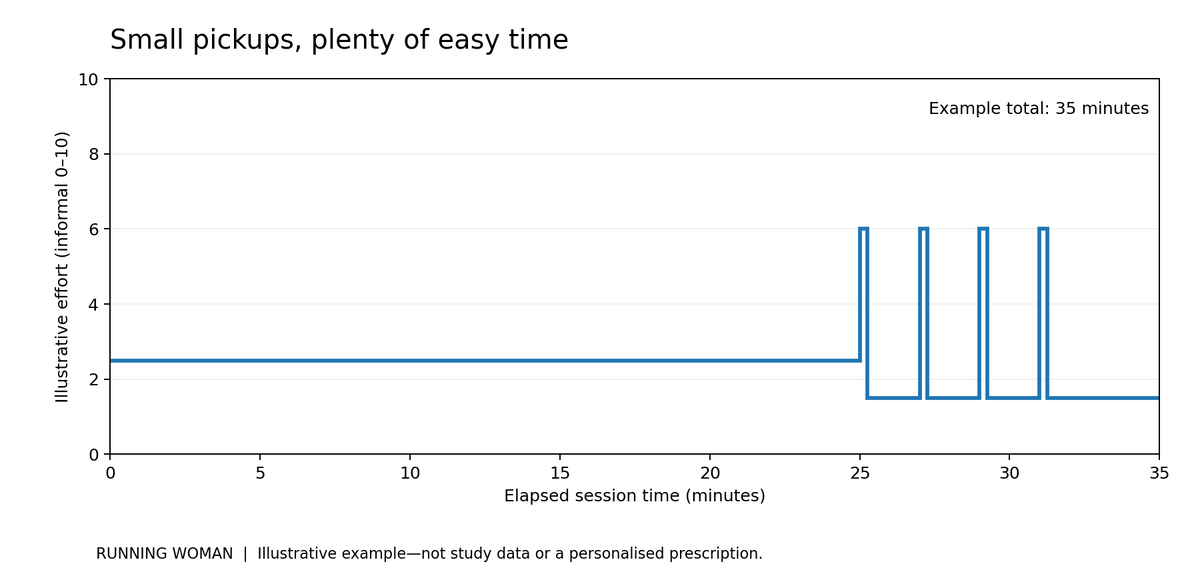
After 25 minutes of easy running, complete 4 rounds of 15 seconds of relaxed quicker running and 105 seconds of easy recovery, then finish with 2 gentle minutes. Total time is 25 + 8 + 2 = 35 minutes.
The full recovery after the last stride is included. If you need longer, take it. The example is not a rule that everyone must be ready again after exactly 105 seconds.
Do not increase speed, number and duration together. You can repeat the same small dose for weeks, or remove it when other training becomes more demanding.
Where they fit in the week
An appropriate place is after an easy run on a day when your legs feel normal and you have enough room in the week for a small faster-running stimulus. For example, an established runner might use Tuesday easy plus a few strides, Thursday easy or a modest workout, and Sunday a familiar longer run.
That is not an instruction to squeeze strides into every outing. Avoid automatically adding them after the longest run, after a hard hill session or on a recovery day when you feel sore.
A familiar handful of strides can also form part of a warm-up for a harder workout. The warm-up literature supports preparing for performance broadly, not a compulsory stride count for every runner.[4]
Where they fit across a training cycle
Strides can introduce a little quicker running during a predominantly easy phase. During race preparation they can remain a small familiar element, rather than escalating alongside every other part of the plan.
Before an event, do only what you have already practised and tolerated. Race week is not the ideal moment to discover that maximum accelerations feel quite different from the relaxed strides you intended.
Common questions
How fast should I run? Fast enough to notice a different rhythm, but not so fast that you tighten up or need to strain. Avoid translating an arbitrary percentage of maximum speed into a false sense of precision.
Do strides count as a hard session? A few relaxed efforts usually have a different overall dose from a full interval workout, but they are still faster running. Their suitability depends on the wider day and week, not only how many seconds they last.
What is the best sign I have done them well? You finish with the movement still feeling smooth. You have practised speed without making exhaustion the objective.
Keep exploring
- Sprint training for distance runners: quick feet, full recovery, careful choices
- Warm-ups and cool-downs: useful bookends, without the recovery myths
- Easy runs: the everyday miles that deserve more credit
Sources and further reading
This guide is general education for adults, not an individual medical, rehabilitation or pregnancy/postpartum training plan. Seek qualified advice when symptoms, a health condition or a return from injury make exercise decisions uncertain.
-
Haugen T, Sandbakk Ø, Seiler S, Tønnessen E (2022). The Training Characteristics of World-Class Distance Runners: An Integration of Scientific Literature and Results-Proven Practice. Sports Medicine – Open. DOI:
10.1186/s40798-022-00438-7. ↩︎ -
Haugen T, Seiler S, Sandbakk Ø, Tønnessen E (2019). The Training and Development of Elite Sprint Performance: an Integration of Scientific and Best Practice Literature. Sports Medicine – Open. DOI:
10.1186/s40798-019-0221-0. ↩︎ -
Blagrove RC, Howatson G, Hayes PR (2018). Effects of Strength Training on the Physiological Determinants of Middle- and Long-Distance Running Performance: A Systematic Review. Sports Medicine. DOI:
10.1007/s40279-017-0835-7. ↩︎ -
Fradkin AJ, Zazryn TR, Smoliga JM (2010). Effects of warming-up on physical performance: a systematic review with meta-analysis. Journal of Strength and Conditioning Research. DOI:
10.1519/JSC.0b013e3181c643a0. ↩︎