
A time trial can tell you something useful about your running. It cannot tell you whether you are a good person, whether last month was worthwhile or whether you are allowed to feel proud of yourself.
Used occasionally, testing helps you make decisions. Used constantly, it can turn every familiar route into a place where you wait for a verdict.
The highlights
- A time trial tests a defined task; a practice race can also rehearse logistics and pacing.
- A hard test belongs in the training load and replaces another demanding session.
- Comparable conditions and a clear question matter more than testing as often as possible.
At a glance
Main purpose: Assess current performance or rehearse event decisions without confusing testing with everyday training.
Effort: A hard test is demanding; an easy benchmark is deliberately not a race.
Where it fits: Replaces a purposeful session and needs appropriate space around it.
When in a training cycle: Occasionally when the information serves a decision, not automatically every week.
The examples below are original coaching illustrations, not protocols tested in the cited studies or personalised prescriptions. Effort numbers use an informal 0–10 guide, not a laboratory zone conversion. Choose an option within your current capacity; you never have to progress because a calendar says so.
What is a time trial?
It is an attempt at a defined performance task: covering a known distance as well as you appropriately can, or covering distance within a fixed period.
A practice race adds the setting of an event. You might run it hard to assess current performance, or deliberately control it to rehearse the approach for another event. Be honest about which purpose you choose.
An easy benchmark is different again. Repeating a comfortable route and noting effort can provide information without turning it into a race. A beginner does not need maximal testing to have a meaningful training record.
What is it used for?
A test can help answer a specific question: is the planned race approach realistic, have you learned to start more evenly, or does a familiar effort feel more manageable than it did previously?
An event rehearsal can answer practical questions too. Did the breakfast timing suit you? Was the kit comfortable? Did your run–walk plan work in a group? You do not need a personal best to learn something from those details.
Decide the question in advance. Otherwise an ordinary result can tempt you to invent a harsh interpretation that the session was never designed to support.
What does research contribute?
Studies of running programmes use performance tests to assess change; a recreational-runner comparison found similar improvement under different training distributions.[1] That is a reminder that a result reflects a period of preparation, not a requirement to test at every opportunity.
Pacing research considers how effort is distributed across the task.[2] A controlled opening is therefore part of what you can practise, rather than treating the first kilometre as a separate competition.
Threshold research also shows that different assessment methods need not produce identical values.[3] A field time trial does not automatically measure your exact lactate threshold, regardless of how confidently an online calculator labels the output.
Running Woman’s editorial takeaway: Collect information you can use, not a result you can use against yourself.
A gentle benchmark for newer runners
Choose a familiar safe route and repeat a 20-minute comfortable outing: 5 minutes walking, 10 minutes using your usual easy run–walk rhythm, and 5 minutes walking.
Record the route, the run–walk pattern and how manageable it felt. You may note distance, but do not chase a greater distance by turning the session hard.
Repeat only when the comparison would be useful, using a similar approach. Completing it more comfortably or needing fewer adjustments can be meaningful without making speed the sole outcome.
If the full duration is not yet comfortable, use a shorter familiar outing. The benchmark should describe where you are, not pressure you into somebody else’s starting point.
An experienced-runner time-trial illustration
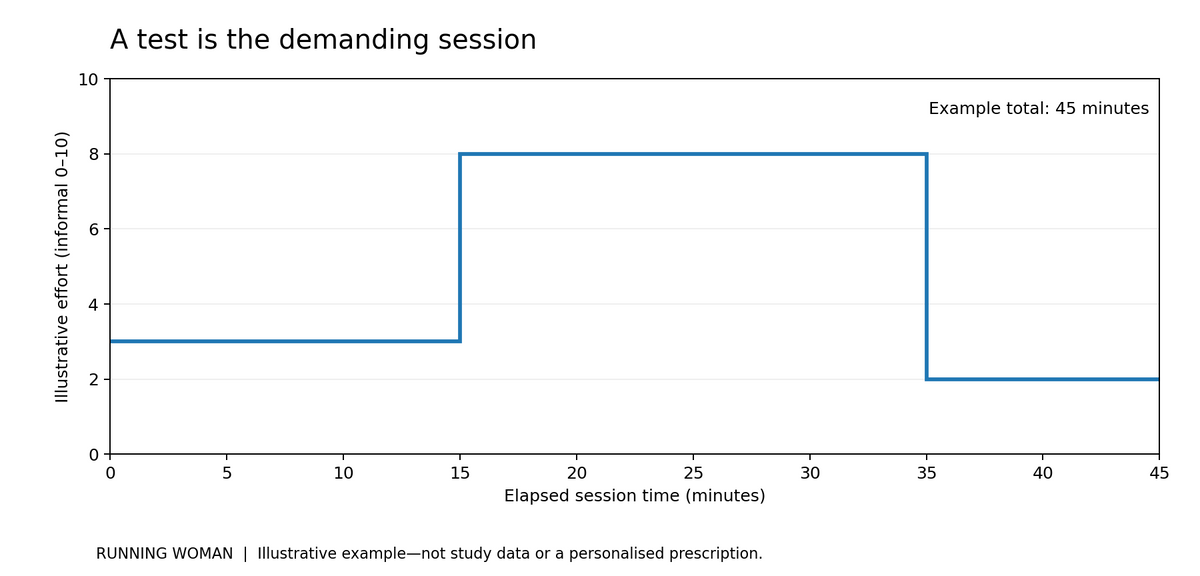
For an established runner accustomed to hard continuous efforts and with no reason to avoid them, a 45-minute session could include 15 minutes of familiar preparation, a 20-minute self-paced hard effort, and 10 minutes very easy finishing activity.
Choose a safe, uninterrupted setting and aim for an evenly managed effort rather than sprinting the opening minute. The preparation can include familiar controlled strides within the 15 minutes, not as uncounted extras.
This is an optional performance task, not a threshold test protocol or a beginner workout. A recent race may already provide enough information, making another hard test unnecessary.
A practice-race alternative
Choose an event that fits the wider goal and current preparation. Before starting, decide whether it is a hard performance test or a controlled rehearsal.
If it is controlled, write down the effort or run–walk approach you intend to practise. Avoid quietly changing the purpose at the start because the runners around you set off quickly.
Include the event duration, preparation and finishing activity in the training week. A Saturday event followed by a demanding Sunday long run is a substantial combination, not two harmless traditions that happen to share a weekend.
Where it fits in a week
A hard time trial normally replaces intervals, tempo work or another demanding session. Put enough comfortable or non-running time around it to match your preparation and response.
On a three-run week, consider an easy outing, the test session and a familiar comfortable outing whose duration is appropriate after the test. There is no obligation to preserve the longest run unchanged.
Do not add a test simply because a scheduled workout felt disappointing. Testing while frustrated can make the purpose less clear and the week more demanding without resolving the original question.
When in a training cycle?
An occasional baseline or mid-block check may help refine a plan. Allow enough time between checks that the information serves a real decision rather than satisfying an urge for constant reassurance.
A practice race can be useful when its timing leaves room to absorb the effort before the main event. In the final preparation period, avoid introducing a demanding test just to confirm fitness you have already demonstrated in training.
After illness, injury or a substantial interruption, use appropriate return guidance before considering a hard benchmark. Testing is not the first step in proving that you are ready to return.
How to interpret the result
Record context: route, surface, weather, time of day, preparation and the effort you actually used. Two outings with different conditions are not a clean laboratory comparison.
Look for useful decisions rather than absolute certainty. You might revise the opening pace, repeat a training block or choose a more sustainable event goal.
One result should not outweigh everything else you know about the preparation. Equally, a fast short test does not prove readiness for a much longer event. Duration-specific preparation still matters.
Common questions
Can my regular community event be the test? Yes, when you deliberately choose to run it hard. On other weeks it can remain easy or social; attendance does not require racing.
Should I test every week? Only a clear individual purpose could justify that pattern. This guide does not recommend it as a default.
What if I am slower? Start with context and the question you intended to answer. Adjust the plan where useful, and avoid turning a single number into a story about your worth.
A good test leaves you with a clearer next step. It does not need to leave you with a new reason to be unkind to yourself.
Keep exploring
- Race-pace training: practising your event without racing every workout
- Tapering: doing less so you can bring more to race day
- Polarised, pyramidal and 80/20 training: sorting the week, not worshipping a percentage
Sources and further reading
This guide is general education for adults, not an individual medical, rehabilitation or pregnancy/postpartum training plan. Seek qualified advice when symptoms, a health condition or a return from injury make exercise decisions uncertain.
-
Festa L et al. (2020). Effects of Different Training Intensity Distribution in Recreational Runners. Frontiers in Sports and Active Living. DOI:
10.3389/fspor.2019.00070. ↩︎ -
Abbiss CR, Laursen PB (2008). Describing and understanding pacing strategies during athletic competition. Sports Medicine. DOI:
10.2165/00007256-200838030-00004. ↩︎ -
Heuberger JAAC, Gal P, Stuurman FE, de Muinck Keizer WAS, Mejia Miranda Y, Cohen AF (2018). Repeatability and predictive value of lactate threshold concepts in endurance sports. PLOS ONE. DOI:
10.1371/journal.pone.0206846. ↩︎