
A brief jog break does not cancel a workout. Sometimes it is exactly what makes the workout useful. Cruise intervals take a stretch of controlled harder running and divide it into pieces, with enough breathing room to reset without turning the session into a series of sprints.
For runners who find a continuous tempo mentally daunting, that can be a much friendlier way in.
The highlights
- Cruise intervals are usually broken-up threshold work, not short all-out repetitions.
- The recoveries help organise the dose; they are not permission to race each block.
- Choose cruise intervals or a continuous tempo when planning the quality slot—not both automatically.
At a glance
Main purpose: Accumulate controlled threshold-style work in manageable blocks separated by brief easy recoveries.
Effort: Comfortably hard, roughly 6–7 out of 10; keep the work repeatable.
Where it fits: Uses the tempo or quality-session slot rather than becoming an additional hard day.
When in a training cycle: A useful bridge towards sustained tempo running or a variation within race preparation.
The examples below are original coaching illustrations, not protocols tested in the cited studies or personalised prescriptions. Effort numbers use an informal 0–10 guide, not a laboratory zone conversion. Choose an option within your current capacity; you never have to progress because a calendar says so.
What are cruise intervals?
The coaching term usually means repetitions at a controlled threshold-style effort, separated by relatively short easy recoveries. Common examples involve blocks lasting several minutes rather than a few seconds.
They are also called threshold intervals or broken tempo runs. Those names describe the same broad idea, but actual prescriptions differ. Three five-minute blocks and five eight-minute blocks are not interchangeable simply because both carry the word threshold.
An interval is a format, not an intensity. Buchheit and Laursen’s programming review makes clear that the work and recovery variables shape the physiological demand.[1] Here, we deliberately keep the work controlled rather than aiming for the highest speed possible.
Why break the work into pieces?
Our practical rationale is dose control. Shorter blocks offer chances to check effort, adjust pace and keep the session from drifting into a test. They can also make the task easier to understand: finish this manageable block, reset, then decide whether the next remains appropriate.
That does not mean broken work is automatically easier in every respect. More repetitions, faster running or shorter rests can make an interval session very demanding. Look at the total time spent working as well as the length of each repetition.
Nor is there a requirement to graduate to continuous tempo running. An established runner can use both formats at different points, depending on preference and the programme’s purpose.
A small but important research caution
Heuberger and colleagues compared eight lactate-threshold concepts in 48 trained male cyclists. They reported:
“All concepts showed high repeatability”
— Heuberger and colleagues, 2018.[2]
That study concerns assessment, not a trial of cruise intervals in women runners. Its relevance is narrower: threshold numbers depend on how you define and measure them. A repeatable test result does not make every threshold label identical.
Faude and colleagues’ review similarly documents multiple threshold concepts.[3] Our application is to avoid false precision. “Controlled comfortably hard” is more honest for a general session example than claiming a pace or blood-lactate value must be correct for every reader.
Direct comparisons establishing the best cruise-interval recipe for recreational women are limited in the sources reviewed for this library. The specific sessions below are coaching illustrations, not research-derived optimums.
How to get the effort right
Begin the first block slightly cautiously. Aim for the later blocks to resemble the first in control, rather than relying on a heroic final repetition to complete the session.
During the recovery, jog very easily or walk when needed. The purpose is to regain enough composure to continue appropriately. If you repeatedly need far longer breaks, the work pace or total dose may be too ambitious for that day.
Do not chase heart rate in the opening seconds of a block. Instead, use a sensible starting pace and the developing effort. A watch can provide context, but it cannot decide whether your technique, breathing and overall readiness remain appropriate.
Two clearly counted sessions
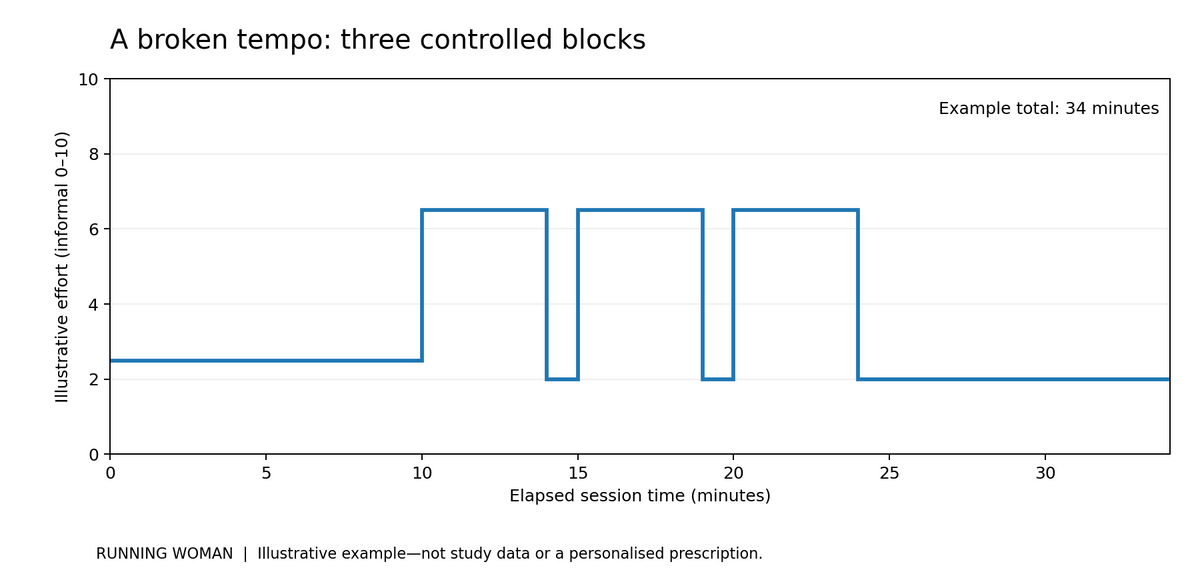
A modest introduction: 34 minutes. Warm up with 10 easy minutes. Run 3 × 4 minutes at controlled comfortably hard effort, with 1 minute of easy jogging between repetitions. Finish with 10 easy minutes. There are two recoveries, so the arithmetic is 10 + 12 + 2 + 10 = 34 minutes.
A more established version: 48 minutes. Begin with 15 easy minutes. Run 3 × 7 controlled minutes, with 1 minute of easy jogging between repetitions. Finish with 10 easy minutes. The total is 15 + 21 + 2 + 10 = 48 minutes.
The second session adds both total duration and harder-running time. It is not an automatic week-two prescription. Repeat the smaller dose until it fits comfortably within your routine, or keep using it because it already does the job.
A beginner can replace the work blocks with easy running and use walking breaks. That is useful run–walk training, not a need to mimic threshold effort prematurely.
Where cruise intervals fit in the week
Use them in the slot that might otherwise contain a tempo, fartlek, hills or another quality session. For an established three-day runner, that could be Thursday, between a Tuesday easy run and a Sunday conversational long run.
Do not add a hard Saturday parkrun because the Thursday workout “had breaks”. Breaks are part of the design, not evidence that the session was light. Likewise, a long run with substantial race-pace work deserves to be counted as another demanding session.
Allow an easy or non-running day afterwards as a starting arrangement, then adjust to your normal training and response. There is no universal number of hours that guarantees recovery for everyone.
Where they fit across a training cycle
Cruise intervals can introduce sustained harder running after a consistent easy-running phase. Later, they can vary a familiar threshold routine or support an event-preparation block without requiring every session to become longer.
Near a race, reduce the amount of work rather than trying to prove fitness with the largest session yet. Taper research supports reducing overall volume while retaining some familiar intensity in appropriate circumstances.[4] That is not an instruction to keep the full cruise workout unchanged.
Common questions
Can I run faster because the breaks are short? Only when a different session is explicitly intended. Otherwise, the breaks help preserve control at the chosen effort. Turning every repetition into a race changes the workout.
Are cruise intervals better than continuous tempo? Not universally. Preference, experience, event demands and total dose matter. A useful comparison is whether each version lets you complete appropriate work without disrupting the rest of your week—not which sounds more impressive.
The breathing room is not cheating. It is part of the plan.
Keep exploring
- Tempo and threshold runs: comfortably hard, without the mystery
- Interval training: faster running, sensible recoveries and no need to sprint
- Fartlek training: a little speed play for your running week
Sources and further reading
This guide is general education for adults, not an individual medical, rehabilitation or pregnancy/postpartum training plan. Seek qualified advice when symptoms, a health condition or a return from injury make exercise decisions uncertain.
-
Buchheit M, Laursen PB (2013). High-intensity interval training, solutions to the programming puzzle: Part I: cardiopulmonary emphasis. Sports Medicine. DOI:
10.1007/s40279-013-0029-x. ↩︎ -
Heuberger JAAC, Gal P, Stuurman FE, de Muinck Keizer WAS, Mejia Miranda Y, Cohen AF (2018). Repeatability and predictive value of lactate threshold concepts in endurance sports. PLOS ONE. DOI:
10.1371/journal.pone.0206846. ↩︎ -
Faude O, Kindermann W, Meyer T (2009). Lactate threshold concepts: how valid are they?. Sports Medicine. DOI:
10.2165/00007256-200939060-00003. ↩︎ -
Wang Z, Wang YT, Gao W, Zhong Y (2023). Effects of tapering on performance in endurance athletes: A systematic review and meta-analysis. PLOS ONE. DOI:
10.1371/journal.pone.0282838. ↩︎