
Running advice sometimes makes it sound as though there is a perfect percentage hidden inside your watch. Find it, obey it, and every workout will suddenly make sense.
Polarised and pyramidal training are useful ideas, but they are descriptions of a training mix—not reasons to add hard running just because a chart looks insufficiently symmetrical.
The highlights
- Both approaches generally contain a large amount of low-intensity work.
- Their definitions often use three physiological zones, not your watch’s five-zone labels.
- Percentages change according to whether you count time, distance or whole sessions.
At a glance
Main purpose: Understand how easy, moderate and harder work are distributed across a training period.
Effort: A description of the mixture of intensities, not an individual session.
Where it fits: Used to review the whole week or block after accounting for all sessions.
When in a training cycle: The balance may change with experience, available time and event preparation.
The examples below are original coaching illustrations, not protocols tested in the cited studies or personalised prescriptions. Effort numbers use an informal 0–10 guide, not a laboratory zone conversion. Choose an option within your current capacity; you never have to progress because a calendar says so.
First, what are we actually dividing?
Training intensity distribution describes how much training happens at different intensities over a period. That might be a week, several weeks or a season.
Research commonly uses a three-zone framework: below the first physiological threshold, between the first and second thresholds, and above the second. In that framework, zone 2 is the middle band. It is not automatically the same as the easy “zone 2” shown by a five-zone watch system.[1]
The boundaries also depend on how thresholds are defined and assessed.[2] A simple perceived-effort number does not establish your exact laboratory zones.
What does pyramidal mean?
A pyramidal distribution contains the most low-intensity work, less middle-intensity work and the smallest amount at high intensity. Picture a broad base narrowing upwards.
Polarised training also emphasises low intensity, but includes relatively more high-intensity than middle-intensity work. These are broad patterns, not instructions to make every runner’s chart identical.[1:1]
A plan may shift between patterns across a season. The labels can help describe what happened, but they do not explain whether the sessions suited the individual, were well executed or fitted the event.
Where does 80/20 fit?
It is a shorthand often used to encourage a clear distinction between easier and more demanding training. The difficulty begins when the shorthand is treated as an exact target without defining the measurement.
Does the 20% refer to minutes above a threshold? The number of sessions with any purposeful running? Distance? Those can produce very different answers from the same week.
For this guide, the practical message is not to chase a percentage. It is to avoid accidentally making every outing demanding and to count the actual work honestly.
A worked example: one week, two very different percentages
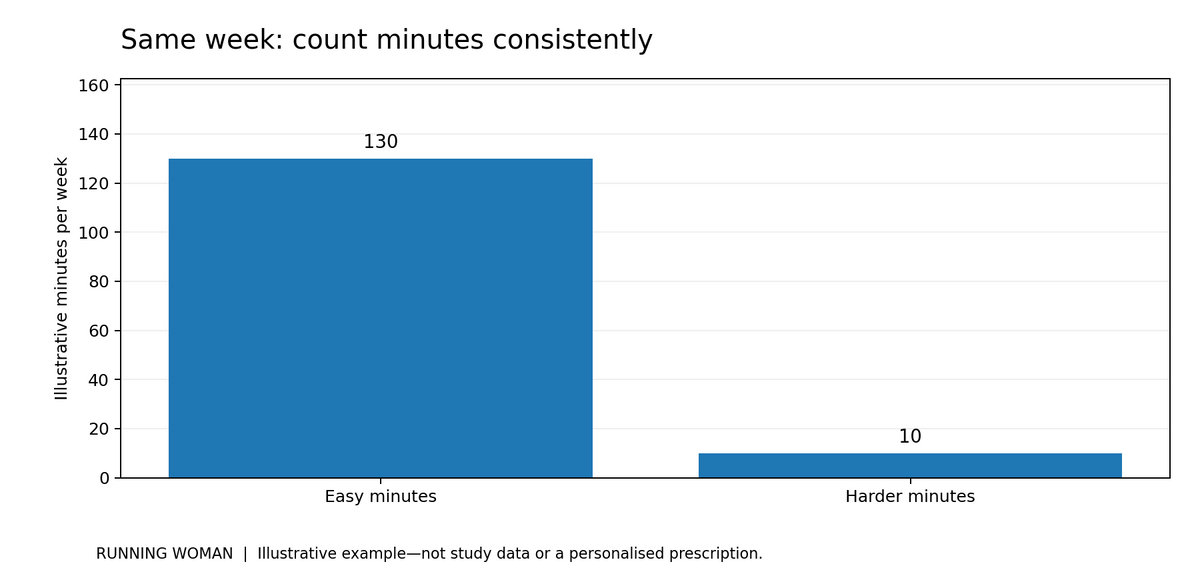
Imagine an established runner completing three sessions: 40 easy minutes, a 40-minute session containing 10 harder minutes and 30 easy minutes, then 60 easy minutes.
The total is 140 minutes, with 10 harder minutes. By time, that is about 7.1% harder running. By the session-goal method, one of three outings is the harder session: about 33.3% of sessions.
Both calculations describe the same illustrative week. Neither proves that the runner has trained correctly or incorrectly. The example also assumes the harder minutes genuinely meet the definition being counted; a watch label alone may not establish that.
What does research say about the best distribution?
A 10-week comparison involving 30 recreational runners found improvement in both polarised and more moderately focused groups. The full-group between-group difference was not statistically significant; favourable exploratory subgroup results should not replace that main finding.[3]
Another recreational-runner study reported similar improvements under two different training distributions.[4] Together, these findings argue against declaring a single universally winning percentage from a small collection of studies.
Running Woman’s editorial takeaway: Choose a training week that serves you, then use the numbers to understand it—not to bully it into a slogan.
What should a beginner do with this?
Usually, much less than social media suggests. Establish comfortable running or run–walking, leave non-running days as needed and avoid adding hard work simply to create an 80/20 split.
A beginner week containing only easy activity is not an error waiting to be corrected. The immediate question is whether the routine is manageable and repeatable.
When purposeful faster running becomes appropriate, start with a small, understandable session. Learning the difference between easy and controlled quicker effort is more useful than building a dashboard before you have a stable routine.
What about an established three-run week?
A simple option is two easy outings and one session with a clear purpose, with the longer outing still treated as a meaningful demand. That purposeful session might contain a small fartlek or steady block; it does not need to be maximal.
Choose the session according to your goal and preparation. Avoid using the label polarised to justify intervals that do not fit your current capacity.
If the longer run is unusually demanding or contains race-pace work, another hard session may not belong in the same week. Total strain cannot be fully captured by counting minutes in a single intensity band.
What changes with four or five runs?
Additional running days do not automatically require additional quality sessions. Often the first question is how to keep the added running comfortable and appropriate.
An established runner may have one or sometimes two purposeful sessions, but that is not a universal prescription. Long runs, hills, strength work, work demands and recovery all influence whether the overall week makes sense.
The purpose of a distribution model is to make the pattern clearer. It should not obscure the human being doing the training.
Common mistakes
Counting the entire interval session as high-intensity time while counting the long run minute by minute mixes methods. Pick a method and state it.
Treating all middle-intensity running as worthless “junk” is another oversimplification. Steady and threshold work can have clear purposes; the question is how much, for whom and when.
Finally, do not confuse heart-rate lag during short repetitions with proof that the session was easy. A device’s summary is one view of the workout, not the workout itself.
A useful weekly review
Ask what each session was meant to do, whether the easy outings stayed comfortable, and whether the demanding work left enough room for the rest of life.
Then ask whether the next week needs a change at all. Sometimes the most useful answer is to repeat the same sensible pattern.
Your running does not need perfect mathematical branding. It needs a mixture you understand and can actually live with.
Keep exploring
- Easy runs: the everyday miles that deserve more credit
- Steady runs: the useful middle gear—and how not to live there
- Base-building: making running fit before making it harder
Sources and further reading
This guide is general education for adults, not an individual medical, rehabilitation or pregnancy/postpartum training plan. Seek qualified advice when symptoms, a health condition or a return from injury make exercise decisions uncertain.
-
Stöggl TL, Sperlich B (2015). The training intensity distribution among well-trained and elite endurance athletes. Frontiers in Physiology. DOI:
10.3389/fphys.2015.00295. ↩︎ ↩︎ -
Faude O, Kindermann W, Meyer T (2009). Lactate threshold concepts: how valid are they?. Sports Medicine. DOI:
10.2165/00007256-200939060-00003. ↩︎ -
Muñoz I, Seiler S, Bautista J, España J, Larumbe E, Esteve-Lanao J (2014). Does polarized training improve performance in recreational runners?. International Journal of Sports Physiology and Performance. DOI:
10.1123/ijspp.2012-0350. ↩︎ -
Festa L et al. (2020). Effects of Different Training Intensity Distribution in Recreational Runners. Frontiers in Sports and Active Living. DOI:
10.3389/fspor.2019.00070. ↩︎