
Tapering is the part of a plan where doing less can feel strangely harder than doing more. The calendar says ease back; your brain wonders whether one final long run might be reassuring.
The point is to arrive ready to use your preparation, not to keep proving that you have done it. Your fitness does not need a last-minute audition.
The highlights
- A taper reduces training load before an event; it is not a final fitness-building challenge.
- Maintaining some intensity means a smaller dose of familiar quicker running, not keeping the entire hard workout.
- The right reduction depends on your usual training, fatigue and event.
At a glance
Main purpose: Reduce accumulated training demand before an event while retaining suitable familiar activity.
Effort: Less total work; any quicker running stays brief, familiar and appropriate.
Where it fits: Replaces the normal training week rather than adding a special workout.
When in a training cycle: The final preparation before an event, with duration and reduction matched to the runner and race.
The examples below are original coaching illustrations, not protocols tested in the cited studies or personalised prescriptions. Effort numbers use an informal 0–10 guide, not a laboratory zone conversion. Choose an option within your current capacity; you never have to progress because a calendar says so.
What is tapering?
It is a planned reduction in training before an event. You change the amount of work so that the final days are not simply another normal training block with a race added at the end.
A taper differs from a rest day, an ordinary lighter week and post-race recovery. Its particular purpose is to prepare for an approaching performance.
It also differs from abruptly stopping a routine because you are ill or injured. Medical decisions about whether to exercise take priority over preserving the shape of a taper.
What does the research say?
A 2023 meta-analysis included 14 studies of trained endurance athletes. It found support for reduced training volume while retaining intensity and frequency; a reduction of 41–60% over a taper of up to 21 days was associated with effective strategies. The authors described:
“training volume is progressively reduced by 41–60%” — Wang and colleagues, 2023.[1]
These are group-level findings from predominantly male, trained samples across endurance sports—not a universal beginner prescription. Subgroup comparisons cannot determine one person’s ideal taper. The paper’s discussion of pre-taper overload is not a recommendation to add a last-minute overload week.
The practical application is to reduce the overall demand while keeping preparation familiar, with individual adjustment rather than percentage worship.
Why less does not mean you have stopped caring
After several weeks of preparation, repeating the biggest workouts may feel emotionally reassuring. That does not make them the right final-week decision.
A review of maintenance training distinguishes keeping adaptations from continually increasing the training dose.[2] It is a useful reminder that more is not the only valid direction of travel, although a maintenance review does not supply a complete race taper.
Think of the taper as completing the preparation, not interrupting it. The time you are no longer spending on extra kilometres can go into ordinary practicalities and a calmer approach to the event.
What usually changes?
The clearest change is less total running. That might mean shorter easy outings, fewer repetitions in a familiar session and a shorter longer run.
The intensity of a brief quicker portion may remain familiar, but its volume becomes smaller. Four short controlled repetitions are not the same workload as a full interval session simply because the pace is similar.
You may also reduce demanding supporting work. Avoid new strength exercises, novel plyometrics or an unfamiliar hilly route. Those additions work against the idea of arriving without unexpected training consequences.
A small-event illustration
For an established runner who normally runs three times a week and is treating a 5K as an important event, one possible event week is a short easy Tuesday outing, a shorter familiar Thursday outing with a few controlled strides, then the event at the weekend.
Keep any strides familiar; do not introduce them during taper week because this example mentions them. The race replaces a purposeful session or longer outing rather than becoming a fourth demand on top of the usual week.
This is a scheduling illustration, not a fixed taper duration for all 5K runners. A first event focused on completion may call for a simpler approach agreed within the runner’s existing plan.
A longer-event volume illustration
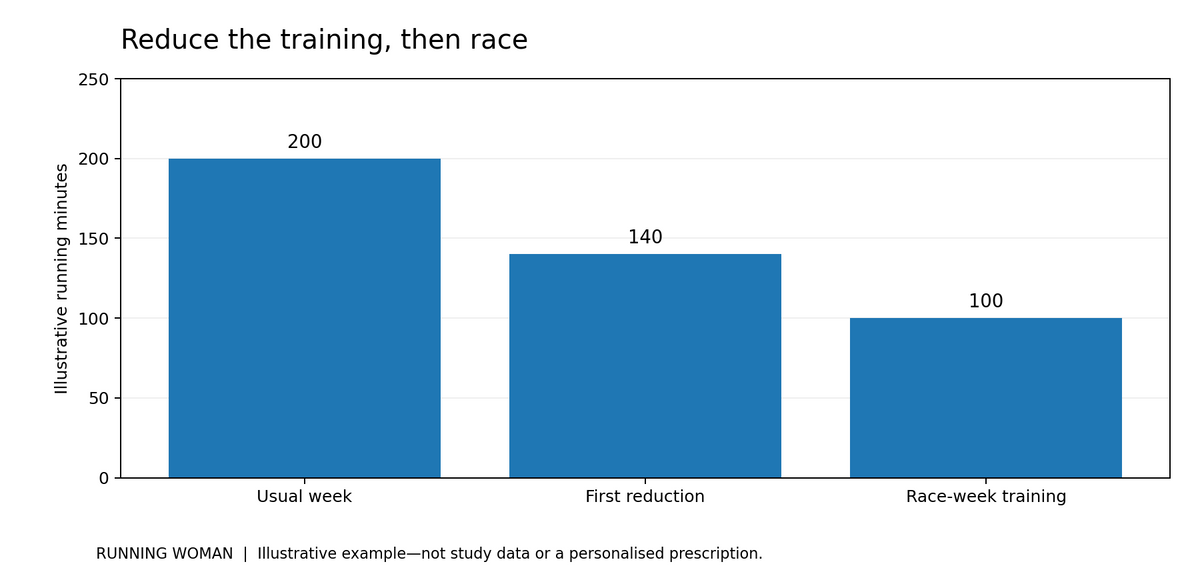
Imagine a runner whose established week totals 200 running minutes. An illustrative two-step reduction might be 140 minutes during the next week, then 100 minutes of pre-race training in event week, with the race itself excluded from that 100-minute figure.
Those numbers show how to express a reduction transparently. They are not a recommended marathon plan or a reason for somebody running 80 minutes to increase to 200 first.
The relevant baseline is the runner’s normal completed training, not the most ambitious week written on a plan. Account for disruption and fatigue before deciding what to retain.
How do you choose the final quicker session?
Use a smaller version of something already familiar. Keep it controlled enough that you finish feeling you could have done more.
For example, an established runner who regularly uses short race-effort blocks might retain a few brief blocks while removing much of the usual main set. Another runner may do only easy running.
Do not try to create freshness by making the short session unusually fast. Less volume paired with a brand-new maximum effort is not automatically a gentle combination.
What about food, sleep and nerves?
Avoid turning reduced mileage into a reason to pursue last-minute weight loss. The IOC’s REDs consensus describes harms associated with problematic low energy availability.[3] Use appropriate event-specific advice for your individual nutrition strategy.
Keep ordinary routines as steady as circumstances allow. Prepare the kit, travel details and starting plan early enough that the final evening does not become a scavenger hunt.
Feeling restless does not mean the taper has failed. You can acknowledge the urge to do more without letting it write the next session.
What if training has not gone to plan?
Do not use taper week to repay missed sessions. Reconsider the race goal, the run–walk strategy or participation itself where health or preparation makes that necessary.
A taper cannot substitute for months of missing preparation. Equally, one disrupted session does not mean you need a dramatic correction.
Look at the whole block and make a realistic decision. Arriving with a sensible plan is more useful than arriving with a heroic final training entry.
Common questions
Do I need to stop running completely? Not necessarily. A taper often retains familiar activity, but health circumstances can override the training model.
Should I always taper for three weeks? No. Duration depends on the event, the runner and the preceding workload. A finding that includes up to 21 days is not an instruction that everybody needs 21.
Can I test my fitness one last time? A demanding test adds another event to recover from. Use the evidence from preparation rather than demanding a fresh certificate in the final days.
Less is not an absence of commitment. Sometimes it is the final expression of it.
Keep exploring
- Race-pace training: practising your event without racing every workout
- Rest days and cutback weeks: the parts of training that do not need a GPS trace
- Time trials and practice races: useful feedback without a weekly judgement day
Sources and further reading
This guide is general education for adults, not an individual medical, rehabilitation or pregnancy/postpartum training plan. Seek qualified advice when symptoms, a health condition or a return from injury make exercise decisions uncertain.
-
Wang Z, Wang YT, Gao W, Zhong Y (2023). Effects of tapering on performance in endurance athletes: A systematic review and meta-analysis. PLOS ONE. DOI:
10.1371/journal.pone.0282838. ↩︎ -
Spiering BA, Mujika I, Sharp MA, Foulis SA (2021). Maintaining Physical Performance: The Minimal Dose of Exercise Needed to Preserve Endurance and Strength Over Time. Journal of Strength and Conditioning Research. DOI:
10.1519/JSC.0000000000003964. ↩︎ -
Mountjoy M et al. (2023). 2023 International Olympic Committee’s (IOC) consensus statement on Relative Energy Deficiency in Sport (REDs). British Journal of Sports Medicine. DOI:
10.1136/bjsports-2023-106994. ↩︎