
Race-pace training sounds wonderfully straightforward: run at the pace you want to race. The important missing word is realistic. Your wish-list finish time and your current fitness are not always on speaking terms.
Used thoughtfully, this training helps make an event feel more familiar. Used as a weekly audition for a dream result, it can turn an ordinary training plan into a rather exhausting argument with a calculator.
The highlights
- Race pace describes an event target, not a universal effort zone.
- Use a target grounded in current preparation, and adjust for conditions.
- Practise parts of the event; you usually do not need to reproduce the whole race.
At a glance
Main purpose: Rehearse a realistic event effort, pacing decisions and race-day routines.
Effort: Event-dependent: marathon pace and 5K pace are not the same training intensity.
Where it fits: Replaces another purposeful workout; sometimes forms part of a long run.
When in a training cycle: Most relevant during event-specific preparation, with smaller familiar doses near race day.
The examples below are original coaching illustrations, not protocols tested in the cited studies or personalised prescriptions. Effort numbers use an informal 0–10 guide, not a laboratory zone conversion. Choose an option within your current capacity; you never have to progress because a calendar says so.
What is race-pace training?
It is a session containing running at approximately the effort or pace appropriate to a particular race. That might mean short controlled blocks around a current 5K effort, or longer sections around a realistic half-marathon effort.
The event label matters. Ten minutes at marathon pace and ten minutes at 5K pace are different requests. Nor does a pace calculator know whether your endurance preparation matches its prediction.
For this guide, race pace means a working target supported by recent, relevant running—not a speed selected because the resulting finish time looks lovely. On a hilly course or a windy day, use an appropriate effort rather than forcing the flat-road number.
What is it used for?
The practical aims are familiarity and decision-making: recognising the opening effort, resisting an overenthusiastic start, settling into rhythm and noticing when the plan needs adjustment.
A session can also rehearse shoes, clothing and the logistics you intend to use. For a longer event, that may include a previously considered food and drink plan. Do not introduce every new item in the same session; otherwise a disappointing outing leaves you with too many possible explanations.
Pacing research considers how effort is distributed across an event, rather than treating each kilometre as an isolated achievement.[1] Our coaching application is to practise purposeful restraint as well as purposeful speed.
What does research say?
A review of world-class distance-running practice describes event-specific work becoming more prominent nearer competition:
“volume of race-pace running increases as the main competition approaches” — Haugen and colleagues, 2022.[2]
This is a description of elite preparation, not evidence that a recreational runner should copy elite mileage or include several race-pace workouts each week.
There is also no single physiological threshold called race pace. A review identified numerous competing lactate-threshold definitions.[3] Consequently, a target race speed should not automatically be presented as your measured threshold.
Our practical interpretation: use race-specific running to answer a clear question about the event. Avoid using it as a catch-all explanation for why every training run should get faster.
A gentler introduction: practise the opening, not the finish
A newer runner does not need a hard race simulation. Consider a 30-minute familiar outing: 10 minutes of comfortable walking and running, 10 minutes at the sustainable run–walk rhythm you plan to start your event with, and 10 easier minutes.
This is suitable only where that total duration is already comfortable. The middle section is not a demand to run continuously or faster. It rehearses your intended approach, including planned walking breaks.
Afterwards, ask whether the beginning felt controlled and whether you could follow the plan without chasing somebody else. Those are useful observations even without a pace target.
An established-runner example
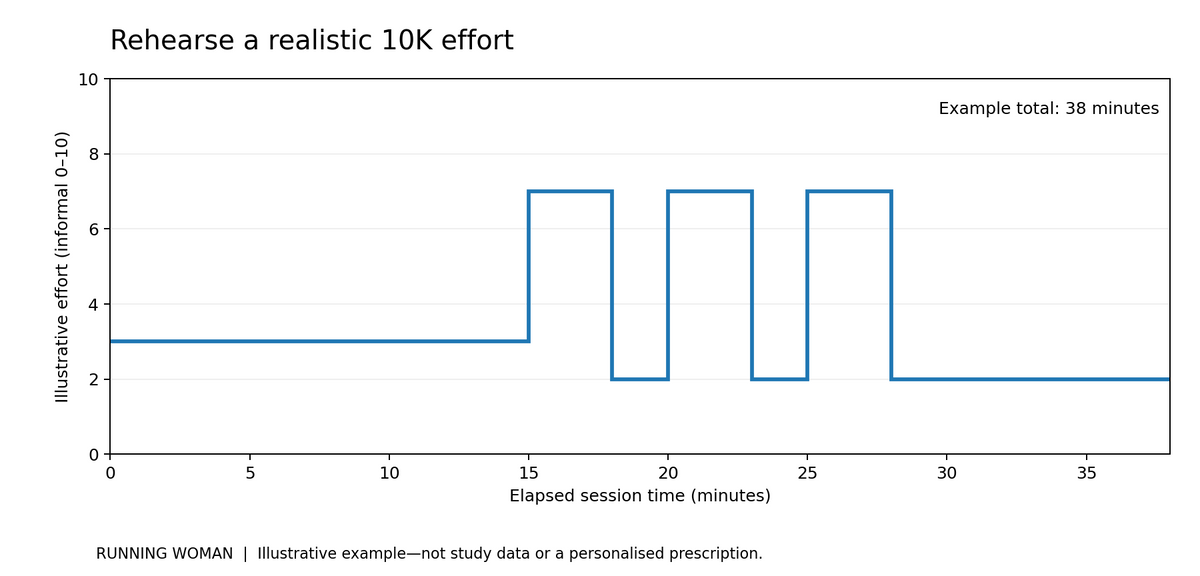
For someone already accustomed to faster training and preparing for a 10K, one illustration is 38 minutes: 15 minutes easy, three 3-minute blocks around a realistic current 10K effort, 2 minutes very easy between the first and second and between the second and third blocks, then 10 minutes easy.
That is 9 purposeful minutes, 4 recovery minutes and 25 easy minutes. The recoveries are there to support control, not to permit an unrealistic target.
Start with the effort, not the fastest average you can rescue. If the second block is already a struggle, reduce the target or end the quicker work. A short successful rehearsal is more useful than proving that an unsuitable pace is unsuitable.
Where it fits in a week
On a three-run routine, a simple arrangement is an easy run, this race-specific session, then a familiar conversational longer run, with non-running days between them where practical.
Do not add the session on top of intervals, a tempo run and a hard Saturday event. It replaces one of those demands. If you include race-pace sections in the longer run instead, consider that your main demanding session for the week.
Distance and intensity deserve separate consideration. Make the first experiment shorter or gentler than a later, familiar version. There is little value in simultaneously testing new distance, new pace and new footwear.
When in the training cycle?
Build enough regular running to support the task before making race specificity a priority. As an event approaches, use the occasional session to refine rather than continually escalate the target.
In the final preparation period, keep any sharper work familiar and modest. This is not the moment for a heroic full-distance rehearsal. If training has been disrupted, revise the race approach instead of attempting to squeeze the missing preparation into one impressive workout.
After the event, this type of session can disappear until it has a job again. Running for enjoyment does not need a permanent race-pace assignment.
Common questions
Should I train at my goal pace or current race pace? Begin with what current preparation supports. A stretch goal can remain a hope without governing every workout.
What if the route is hilly? Practise the effort and decisions appropriate to that terrain. A rigid kilometre target can be the wrong instruction uphill or downhill.
Does completing the session guarantee my result? No. Training blocks contain recoveries, and a race adds distance, conditions and decisions. Treat the session as one piece of information, not a certificate.
Can a practice race replace this? Yes, but record the practice race as demanding training. Calling it a rehearsal does not make the effort free.
You are practising how you want to begin and manage your race—not trying to collect your finish-line feeling several weeks early.
Keep exploring
- Time trials and practice races: useful feedback without a weekly judgement day
- Tempo and threshold runs: comfortably hard, without the mystery
- Tapering: doing less so you can bring more to race day
Sources and further reading
This guide is general education for adults, not an individual medical, rehabilitation or pregnancy/postpartum training plan. Seek qualified advice when symptoms, a health condition or a return from injury make exercise decisions uncertain.
-
Abbiss CR, Laursen PB (2008). Describing and understanding pacing strategies during athletic competition. Sports Medicine. DOI:
10.2165/00007256-200838030-00004. ↩︎ -
Haugen T, Sandbakk Ø, Seiler S, Tønnessen E (2022). The Training Characteristics of World-Class Distance Runners: An Integration of Scientific Literature and Results-Proven Practice. Sports Medicine – Open. DOI:
10.1186/s40798-022-00438-7. ↩︎ -
Faude O, Kindermann W, Meyer T (2009). Lactate threshold concepts: how valid are they?. Sports Medicine. DOI:
10.2165/00007256-200939060-00003. ↩︎