
Tempo. Threshold. Lactate turnpoint. Running has a remarkable ability to give something several names before anyone explains what it feels like.
For this guide, think of a controlled stretch of comfortably hard running: you are working, you know you are working, but you are not counting down the seconds until rescue. It is a useful session when it is kept in its lane.
The highlights
- Tempo is a flexible coaching label; threshold refers to physiological concepts that are not all identical.
- The aim is controlled, sustained work—not the fastest twenty minutes you can manage.
- A broken-up threshold session can be a more approachable alternative to a continuous tempo.
At a glance
Main purpose: Develop controlled sustained effort relevant to endurance performance, without turning every session into a race.
Effort: Comfortably hard and controlled; roughly 6–7 out of 10, not a precise threshold measurement.
Where it fits: Usually the week’s main quality session; alternate with other demanding workouts.
When in a training cycle: After consistency is established, often during a race-preparation block.
The examples below are original coaching illustrations, not protocols tested in the cited studies or personalised prescriptions. Effort numbers use an informal 0–10 guide, not a laboratory zone conversion. Choose an option within your current capacity; you never have to progress because a calendar says so.
What do tempo and threshold mean?
Tempo is used loosely. Some coaches mean a steady run; others mean a demanding sustained effort near an upper lactate or ventilatory threshold. Here, tempo means the latter: controlled, comfortably hard running, not an all-out test.
Threshold itself is not one universally agreed number. Faude and colleagues reported:
“A total of 25 different LT concepts were located.”
— Faude and colleagues, 2009; LT means lactate threshold.[1]
The review distinguishes different ways of identifying changes in blood lactate during exercise. This is why a fixed blood-lactate value, a watch estimate, a percentage of maximum heart rate and a pace from an old race should not be treated as interchangeable measurements of your threshold.
For a general training guide, effort is a useful starting point. A laboratory test or a coach working from your actual performances can make the prescription more specific where that is genuinely useful.
What is the session used for?
Threshold-style training is used to practise and develop sustained, controlled endurance effort. The broader science links threshold-related measures with endurance performance, but that relationship is not proof that one particular twenty-minute workout is optimal.[1:1]
The practical appeal is repeatability. Rather than sprinting until you need a long break, you stay within an effort you can hold with some control. That makes it a different experience from shorter, harder interval sessions.
It can also teach restraint. The first minutes often feel easier than the final ones. Starting slightly conservatively gives the session somewhere sensible to go, rather than making the last third a negotiation with your watch.
What should it feel like?
Breathing is substantial but not chaotic. You can usually manage a short phrase, although a long conversation is no longer the point. You should feel that the final minutes require concentration, not a rescue effort.
The informal 6–7 out of 10 guide is not a test. Effort varies with duration and circumstances, and perceived effort cannot tell you an exact lactate concentration. Avoid forcing yourself to hold a pace simply because a calculator has printed it.
Be particularly wary of defining threshold as everybody’s 10K pace. A 10K takes different runners very different amounts of time. Race duration matters, so one race-distance label is not a universal intensity prescription.
The useful distinction from intervals
Both workouts can use repetitions. An interval simply describes work separated by recovery; the work does not have to be a sprint. Buchheit and Laursen emphasise that intensity, repetition duration and recovery structure change the stimulus.[2]
A continuous tempo holds controlled work without breaks. Cruise intervals divide similar controlled work into smaller blocks with brief easy recoveries. Harder aerobic intervals use a different effort and often a different recovery pattern. The format and intensity both matter.
This also explains why adding a one-minute break does not give permission to run each block flat out. You have changed the format, not automatically changed the purpose.
Two practical examples
A modest continuous introduction: 30 minutes. Run easily for 10 minutes, complete 10 minutes of controlled comfortably hard running, then jog easily for 10. This is for an established runner, not a first running session. Start gently enough that you could finish the block without straining.
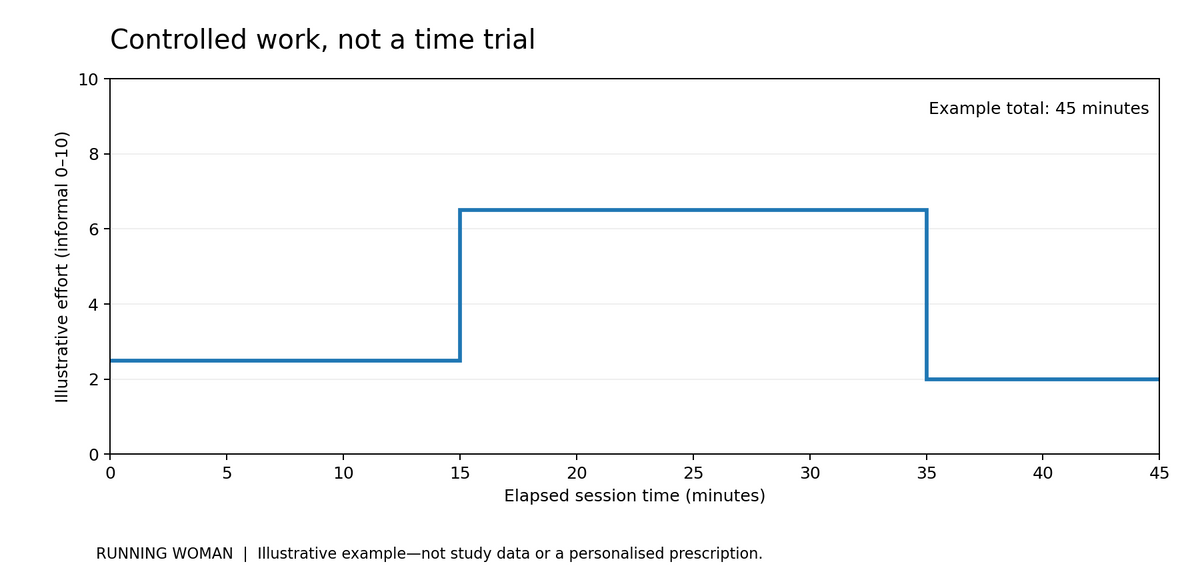
A familiar session for someone already tolerating threshold work: 45 minutes. Run easily for 15 minutes, complete 20 controlled minutes, and jog easily for 10. This is not automatically the next step after the first example; the total duration and harder-running dose are both larger.
Prefer a broken version? Try the separate cruise-interval article rather than combining both workouts. Pick one appropriate session.
If the first few minutes feel much harder than intended, slow down. If that does not restore control, finish easy or stop. Successfully adjusting a workout is a better training decision than defending its original pace at any cost.
Where it fits in the week
For an established three-run week, Tuesday might be easy, Thursday a modest tempo session and Sunday a familiar easy long run. If Sunday is becoming substantially longer or includes harder terrain, Thursday may need to stay easy instead.
With more running days, keep the surrounding runs genuinely relaxed. A tempo, an interval session and a hard parkrun are three demanding outings, even if they have different names. Do not assume the variety makes them easy to recover from.
Faster sessions are alternatives to consider across a programme, not ingredients to include every week. There is no requirement to perform tempo and intervals in the same seven days.
Where it fits in a training cycle
Introduce sustained harder work after a period in which ordinary running feels dependable. During an event-preparation block, use it when controlled endurance effort matches the current goal. Later, more race-specific sessions may take its place.
Do not increase the tempo duration, total weekly running and long run together by default. The 2025 running-load cohort reinforces that individual session changes deserve attention, although it cannot provide a universally safe progression formula.[3]
During a lighter week, shorten the block or leave it out. Near a race, any retained intensity should come within an appropriately reduced overall workload rather than a last-minute attempt to gain fitness.
Frequently asked questions
Should I finish completely exhausted? No. You should recognise that you worked, but exhaustion is not the intended measure of success. The ability to repeat controlled training matters more than producing one dramatic session.
Is threshold training necessary if I do not race? No. It can be enjoyable variety for an established runner, but easy running, run–walk and other activity can remain the whole plan. You do not need to collect every training type.
The best tempo run often looks almost uneventful from the outside. Inside, you have practised working with purpose—and stopping before purpose turns into punishment.
Keep exploring
- Cruise intervals: threshold training with a little breathing room
- Interval training: faster running, sensible recoveries and no need to sprint
- Steady runs: the useful middle gear—and how not to live there
Sources and further reading
This guide is general education for adults, not an individual medical, rehabilitation or pregnancy/postpartum training plan. Seek qualified advice when symptoms, a health condition or a return from injury make exercise decisions uncertain.
-
Faude O, Kindermann W, Meyer T (2009). Lactate threshold concepts: how valid are they?. Sports Medicine. DOI:
10.2165/00007256-200939060-00003. ↩︎ ↩︎ -
Buchheit M, Laursen PB (2013). High-intensity interval training, solutions to the programming puzzle: Part I: cardiopulmonary emphasis. Sports Medicine. DOI:
10.1007/s40279-013-0029-x. ↩︎ -
Schuster Brandt Frandsen J et al. (2025). How much running is too much? Identifying high-risk running sessions in a 5200-person cohort study. British Journal of Sports Medicine. DOI:
10.1136/bjsports-2024-109380. ↩︎