
A sprint is not just an interval with a more dramatic name. True sprinting asks for very high speed or force over a short time, and the recovery can be much longer than the running.
That can surprise distance runners accustomed to judging a workout by how breathless it makes them. In speed-focused work, resting properly may be the most disciplined part of the session.
The highlights
- Relaxed strides, aerobic intervals and maximal sprinting are different activities.
- Quality and generous recovery matter more than accumulating exhaustion.
- Near-maximal sprinting is optional, advanced work—not a shortcut every runner needs.
At a glance
Main purpose: Develop or maintain speed-oriented qualities through brief high-quality efforts, rather than prolonged breathlessness.
Effort: Fast movement with quality prioritised; genuine maximal sprinting requires individual preparation and supervision.
Where it fits: An optional speed-focused element on a fresh day; not an automatic add-on after exhausting training.
When in a training cycle: Introduced gradually after preparation; unnecessary for many recreational goals.
The examples below are original coaching illustrations, not protocols tested in the cited studies or personalised prescriptions. Effort numbers use an informal 0–10 guide, not a laboratory zone conversion. Choose an option within your current capacity; you never have to progress because a calendar says so.
What do we mean by sprint training?
Sprint training aims at very fast running qualities: accelerating, reaching speed or maintaining it briefly. It differs from three-minute aerobic intervals, where the purpose is repeated sustained hard work, and from relaxed strides, which introduce quicker movement without pursuing maximum speed.
Some distance runners use short hill accelerations as a speed-oriented variation. Others use flat-ground efforts or coached sprint drills. The names do not make the demands identical.
A thirty-second all-out effort with short recovery is another distinct format, often called sprint interval training. It can create substantial fatigue and should not be confused with a handful of short accelerations separated by long rests.
What does the research support?
Haugen and colleagues’ review of elite sprint training states:
“Full recovery is required between each sprint”
— Haugen and colleagues, 2019.[1]
The review combines research and elite practice. It supports the importance of preserving speed and quality, but its high-performance prescriptions should not be copied directly into a recreational runner’s week.
Research on low-volume high-intensity training includes demanding laboratory protocols, frequently on bicycles.[2] Those findings are not proof that inexperienced runners should perform repeated all-out running sprints. The exercise mode and preparation matter.
Our interpretation is deliberately conservative: begin with relaxed quicker running, and treat genuinely near-maximal sprinting as a separate progression best planned with a suitably qualified coach.
What might a distance runner use it for?
A speed-oriented element can provide practice at movements and rhythms not encountered during easy running. For runners with relevant competitive goals, a coach may include it to develop acceleration or finishing-speed qualities.
That does not mean every marathon runner needs a sprint programme, or that a faster sprint automatically translates into a faster marathon. Different qualities and event demands overlap without being interchangeable.
It is also possible to enjoy quicker running for its own sake. You do not need to justify every acceleration through a race prediction. But enjoyment should sit alongside an honest assessment of readiness, not replace it.
The first question is preparation, not stopwatch time
Before considering this work, ordinary running and relaxed strides should already be comfortable. Any recent calf, Achilles, hamstring or other relevant symptoms warrant individual advice rather than an experiment with maximum speed.
Use an appropriate warm-up, predictable ground and enough space to slow gradually. Avoid testing top speed on a steep descent, slippery surface or unfamiliar treadmill.
This article does not provide a universal clearance test. Being able to run easily does not automatically establish readiness for sprinting, and being strong in the gym does not remove the need to become accustomed to faster running.
A lower-risk place to begin: strides, not maximal sprints
For someone new to speed-oriented work, use the separate strides guide. One example is a familiar easy run followed by three smooth ten-second pickups with generous recovery. Keep them submaximal and relaxed.
That is not “beginner maximal sprint training”. It is an earlier, different activity. Preserving the distinction is important: changing the label must not quietly raise the effort.
You can stay with strides indefinitely if they suit your goals. There is no compulsory ladder ending in all-out sprinting.
An illustrative hill-acceleration structure
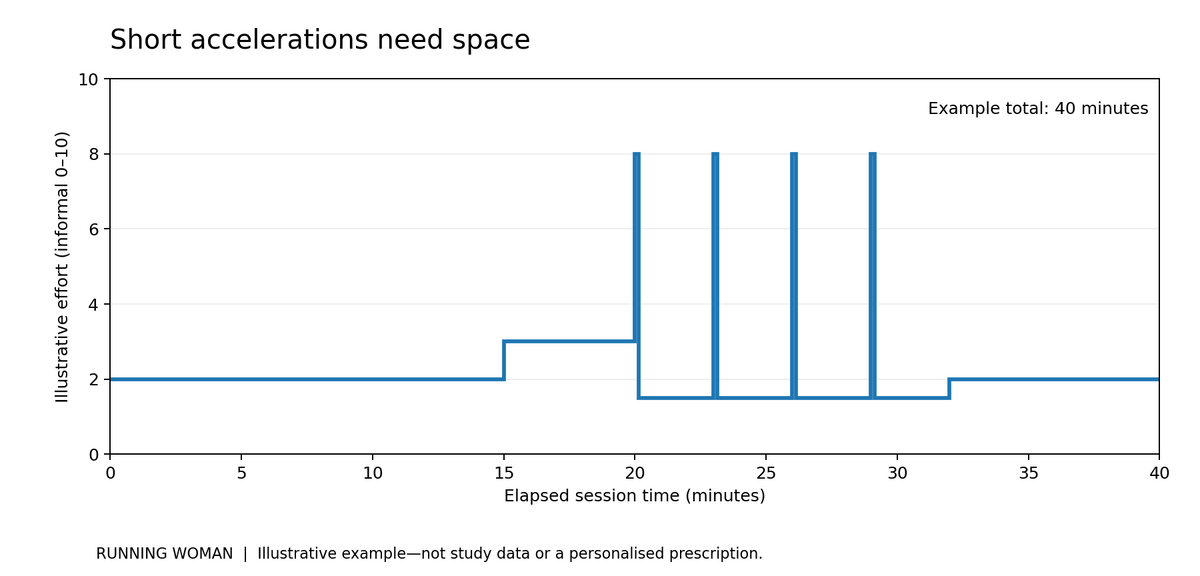
For an experienced runner already accustomed to short fast uphill efforts, a coach might use 15 minutes of easy warming up, 5 minutes of familiar preparatory movement, then 4 rounds of an 8-second controlled fast uphill acceleration and 2 minutes 52 seconds of easy recovery, followed by 8 easy minutes. Total time is 40 minutes.
This example is submaximal, not an instruction to reach absolute top effort. Each round occupies three minutes; extend recovery whenever quality has not returned. The total time is a planning illustration, not a physiological recovery guarantee.
Stop if coordination deteriorates, symptoms appear or the effort becomes strained. A near-maximal flat-ground sprint prescription would need its own individual assessment and is intentionally not supplied as a general beginner workout.
Where it belongs in a week
Speed-focused work belongs when you are sufficiently fresh to move well, not as an exhausted finisher after the week’s longest outing. The surrounding programme should recognise that a short session can still be demanding.
For an experienced runner, it may replace another faster-running element rather than become an additional one. Do not stack sprinting, plyometrics and a new heavy lower-body session together simply because each has a small time footprint.
Hill-training research concerns particular studied programmes, not a guarantee that every short hill effort is suitable for every runner.[3] The safest-looking location does not make dose irrelevant.
Where it belongs in the season
Introduce new speed demands gradually within a period that allows observation and adjustment. Avoid beginning maximal sprint work during a taper or while simultaneously extending long runs.
A runner whose current priority is building a dependable easy-running habit can leave sprinting out entirely. A runner preparing for an event with tactical accelerations may have more reason to discuss it with a coach.
Two common confusions
“I was not very breathless, so it did not count.” Breathlessness is not the sole measure of speed work. The purpose is not to make every training quality feel like an aerobic interval session.
“Shorter recovery makes it more advanced.” Sometimes it simply prevents you doing the intended work well. Full recovery is a feature, not a concession.
Quick running can be joyful. It becomes more useful when you give it its own purpose, preparation and space—not when you disguise a maximal effort as a harmless little extra.
Keep exploring
- Strides: a small dose of quicker running, not a secret sprint workout
- Hill repeats: making friends with the uphill bits
- Plyometric training: small jumps, careful landings and no need for a giant box
Sources and further reading
This guide is general education for adults, not an individual medical, rehabilitation or pregnancy/postpartum training plan. Seek qualified advice when symptoms, a health condition or a return from injury make exercise decisions uncertain.
-
Haugen T, Seiler S, Sandbakk Ø, Tønnessen E (2019). The Training and Development of Elite Sprint Performance: an Integration of Scientific and Best Practice Literature. Sports Medicine – Open. DOI:
10.1186/s40798-019-0221-0. ↩︎ -
Gibala MJ, Little JP, MacDonald MJ, Hawley JA (2012). Physiological adaptations to low-volume, high-intensity interval training in health and disease. The Journal of Physiology. DOI:
10.1113/jphysiol.2011.224725. ↩︎ -
Barnes KR, Hopkins WG, McGuigan MR, Kilding AE (2013). Effects of different uphill interval-training programs on running economy and performance. International Journal of Sports Physiology and Performance. DOI:
10.1123/ijspp.8.6.639. ↩︎