
You do not have to love hills to use them well. You do not even have to run to the top. A hill repeat is simply a planned piece of uphill running followed by enough recovery to do the next piece appropriately.
The important part is matching the hill and the dose to the job. A gentle thirty-second climb and a two-minute grind up a steep slope are not the same workout wearing different scenery.
The highlights
- Hill repeats come in several forms; longer aerobic efforts differ from very short hill sprints.
- Use effort rather than flat-ground pace, and recover downhill without racing.
- A hill session is still demanding even when the distance recorded looks small.
At a glance
Main purpose: Practise controlled uphill running and add a terrain-specific higher-effort stimulus.
Effort: Depends on repetition length; the examples are controlled, not maximal sprints.
Where it fits: Usually replaces another quality workout; keep neighbouring days easy or non-running.
When in a training cycle: Useful after a consistent base and when preparing for hilly events.
The examples below are original coaching illustrations, not protocols tested in the cited studies or personalised prescriptions. Effort numbers use an informal 0–10 guide, not a laboratory zone conversion. Choose an option within your current capacity; you never have to progress because a calendar says so.
What are hill repeats used for?
Repeated uphill running can provide a specific way to practise climbing and work at a higher effort without needing a track. A runner preparing for a hilly course may also use it to learn how different gradients change the rhythm she can maintain.
Some sessions use short controlled climbs. Others use longer repetitions for sustained aerobic work. Very short, fast hill sprints focus more on speed and force and deserve a different dose and recovery approach; they are covered in the sprint article.
Do not assume that hills replace every other sort of training. Running uphill is not identical to lifting weights, and being comfortable climbing does not automatically prepare you for long descents.
What the research says
Barnes and colleagues studied 20 trained runners across five uphill interval programmes over six weeks. Their starting caveat was:
“the optimal parameters for prescribing intervals are unknown”
— Barnes and colleagues, 2013.[1]
The study reported improvements in relevant performance measures, but the small groups and absence of a non-hill control limit claims about superiority. It does not prove that one hill length is best, or that every woman runner should add the same session.
The wider strength-training literature supports benefits from resistance work for running performance, but that is a separate evidence base.[2] “Hills are strength training in disguise” is a useful image only up to a point; it should not become a claim that the two are interchangeable.
Choose the hill before choosing the workout
For these examples, look for a modest incline on even, non-slippery ground, with enough room to slow safely. You should be able to maintain a recognisable running action rather than immediately scrambling or leaning onto your thighs.
A quieter, shorter hill close to home may be more useful than an impressive landmark. Check the descent too. The recovery route should be safe and manageable when you are breathing harder.
You do not need an exact gradient for an introductory session. Avoid turning a broad coaching suggestion into false precision: a suitable slope for one runner may feel very different to another.
How should the running feel?
Begin under control. Let speed change with the slope rather than trying to reproduce a flat-road pace. Think of a relaxed upper body and steps that feel manageable, not of forcing a particular foot strike or dramatically changing your posture.
The last few seconds should still look like running you chose, not running you are surviving. If you are straining or losing coordination, reduce the effort or stop the set.
Walk or jog back down as needed. Descending is not free recovery: downhill running can create substantial eccentric loading, especially when unfamiliar.[3] The return journey is not the place for an unplanned downhill race.
Two introductory structures
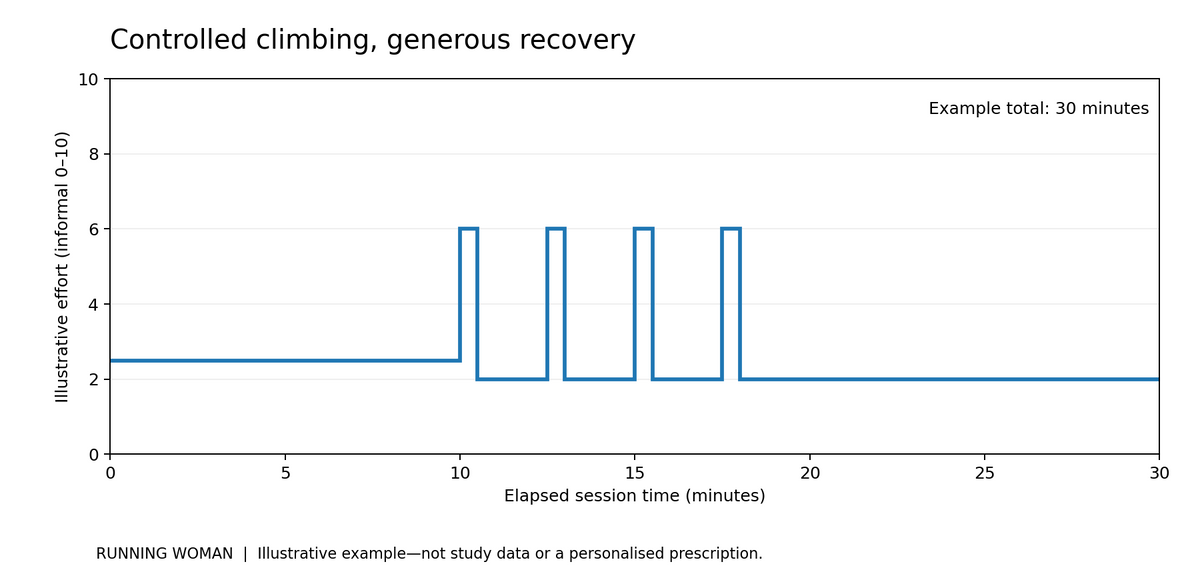
A modest controlled session: 30 minutes. Warm up with 10 easy minutes. Complete 4 rounds of 30 seconds uphill at a purposeful but controlled effort and 2 minutes of walking or gentle jogging recovery. Finish with 10 easy minutes. The four 2.5-minute rounds total 10 minutes.
For someone already accustomed to hills: 43 minutes. Warm up for 15 minutes. Complete 6 rounds of 1 minute uphill and 2 minutes easy recovery, then finish with 10 easy minutes. The total is 15 + 18 + 10 = 43 minutes.
Both examples include recovery after the final repetition. If returning safely takes longer, take longer; do not rush the descent to preserve the printed total. Choose a different hill or fewer repetitions next time if the logistics do not fit.
These are not sprint sessions. Keep the climbing repeatable. A beginner’s alternative is a gentle walk on the hill within an otherwise comfortable outing, without attempting the harder examples.
Where it fits in the week
Use the hill session instead of intervals, fartlek or tempo when it is the chosen quality workout. For an established three-run week, that could be Thursday between a Tuesday easy run and a Sunday conversational longer run.
If the Sunday route is also much hillier than usual, reduce another demand. Hill repetitions, a hard gym session and a long hilly run are not three unrelated tasks simply because they appear under different labels.
Avoid adding hills to a recovery outing. When the day’s aim is to keep demand low, choose terrain that makes that easier.
Where it fits in a training cycle
Introduce controlled hill work after ordinary running feels dependable. For a hilly event, practise the terrain progressively across the preparation period rather than saving the first serious hills for race week.
Early sessions can be short and technically straightforward. Later work may become more event-specific, but there is no need to increase gradient, repetition length and repetition count together.
Near a race, retain only familiar, appropriately reduced work. A new steep hill or a fast descent can add an unwanted surprise when the aim is freshness.
Questions worth asking
Are hills safer because I am running more slowly? Not automatically. Slower ground speed does not mean low effort or low tissue demand. The slope, recovery descent and your familiarity all matter. No hill protocol guarantees injury prevention.
Should I sprint the final repeat? Not unless sprinting is the deliberately planned and appropriate purpose—which it is not in these examples. Finishing with control is more useful than changing the session in the last thirty seconds.
Can I use a treadmill incline? Possibly, with a machine you know how to operate safely. Allow time for speed changes and keep the effort controlled. The treadmill article explains why indoor and outdoor pace should not be treated as exact equivalents.[4]
You do not need to conquer the hill. You need to use it for the session you actually intended.
Keep exploring
- Sprint training for distance runners: quick feet, full recovery, careful choices
- Trail and downhill running: training for the ground beneath your feet
- Strength training for runners: useful work that does not need to take over your life
Sources and further reading
This guide is general education for adults, not an individual medical, rehabilitation or pregnancy/postpartum training plan. Seek qualified advice when symptoms, a health condition or a return from injury make exercise decisions uncertain.
-
Barnes KR, Hopkins WG, McGuigan MR, Kilding AE (2013). Effects of different uphill interval-training programs on running economy and performance. International Journal of Sports Physiology and Performance. DOI:
10.1123/ijspp.8.6.639. ↩︎ -
Blagrove RC, Howatson G, Hayes PR (2018). Effects of Strength Training on the Physiological Determinants of Middle- and Long-Distance Running Performance: A Systematic Review. Sports Medicine. DOI:
10.1007/s40279-017-0835-7. ↩︎ -
Bontemps B, Vercruyssen F, Gruet M, Louis J (2020). Downhill Running: What Are The Effects and How Can We Adapt? A Narrative Review. Sports Medicine. DOI:
10.1007/s40279-020-01355-z. ↩︎ -
Miller JR, Van Hooren B, Bishop C, Buckley JD, Willy RW, Fuller JT (2019). A Systematic Review and Meta-Analysis of Crossover Studies Comparing Physiological, Perceptual and Performance Measures Between Treadmill and Overground Running. Sports Medicine. DOI:
10.1007/s40279-019-01087-9. ↩︎