
A progression run starts with patience and finishes with a little more purpose. That is the whole idea—not starting too fast, slowing in the middle and rescuing the average pace with a frantic final kilometre.
Done thoughtfully, it can help you practise changing gears. Done competitively every Sunday, it can also turn your supposedly easy long run into another race. The finish needs a plan before the start does.
The highlights
- A progression run gets gradually quicker or harder; the finishing effort should be decided in advance.
- A gentle easy-to-steady progression differs from a hard fast-finish long run.
- Add intensity instead of another demand, not automatically on top of it.
At a glance
Main purpose: Practise changing effort gradually and finishing a planned run under control.
Effort: Starts easy; ends at a clearly chosen steady or harder effort, depending on the version.
Where it fits: Can replace a quality session or alter a long run; count a demanding finish as harder work.
When in a training cycle: Useful after a stable base and in selected race-preparation sessions.
The examples below are original coaching illustrations, not protocols tested in the cited studies or personalised prescriptions. Effort numbers use an informal 0–10 guide, not a laboratory zone conversion. Choose an option within your current capacity; you never have to progress because a calendar says so.
What is a progression run?
A progression run changes effort gradually over the outing. One version moves from very easy to ordinary easy running. Another begins easy and ends steady. A more demanding version finishes near threshold or race effort.
These are not equivalent sessions. The word progression describes the direction of change, not a guaranteed intensity. A ten-minute steady finish and a long hard finish after two hours of running have very different practical costs.
A fast-finish long run is a specific variation: some faster running comes late in a longer outing. It is not the default way to do every long run.
What is it used for?
Our coaching rationale is to practise restraint early, recognise effort changes and finish with control. A planned transition can also make an ordinary route more engaging without needing a track or repeated stops.
For race preparation, progression may help rehearse the decision to hold back at the start. That is a skill-based rationale, not evidence that every race should be run with a large negative split.
A negative split means the second half takes less time than the first. It describes a result, not necessarily a successful strategy for every event, course or runner. Nor does practising a progression automatically guarantee one on race day.
What does the science say?
Abbiss and Laursen’s pacing review considers:
“how an athlete distributes work and energy throughout an exercise task”
— Abbiss and Laursen, 2008.[1]
The review concerns pacing in competition across different durations. It supports taking effort distribution seriously, but it is not a trial proving that progression runs outperform steady running as a training method.
We therefore separate the evidence from the application. The evidence concerns pacing. The application here is a deliberately controlled rehearsal of changing effort. The particular examples below are not validated optimums.
Observational long-run research also cannot establish that adding a hard finish makes a long run more effective for everybody.[2] Longer and faster are separate variables, not a compulsory pair.
How to keep it controlled
Decide the finishing effort before leaving. “Finish steady” is different from “finish as fast as possible”. Choose a route where terrain allows you to adjust sensibly, and let effort take priority over pace in wind or on hills.
The first part should feel almost restrained. Do not spend it worrying that you are damaging your average pace. The average is not the purpose of the session.
At each transition, make a small adjustment. You should not need to surge abruptly. If the planned final effort feels wrong that day, finish at the current effort or ease down. A progression is an option within the run, not an obligation you owe your watch.
A gentle easy-to-steady example
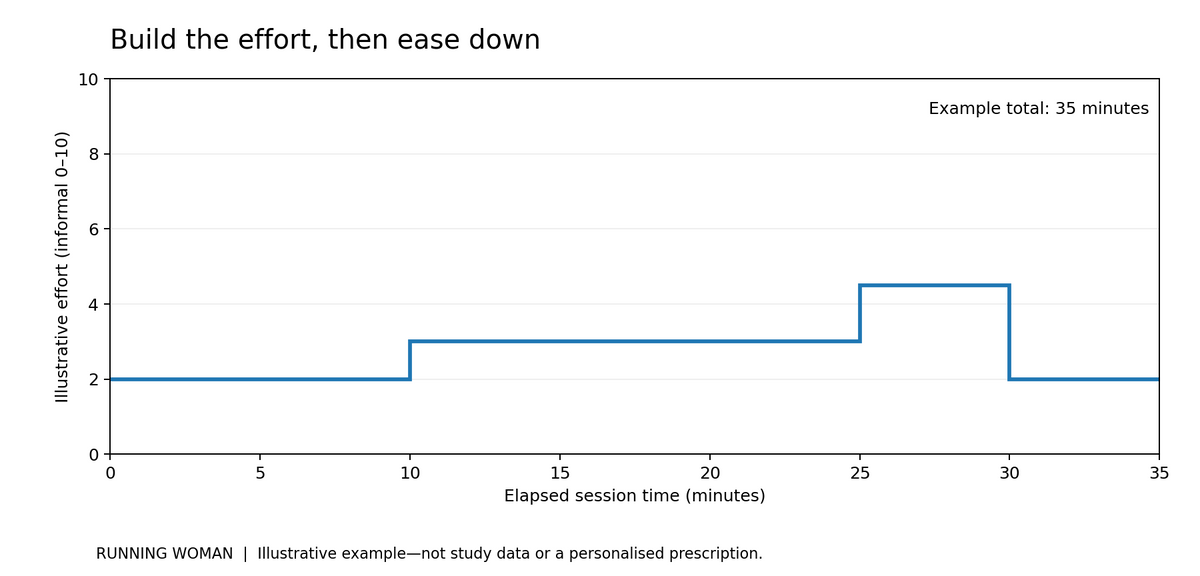
Total: 35 minutes. Run 10 minutes very easily, 15 minutes at ordinary easy effort, 5 minutes steady, then finish with 5 gentle minutes.
Only the final five-minute steady block goes above easy effort. This is an introduction for someone already comfortable with the total duration. It is not a threshold workout in disguise.
For a newer runner, the same shape can stay entirely comfortable: begin walking, alternate easy running and walking, and finish walking. There is no requirement to add harder running to create a worthwhile session.
A more substantial progression example
Total: 50 minutes. Run easily for 15 minutes, continue for 20 minutes at the upper end of your comfortable easy effort, complete 10 controlled steady minutes, then ease down for 5.
This remains a steady-finish example, not an all-out fast finish. Choose it only when the total duration and modest intensity change fit your established training.
An advanced race-pace finish belongs within an event-specific plan. Its length and target depend on your preparation and the race; no single fast-finish formula fits everybody.
Where it fits in a week
A meaningful progression can replace the week’s tempo or other quality session. On a three-run schedule, consider easy Tuesday, progression Thursday and a familiar conversational longer run on Sunday.
Alternatively, a coach may place the progression inside the long run. Then the long run is the more demanding outing, and another quality session may need to disappear or shrink. Do not count it as easy simply because it began that way.
Avoid pairing a first fast-finish experiment with a longer-than-usual run. A large cohort linked single-session distance spikes with injury risk; it did not establish a safe percentage for combining changes in distance and intensity.[3]
Where it fits across a training cycle
Start with a dependable easy-running routine. Introduce a small easy-to-steady finish when that fits comfortably, then assess how the whole week feels rather than progressing automatically.
During race preparation, more specific finishing blocks may serve a clear purpose. In lighter weeks, reduce or remove the finish. During tapering, the aim is to arrive fresh, not to set a new best training average.[4]
There is no reason that every Sunday must finish faster than the last. Repeating familiar training is not a failure to be ambitious.
Questions that help keep the session honest
Should the final part always be my fastest? Within the main progression, that is usually the intended shape. But safety, symptoms and appropriate effort come first. A gentle cool-down afterwards will be slower, deliberately.
Is a progression better than an easy run? It has a different job. Replacing every easy run with one removes the distinction that makes the harder work manageable.
What counts as success? You controlled the beginning, made deliberate changes and stopped the faster part where planned. The session did not need an unplanned sprint to feel complete.
There is something satisfying about finishing with a little left. It is a training choice, not a missed opportunity.
Keep exploring
- Long runs: building endurance without turning Sunday into a survival test
- Steady runs: the useful middle gear—and how not to live there
- Race-pace training: practising your event without racing every workout
Sources and further reading
This guide is general education for adults, not an individual medical, rehabilitation or pregnancy/postpartum training plan. Seek qualified advice when symptoms, a health condition or a return from injury make exercise decisions uncertain.
-
Abbiss CR, Laursen PB (2008). Describing and understanding pacing strategies during athletic competition. Sports Medicine. DOI:
10.2165/00007256-200838030-00004. ↩︎ -
Fokkema T et al. (2020). Training for a (half-)marathon: Training volume and longest endurance run related to performance and running injuries. Scandinavian Journal of Medicine & Science in Sports. DOI:
10.1111/sms.13725. ↩︎ -
Schuster Brandt Frandsen J et al. (2025). How much running is too much? Identifying high-risk running sessions in a 5200-person cohort study. British Journal of Sports Medicine. DOI:
10.1136/bjsports-2024-109380. ↩︎ -
Wang Z, Wang YT, Gao W, Zhong Y (2023). Effects of tapering on performance in endurance athletes: A systematic review and meta-analysis. PLOS ONE. DOI:
10.1371/journal.pone.0282838. ↩︎