
Somewhere between a chatty easy run and a properly demanding workout sits the steady run. It is the comfortable-looking middle gear: you are moving with purpose, but you are not trying to hold a difficult pace at all costs.
That middle gear can be useful. The catch is that it is also very easy to drift into it every time you leave the house. A steady run works best as a choice, not an accident.
The highlights
- Steady is a coaching term, not a universally agreed scientific zone.
- It should be more purposeful than easy running, but noticeably more controlled than threshold work.
- Count the extra demand honestly; do not relabel every medium-hard run as easy.
At a glance
Main purpose: Practise controlled sustained running above easy effort, when a programme has a reason for it.
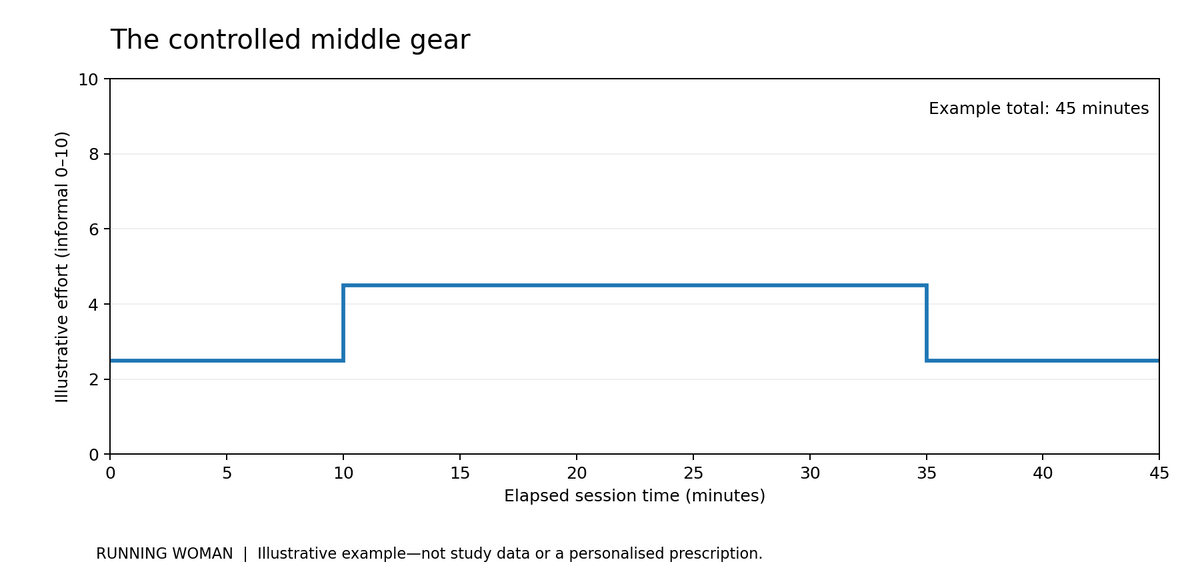
Effort: Purposeful but controlled; roughly 4–5 out of 10, below the threshold session described in this library.
Where it fits: Usually replaces part of an easy run or the week’s quality slot; not every run.
When in a training cycle: Useful in selected endurance-building and race-preparation phases.
The examples below are original coaching illustrations, not protocols tested in the cited studies or personalised prescriptions. Effort numbers use an informal 0–10 guide, not a laboratory zone conversion. Choose an option within your current capacity; you never have to progress because a calendar says so.
First, a definition we can actually use
In this library, steady means a sustained effort above your everyday easy running but below the comfortably hard threshold work described in the tempo article. Breathing is more noticeable. Conversation is still possible, but you may prefer shorter exchanges to an uninterrupted chat.
Other coaches use the word differently. A plan might call an easy aerobic run steady, or use it for marathon-paced running. Read the intended effort and duration rather than assuming the label always means the same thing.
This is not pedantry. Threshold research itself contains multiple concepts and definitions.[1] Adding a loosely defined coaching term on top is a good reason to be clear about what the session should feel like.
What is the purpose?
A steady block can give an established runner a measured step between relaxed running and harder sustained work. It can also be a way to practise patience: begin comfortably, settle into a slightly more purposeful rhythm and finish without escalating into a time trial.
For someone preparing for a longer event, selected steady running may offer useful rehearsal of controlled effort over time. Whether that resembles race pace depends on the event and the runner. The same effort cannot be called marathon pace for everybody.
Our coaching application is to give the session a specific job. “I am practising twenty controlled minutes without chasing the pace” is clearer than “I felt good, so I ran the whole week faster”.
Does the middle intensity have a bad reputation?
You may hear it dismissed as junk miles or a grey zone. That oversimplifies the evidence. Stöggl and Sperlich describe pyramidal training as a pattern in which:
“most training is at low intensity”
— Stöggl and Sperlich, 2015.[2]
Their review also describes moderate-intensity work within real endurance programmes. Its presence is not automatically a mistake. The question is proportion and purpose, not whether every minute must be either extremely easy or extremely hard.
Festa and colleagues found improvements under different training-intensity distributions in recreational runners.[3] That is a useful check on claims that there is only one legitimate way to organise training. It does not establish that a steady-heavy programme is best for every reader.
How should it feel?
Use the first few minutes of the steady block to settle, rather than jumping straight to the fastest pace you hope to hold. You should feel as though you have chosen a gear you can control. If breathing becomes ragged or the effort keeps climbing, back off.
Comfortable speech is a useful anchor for easier running, but the talk test is not a precise instrument for separating every neighbouring training label.[4] Do not turn “I can just about speak” into proof that a run belongs in a particular zone.
A simple personal check is whether you can finish the planned block without a desperate final minute. The answer should be yes. Another is whether the following easy day can genuinely stay easy, rather than becoming damage control.
Two worked examples
A first introduction for an established easy runner: 30 minutes. Run easily for 10 minutes, settle into a gentle steady effort for 10, and return to easy running for 10. The middle block is a modest change, not a hidden ten-minute race.
A longer controlled block: 45 minutes. Use 10 easy minutes, 25 steady minutes and 10 easy minutes. This is for someone already comfortable with the total duration. It is not a progression to make immediately after trying the shorter example once.
For both, choose a familiar, relatively flat route. A demanding hill in the middle can change the session from steady to hard even when pace falls. Effort takes priority over preserving a number.
A beginner’s adaptation is simpler: leave the steady block out and keep the outing easy or run–walk. You do not need a middle gear before you have a comfortable first one.
Where it fits in a week
On a three-run schedule, a steady session can occupy the quality slot that might otherwise contain fartlek, intervals or tempo running. Keep another outing easy. Keep the longer outing controlled and familiar in duration.
On a more established programme, a small steady block may sit within a longer run, but that changes the cost of that long run. Do not add it simply because the plan’s blank space looks inviting. When both duration and effort are rising, reduce another demand.
Avoid the sequence of steady Tuesday, hard Thursday, fast Saturday parkrun and long Sunday by calling the first of those easy. Accurate labels make the week easier to manage.
Where it fits across a training cycle
Steady running can be introduced after a period of dependable easy running, particularly when the aim is controlled sustained work rather than maximum speed. It can also be useful in a specific endurance phase when there is a clear event-related reason.
It is less useful when you are trying to recover, when every outing is already tiring, or when the upcoming race calls for freshness rather than another sizeable workout. A taper is not an opportunity to convert shorter runs into harder ones just to feel productive.
Common questions
Is steady running the same as tempo? Not in this library. We reserve tempo/threshold for a more demanding, sustained effort. Elsewhere, the terms overlap. Ask what intensity the coach intends rather than arguing over the name.
Should I do it every week? Only when it has a useful place. Alternating a steady session with fartlek or threshold work can provide variety without adding another quality day. There is no weekly quota to meet.
Steady running is a useful guest in a training plan. It does not need to move into every room.
Keep exploring
- Easy runs: the everyday miles that deserve more credit
- Tempo and threshold runs: comfortably hard, without the mystery
- Polarised, pyramidal and 80/20 training: sorting the week, not worshipping a percentage
Sources and further reading
This guide is general education for adults, not an individual medical, rehabilitation or pregnancy/postpartum training plan. Seek qualified advice when symptoms, a health condition or a return from injury make exercise decisions uncertain.
-
Faude O, Kindermann W, Meyer T (2009). Lactate threshold concepts: how valid are they?. Sports Medicine. DOI:
10.2165/00007256-200939060-00003. ↩︎ -
Stöggl TL, Sperlich B (2015). The training intensity distribution among well-trained and elite endurance athletes. Frontiers in Physiology. DOI:
10.3389/fphys.2015.00295. ↩︎ -
Festa L et al. (2020). Effects of Different Training Intensity Distribution in Recreational Runners. Frontiers in Sports and Active Living. DOI:
10.3389/fspor.2019.00070. ↩︎ -
Reed JL, Pipe AL (2014). The talk test: a useful tool for prescribing and monitoring exercise intensity. Current Opinion in Cardiology. DOI:
10.1097/HCO.0000000000000097. ↩︎