
Long is relative. For one woman it is her first continuous twenty minutes; for another it is an outing with snacks, spare socks and a surprisingly detailed opinion about public toilets. Both count.
The long run is the session where duration has the starring role. That does not mean running as far as possible. It means choosing a useful amount of time on your feet—and leaving enough of yourself for the rest of the week.
The highlights
- Your long run is longer than your usual outings, not a distance you have to earn the right to use.
- Most long runs can stay easy; adding a fast finish changes the training demand.
- A successful long run includes a realistic plan for recovery, food, fluids and getting home.
At a glance
Main purpose: Practise spending longer on your feet and prepare for the practical demands of longer events.
Effort: Usually conversational, roughly 2–4 out of 10; duration adds difficulty.
Where it fits: Often one longer outing per week, with an easy or rest day afterwards.
When in a training cycle: Built gradually during endurance preparation; shortened during lighter weeks and tapering.
The examples below are original coaching illustrations, not protocols tested in the cited studies or personalised prescriptions. Effort numbers use an informal 0–10 guide, not a laboratory zone conversion. Choose an option within your current capacity; you never have to progress because a calendar says so.
What is the long run used for?
Within a running programme, the long run offers a longer exposure to the activity you are preparing to do. It is also an opportunity to practise pacing, clothing, carrying supplies and, where relevant, eating and drinking while moving.
For a first 5K, the purpose might be feeling comfortable outside for a little longer. For a half marathon, it might be discovering a sustainable rhythm over an extended outing. For a marathon, the practical side becomes especially important: what you can carry, where you can replenish supplies and what happens when enthusiasm at the start exceeds the plan.
You do not need a race to enjoy a long run. A scenic loop and some uninterrupted headspace are perfectly good personal reasons. Training does not always need a finish-line photograph to justify it.
What does research tell us?
Fokkema and colleagues studied 556 half-marathon and 441 marathon runners. Some higher-volume and longer-run categories:
“were associated with a faster finish time”
— Fokkema and colleagues, 2020.[1]
This was observational, not a trial assigning everyone different long-run lengths. Faster or more experienced runners may also be better able to tolerate more training. The study therefore does not establish a mandatory distance, prove that adding miles causes the improvement, or tell you that a first-time runner should copy its higher-mileage groups.
A 2025 cohort of 5,205 runners associated runs more than 10% longer than the longest run in the previous 30 days with higher injury rates.[2] It does not establish that staying below a particular percentage guarantees safety. The useful caution is to notice the size of individual outings, not only the weekly total.
How long should yours be?
Start with what you have recently managed comfortably, not what somebody else’s marathon plan prints in bold. Consider your normal weekly running, how many days you run, how long the outing will take and how you recovered from the previous longer session.
Time can be a helpful planning unit. A fixed distance may mean very different amounts of time on your feet for different runners. That does not create one perfect time limit, but it makes the actual commitment visible.
Avoid treating “the long run must be exactly a quarter of weekly mileage” as a law. Equally, a very large weekend outing surrounded by almost no running deserves a rethink. A personalised event plan can reconcile those competing needs better than a single percentage.
Two sensible examples
For someone comfortable with 25–30-minute outings: 35 minutes. Walk for 5 minutes, use comfortable running or familiar run–walk intervals for 25, then walk for 5. This is an example only for someone for whom that amount is a modest extension—not a first running session.
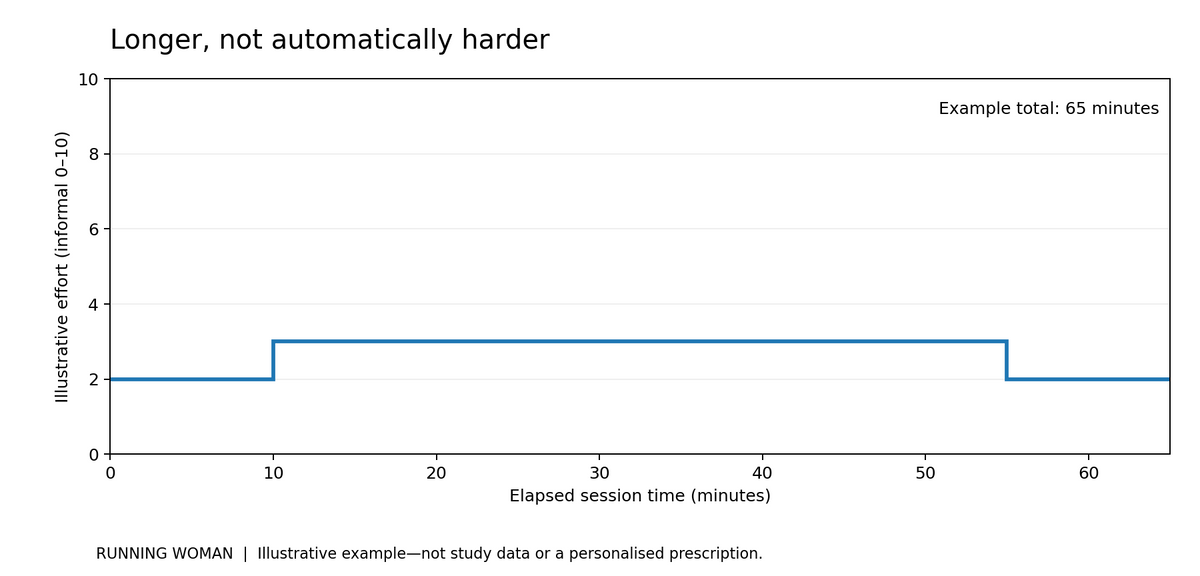
For an established runner already comfortable around an hour: 65 minutes. Begin with 10 particularly easy minutes, continue conversationally for 45, then ease down for 10. Keep the route straightforward. There is no prize for covering more ground than planned.
Walk breaks are welcome in either example. A small marathon comparison found less reported discomfort with run–walk, without establishing that the strategy removes cardiovascular stress or guarantees equal performance.[3]
Do not turn these examples into automatic weekly increases. Repeat a familiar duration when that is the sensible choice. Reducing the outing during a difficult week is an adjustment, not a setback.
What about the pace?
Most general long runs should feel controlled from the start. Comfortable conversation is a useful check, while remembering that a longer duration can still make the total session substantial.[4]
For this article, a fast finish is not the default. If a plan specifies race-pace blocks, progression or a demanding hilly route, treat that as a more challenging variation. It may replace the week’s other quality session rather than sit alongside it.
Never “bank” fast early miles so you can afford to slow later. Choose a start that leaves options open. The first part of a long run is not an audition.
Where it goes in the week and season
Sunday is conventional, not compulsory. Choose a day that offers enough time beforehand and afterwards. A Saturday morning may work better; a midweek day off is equally valid.
For an established three-day runner, a possible structure is Tuesday easy, Thursday a modest quality session or another easy run, and Sunday long. The long run itself may be the main challenge while you build duration, so faster work can wait.
Across a training cycle, first make the routine dependable, then extend selected outings gradually towards your event needs. Later, practise specific details on some long runs. In a taper, the outing gets shorter; it is not the moment to squeeze in missing preparation.
The practical details are part of the session
Plan access to fluids and carry food for an outing where you expect to need it. Practise familiar fuelling rather than deliberately under-eating to make the run “more effective”. The IOC consensus explains that problematic low energy availability can compromise health and performance.[5] Detailed race-fuelling quantities need their own individualised discussion; this article is not prescribing them.
Consider weather, daylight, toilets, phone coverage and a route that offers sensible exit points. Tell someone your plan when appropriate. A loop close to home can be more useful than a dramatic out-and-back that leaves you stranded when the session stops feeling right.
Questions that come up often
Must I cover the full race distance in training? Not necessarily. The answer differs between a first 5K and a marathon, and between runners. Your overall preparation matters more than collecting a single reassuring distance.
What counts as a good result? Completing an appropriate duration at the intended effort, learning something useful and recovering normally for you. Finishing utterly depleted is not a better grade.
The long run should help make your running world bigger—not make the rest of your life smaller.
Keep exploring
- Run–walk training: a proper running strategy, not a consolation prize
- Progression runs: starting gently and finishing with purpose
- Tapering: doing less so you can bring more to race day
Sources and further reading
This guide is general education for adults, not an individual medical, rehabilitation or pregnancy/postpartum training plan. Seek qualified advice when symptoms, a health condition or a return from injury make exercise decisions uncertain.
-
Fokkema T et al. (2020). Training for a (half-)marathon: Training volume and longest endurance run related to performance and running injuries. Scandinavian Journal of Medicine & Science in Sports. DOI:
10.1111/sms.13725. ↩︎ -
Schuster Brandt Frandsen J et al. (2025). How much running is too much? Identifying high-risk running sessions in a 5200-person cohort study. British Journal of Sports Medicine. DOI:
10.1136/bjsports-2024-109380. ↩︎ -
Hottenrott K, Ludyga S, Schulze S, Gronwald T, Jäger F-S (2016). Does a run/walk strategy decrease cardiac stress during a marathon in non-elite runners?. Journal of Science and Medicine in Sport. DOI:
10.1016/j.jsams.2014.11.010. ↩︎ -
Reed JL, Pipe AL (2014). The talk test: a useful tool for prescribing and monitoring exercise intensity. Current Opinion in Cardiology. DOI:
10.1097/HCO.0000000000000097. ↩︎ -
Mountjoy M et al. (2023). 2023 International Olympic Committee’s (IOC) consensus statement on Relative Energy Deficiency in Sport (REDs). British Journal of Sports Medicine. DOI:
10.1136/bjsports-2023-106994. ↩︎