
A blank square on a training calendar is not necessarily a gap. Sometimes it is exactly what belongs there.
Rest days and lighter weeks help make a running routine something you can live with, rather than a list of promises you spend the rest of your life trying not to break. You do not need to earn permission to use them.
The highlights
- Rest, an easy run and a hard non-running workout are different things.
- A cutback week reduces the total demand; there is no universal every-fourth-week rule.
- Persistent symptoms deserve assessment, not simply another motivational instruction to recover harder.
At a glance
Main purpose: Make room for recovery, changing circumstances and a sustainable relationship with training.
Effort: A rest day has no prescribed workout; a cutback week contains less overall demand.
Where it fits: Built into the routine and adjusted when circumstances require it.
When in a training cycle: Useful throughout training, after demanding periods and when the plan stops fitting the person.
The examples below are original coaching illustrations, not protocols tested in the cited studies or personalised prescriptions. Effort numbers use an informal 0–10 guide, not a laboratory zone conversion. Choose an option within your current capacity; you never have to progress because a calendar says so.
What is a rest day?
For this guide, it is a day without a prescribed training session. Normal daily movement is still normal life; you do not need to lie perfectly still to make the day legitimate.
The important distinction is that you are not required to replace the missing run with another workout. A demanding bike class or long hike may be enjoyable, but it is not automatically rest.
A recovery run is also still running. It may be a choice for some established runners, but it should not become a compulsory substitute for a genuinely non-training day.
What is a cutback week?
It is a deliberately lighter training week. You might shorten several outings, reduce the longer run, remove a purposeful faster session or reduce supporting work.
The reduction should be visible in the overall demand, not only the distance column. Dropping ten easy kilometres while adding a hard cycling class and new plyometrics may not produce the lighter week you intended.
A cutback is different from a taper, which is specifically organised before an event, and from post-event recovery, which responds to what the event actually required of you.
What does research say about recovery?
Sleep recommendations for athletes emphasise individual needs:
“We recommend an individualised approach” — Walsh and colleagues, 2021.[1]
The consensus also notes limitations in the evidence, including female representation. It does not establish one sleep target that diagnoses every runner’s readiness.
A review of active cool-downs found limited support for many claimed recovery benefits.[2] That is another reason not to confuse doing something that feels like recovery with proof that you are ready for more training.
Our practical interpretation is to make room for genuine reductions in demand, not simply add more recovery-labelled activities to an already crowded routine.
Is there a scientifically perfect cutback schedule?
No single calendar rule fits every runner. Three increasing weeks followed by a lighter fourth week is one coaching pattern, not a biological law.
A recent cohort associated abrupt increases in individual run distance with injury, but it did not establish a safe universal weekly progression rule.[3] Neither ten per cent nor every fourth week can promise that a plan is appropriate.
Use the calendar as a starting structure, then respond to the person. Sleep disruption, a demanding work period and an unusually difficult session may justify changing the plan before the scheduled lighter week arrives.
A straightforward rest-day example
Suppose your runs are Tuesday, Thursday and Sunday. Monday can simply contain ordinary life, with no requirement to add a recovery jog because Sunday was longer.
A comfortable walk may be pleasant, but it need not have a distance target. If you would rather spend the available time sitting with a book, that is not a less committed training choice.
For a beginner, non-running days between sessions are a sensible way to organise a gradual start, as illustrated by the NHS Couch to 5K structure.[4] The exact number of rest days should still fit your own circumstances.
A cutback-week illustration
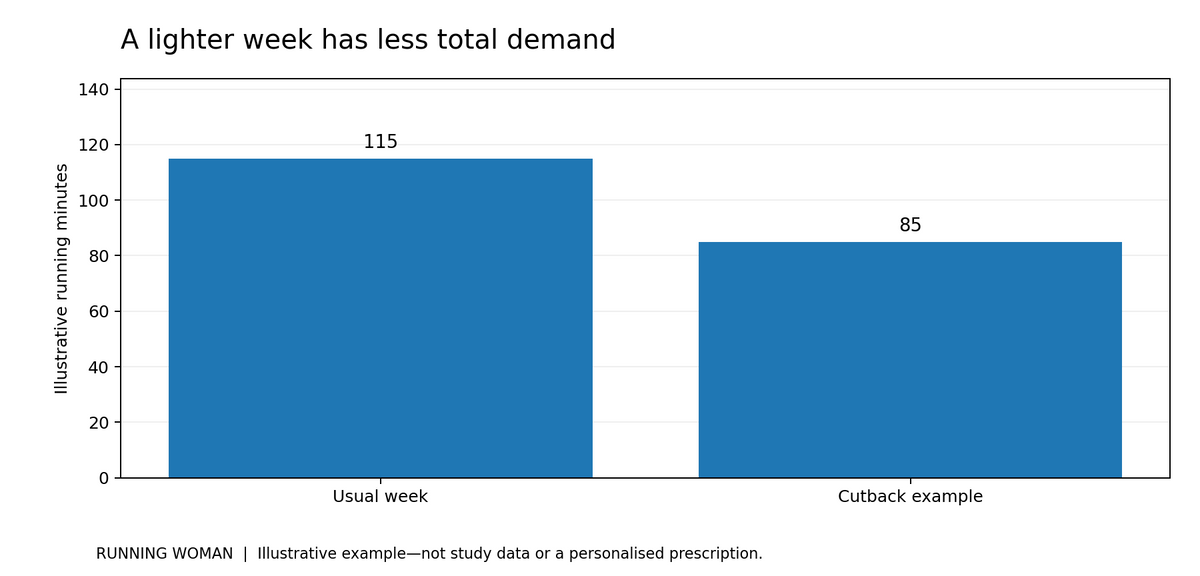
Imagine an established routine of three runs lasting 30, 35 and 50 minutes: 115 minutes total. A lighter example could be 25, 25 and 35 minutes, all comfortable, totalling 85 minutes.
That is about a 26% reduction in running time. It illustrates the arithmetic; it is not a universally recommended cutback percentage.
A different runner might remove one session entirely. Another might keep familiar short runs but omit a demanding main set. Choose the change that actually makes the week easier, rather than the one that preserves the most impressive numbers.
What should happen afterwards?
Do not treat the lighter week as debt. There are no missed kilometres to repay.
Review how you feel and return to an appropriate routine, which may be the same familiar week rather than a new peak. If the cutback has not addressed ongoing symptoms, the answer is not automatically to push through because the designated recovery period has ended.
A clinician or qualified coach can help distinguish a training-plan question from something that needs assessment. The calendar cannot do that job.
A note for women runners
A menstrual-cycle meta-analysis found small average performance effects and substantial limitations, supporting individual adjustment rather than a universal phase-based training schedule.[5] You do not need a rigid calendar telling you which type of run every woman should do on a particular day of her cycle.
Pay attention to your own experience, and seek advice for persistent or concerning changes rather than explaining everything away as normal training. The IOC’s REDs consensus highlights the health and performance implications of problematic low energy availability.[6]
Persistent fatigue, recurrent injuries or menstrual changes are reasons to discuss the situation with a qualified clinician, not a self-diagnosis checklist or an instruction to eat a specific amount from this article.
Rest after illness, injury or an event
These situations may need more than an ordinary cutback. Follow appropriate medical or rehabilitation guidance where relevant, and judge post-event return by the event’s demands and your recovery rather than social-media streaks.
Running a race easily can still be a substantial outing if its duration is unfamiliar. The finish-line medal does not remove its place in the training load.
There is no need to prove commitment by being the first person back on the same route. The next useful session is the one that fits your actual readiness.
Common questions
Will a rest day make me lose everything? Training adaptations are not an attendance stamp that vanishes after one blank day. Research on maintenance shows that reduced training can preserve some capacities in specific settings.[7]
Can I move my rest day? Yes. A plan should serve your week, provided the change does not bunch demanding sessions together without consideration.
What if resting makes me feel guilty? Treat the rest day as a deliberate part of the plan rather than an exception that needs defending. If exercise guilt becomes persistent or distressing, seek support.
You are allowed to finish a training week with energy left for being a person. That is a good outcome, not an accounting error.
Keep exploring
- Recovery runs: when a gentle jog helps—and when rest is better
- Tapering: doing less so you can bring more to race day
- Cross-training for runners: keeping the purpose, changing the movement
Sources and further reading
This guide is general education for adults, not an individual medical, rehabilitation or pregnancy/postpartum training plan. Seek qualified advice when symptoms, a health condition or a return from injury make exercise decisions uncertain.
-
Walsh NP et al. (2021). Sleep and the athlete: narrative review and 2021 expert consensus recommendations. British Journal of Sports Medicine. DOI:
10.1136/bjsports-2020-102025. ↩︎ -
Van Hooren B, Peake JM (2018). Do We Need a Cool-Down After Exercise? A Narrative Review of the Psychophysiological Effects and the Effects on Performance, Injuries and the Long-Term Adaptive Response. Sports Medicine. DOI:
10.1007/s40279-018-0916-2. ↩︎ -
Schuster Brandt Frandsen J et al. (2025). How much running is too much? Identifying high-risk running sessions in a 5200-person cohort study. British Journal of Sports Medicine. DOI:
10.1136/bjsports-2024-109380. ↩︎ -
NHS (undated guidance; checked 3 October 2026). Get running with Couch to 5K. NHS. ↩︎
-
McNulty KL et al. (2020). The Effects of Menstrual Cycle Phase on Exercise Performance in Eumenorrheic Women: A Systematic Review and Meta-Analysis. Sports Medicine. DOI:
10.1007/s40279-020-01319-3. ↩︎ -
Mountjoy M et al. (2023). 2023 International Olympic Committee’s (IOC) consensus statement on Relative Energy Deficiency in Sport (REDs). British Journal of Sports Medicine. DOI:
10.1136/bjsports-2023-106994. ↩︎ -
Spiering BA, Mujika I, Sharp MA, Foulis SA (2021). Maintaining Physical Performance: The Minimal Dose of Exercise Needed to Preserve Endurance and Strength Over Time. Journal of Strength and Conditioning Research. DOI:
10.1519/JSC.0000000000003964. ↩︎