
Base-building is what happens when you stop asking every run to prove something and start asking whether your routine actually works. Can you repeat it? Does it fit your life? Do you still have enough enthusiasm to lace up next week?
It is less glamorous than a dramatic interval session, but a routine that survives a normal Tuesday is a rather valuable foundation.
The highlights
- Base-building is a phase or approach, not a particular workout.
- Begin with a repeatable routine rather than somebody else’s mileage.
- Progress can mean making the same running feel more manageable, not always adding more.
At a glance
Main purpose: Create a repeatable foundation of manageable running before adding more event-specific demands.
Effort: Mostly comfortable; consistency is the main aim, not a mandatory mileage target.
Where it fits: Describes the shape of several weeks, not an extra session in the week.
When in a training cycle: Especially useful when beginning, returning or moving between race-focused periods.
The examples below are original coaching illustrations, not protocols tested in the cited studies or personalised prescriptions. Effort numbers use an informal 0–10 guide, not a laboratory zone conversion. Choose an option within your current capacity; you never have to progress because a calendar says so.
What is base-building?
It is a period in which the priority is establishing or rebuilding regular, manageable running. The sessions are usually straightforward: easy running, run–walk outings and, where appropriate, a slightly longer easy session.
For a new runner, the base may be two short outings a week. For an experienced runner, it may involve returning to a familiar routine after an off-season. The same label covers very different starting points.
Do not compare the numbers without comparing the person. A base is something that supports your next step; it is not a minimum weekly distance required for permission to train properly.
What is it used for?
The practical aims are consistency, familiarity and room to make later decisions. A stable routine helps you notice how an individual change affects the week.
It also gives you time to solve ordinary problems: finding a comfortable route, deciding which days genuinely work, learning to keep easy runs easy and organising any supporting strength work.
A review of elite distance-running practice describes predominantly low-intensity running within much larger training volumes.[1] The useful principle here is the importance of manageable running, not the elite mileage itself.
What does the evidence support?
The NHS Couch to 5K structure illustrates a gradual introduction using running and walking with non-running days between sessions.[2] It is one practical model, not evidence that everybody must reach the same endpoint on the same date.
A large running cohort associated single-session distance spikes with injury.[3] That finding supports caution about abrupt long outings, but it does not validate the familiar weekly ten-per-cent rule as a guarantee of safety.
There is no single scientifically established base-building calendar that fits all recreational runners. The examples in this article are coaching illustrations designed to make the choices visible.
Running Woman’s editorial takeaway: Build a week you can repeat before building a week you can barely survive.
A starting routine
Someone already comfortable walking briskly might choose two short run–walk outings on non-consecutive days. For example, each outing could last 20 minutes: 5 minutes walking, five cycles of 1 minute gentle running and 1 minute walking, then 5 minutes walking.
Repeat that routine before deciding whether another running day or more time is appropriate. A shorter option, or walking alone, may be the better starting point for an individual.
The first achievement is not continuous running. It is finding a manageable amount of movement that fits without leaving the rest of the week feeling like a recovery exercise.
An established-runner illustration
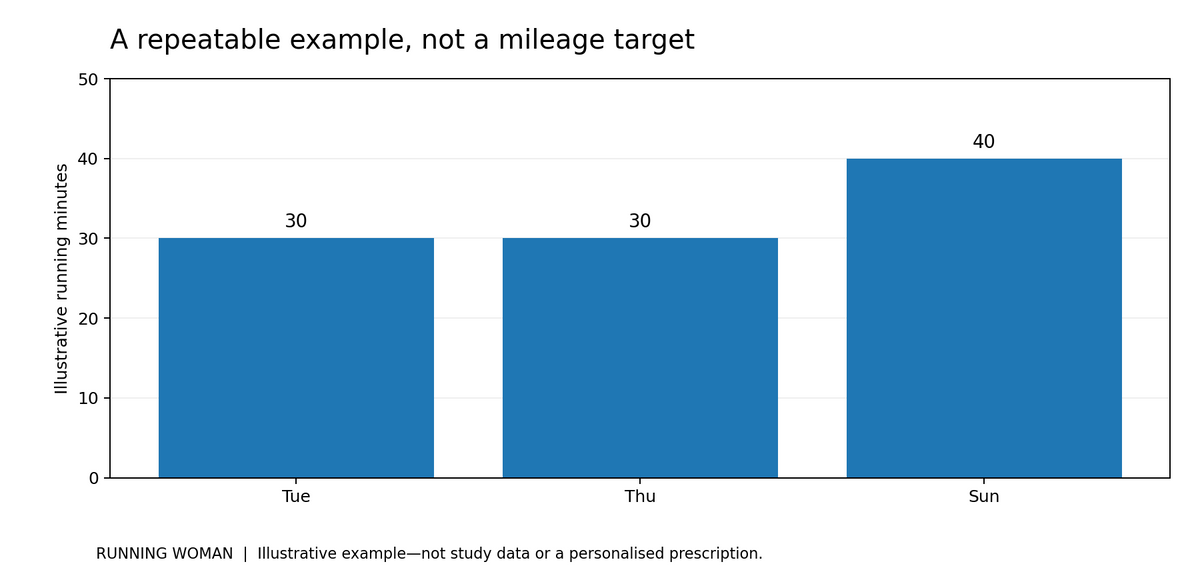
A runner already comfortable with these durations might use three conversational outings: 30 minutes on Tuesday, 30 minutes on Thursday and 40 minutes on Sunday.
That is 100 minutes in the week, not a starting target for everybody. It is useful because the structure is uncomplicated and the longer outing is only modestly longer than the others.
Repeat it, shorten it during a difficult week, or make one small adjustment when the routine genuinely supports that. There is no need to add a tempo session simply because the easy running has begun to feel pleasant.
How to decide what changes next
Ask which problem the change is meant to solve. More time may help prepare for a longer outing; another short day may suit a different schedule; a small amount of familiar strength work may address a separate goal.
Choose one meaningful change rather than extending the long run, adding intervals and increasing gym work together. This makes your response easier to interpret.
Record simple observations alongside duration: overall effort, whether the session remained comfortable and how the following day felt. A few useful notes beat a complicated spreadsheet that makes you anxious about ordinary variation.
Does base-building mean never running quickly?
Not necessarily. An established runner might retain a small amount of familiar, controlled quicker running, such as a few strides. But that is different from turning the phase into a full programme of hard sessions.
For a beginner or someone returning after a difficult period, there is no obligation to add speed. Easy running and walking can be the complete plan for now.
Use the phase’s purpose as the test: does the addition support a stable routine, or does it make the week harder to repeat? “It looks more serious” is not a particularly useful training objective.
Where strength and cross-training fit
Start modestly and count them as part of the whole workload. A short familiar strength routine may fit well; a new demanding class on every non-running day may defeat the point of simplifying.
Research on maintenance distinguishes preserving some fitness from continually trying to improve it.[4] During a busy life period, a smaller stable routine can be a deliberate aim rather than a failed attempt at a bigger one.
You do not have to occupy every blank square on the calendar. Blank squares can be doing important practical work.
How long should the phase last?
Long enough for the routine to become manageable and relevant to your next goal. That may mean several weeks, but this article deliberately avoids a universal duration.
If you have an event date, work backwards from an appropriate plan and your starting point. If there is not enough preparation time, reconsider the event approach rather than compressing the missing base into a sudden increase.
You can also remain in a comfortable general-running routine without moving into a race-focused phase at all. Base-building need not be a waiting room for “real” running.
Common questions
Must the long run grow every week? No. Holding it steady is a valid choice, particularly while another part of life or training changes.
What happens after a missed week? Reassess the current starting point. Do not stack the missed outings into the next week.
How do I know I am ready for more? Look for a routine that feels repeatable, then introduce one appropriate change. Readiness is not an award unlocked by reaching a magic mileage.
The best base is not necessarily the biggest one. It is the one that supports the running—and the life—you actually want.
Keep exploring
- Easy runs: the everyday miles that deserve more credit
- Run–walk training: a proper running strategy, not a consolation prize
- Strength training for runners: useful work that does not need to take over your life
Sources and further reading
This guide is general education for adults, not an individual medical, rehabilitation or pregnancy/postpartum training plan. Seek qualified advice when symptoms, a health condition or a return from injury make exercise decisions uncertain.
-
Haugen T, Sandbakk Ø, Seiler S, Tønnessen E (2022). The Training Characteristics of World-Class Distance Runners: An Integration of Scientific Literature and Results-Proven Practice. Sports Medicine – Open. DOI:
10.1186/s40798-022-00438-7. ↩︎ -
NHS (undated guidance; checked 3 October 2026). Get running with Couch to 5K. NHS. ↩︎
-
Schuster Brandt Frandsen J et al. (2025). How much running is too much? Identifying high-risk running sessions in a 5200-person cohort study. British Journal of Sports Medicine. DOI:
10.1136/bjsports-2024-109380. ↩︎ -
Spiering BA, Mujika I, Sharp MA, Foulis SA (2021). Maintaining Physical Performance: The Minimal Dose of Exercise Needed to Preserve Endurance and Strength Over Time. Journal of Strength and Conditioning Research. DOI:
10.1519/JSC.0000000000003964. ↩︎