
You do not have to run continuously to belong here. Planned walking breaks are a way to organise a session, not an apology for it.
Run–walk training can help make starting feel possible, give a return to running some structure, or provide a deliberate strategy for an event. The ratio is a tool. It is not your ranking as a runner.
The highlights
- Walking can be planned from the start rather than saved for the moment you feel overwhelmed.
- Keep the running portions comfortable; this is not automatically a high-intensity interval session.
- There is no universal run-to-walk ratio, and continuous running is not a compulsory destination.
At a glance
Main purpose: Build manageable running exposure or rehearse a sustainable event strategy using planned walking breaks.
Effort: Usually conversational; the run portions need not be fast.
Where it fits: Can be used for any easy outing or longer session.
When in a training cycle: Useful from the first week of running through to event preparation.
The examples below are original coaching illustrations, not protocols tested in the cited studies or personalised prescriptions. Effort numbers use an informal 0–10 guide, not a laboratory zone conversion. Choose an option within your current capacity; you never have to progress because a calendar says so.
What is run–walk training?
It is an outing that alternates running with walking according to a plan. The plan might be time-based, such as one minute running and ninety seconds walking, or route-based, such as walking a particular hill.
The intention distinguishes it from a speed workout. Although both use repeated blocks, a beginner run–walk session is commonly about manageable exposure and confidence, not hard repetitions.
Some runners gradually lengthen the running sections. Others keep walking breaks because they like the rhythm or find it useful for longer outings. Both approaches belong in a running routine.
What is it used for?
The immediate practical benefit is organisation. Instead of wondering whether you must keep running until you cannot, you know that the next walk is already part of the session.
That makes the workout easier to describe, repeat and adjust. You can change the length of a running block without also changing the total time outdoors, for example. Keeping those decisions separate is often more useful than chasing a continuous-running milestone every week.
The NHS Couch to 5K programme uses progressive running and walking across three sessions per week, with rest days between them.[1] Its structure is one accessible starting option—not a deadline every body must meet.
What does the research say?
A marathon study involving 42 recreational runners, including 20 women, compared continuous running with a run–walk strategy. The run–walk group reported:
“less muscle pain and fatigue” — Hottenrott and colleagues, 2016.[2]
The study did not find a statistically significant difference in finishing time. That does not prove the strategies always produce equivalent times. Nor did run–walk reduce the measured cardiac stress. It was a small event-specific study, not proof that walking breaks prevent running injuries.
The useful conclusion is modest: planned walking is a legitimate strategy to consider, including beyond beginner running. The right approach still depends on your preparation, event and preferences.
A first-session illustration
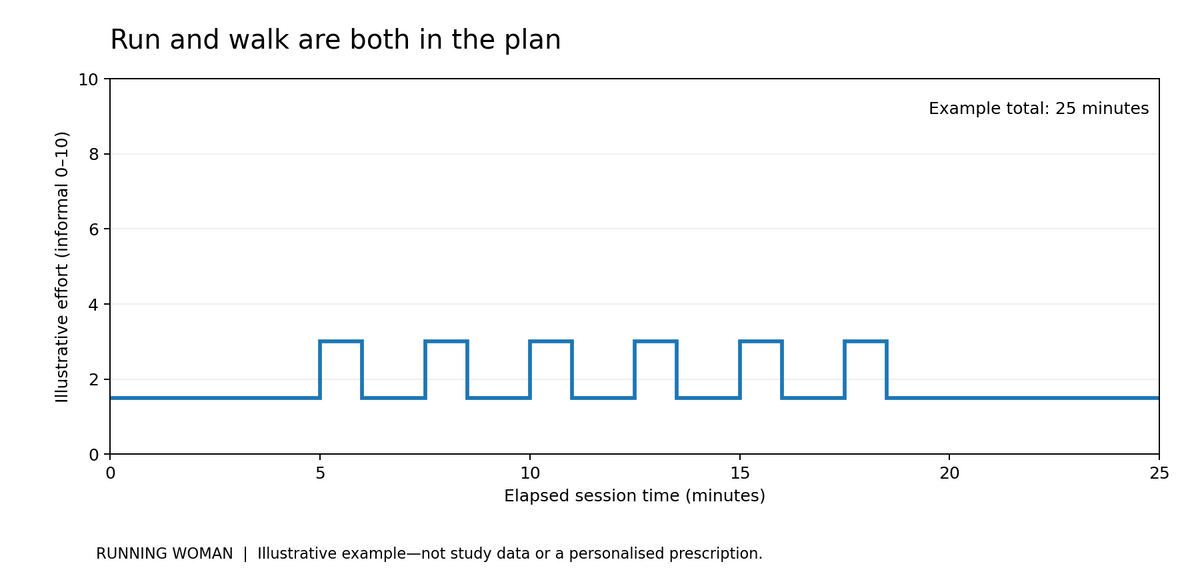
Total: 25 minutes. Begin with 5 minutes of comfortable walking. Repeat 1 minute of gentle running followed by 90 seconds walking six times. Finish with 5 minutes walking.
There are 6 minutes of running within the 25-minute outing. The final walking period inside the sixth cycle is included before the separate closing walk.
This is an illustration, not a requirement to complete six repetitions. A shorter version may be more appropriate. For someone entirely new to exercise, brisk walking alone can be the starting activity while they establish what feels manageable.
During the running minute, aim for an effort at which conversation remains possible. The talk test is a practical intensity cue rather than an exact laboratory measurement.[3]
An established-runner example
For someone already comfortable with the duration, consider 42 minutes: 5 minutes easy walking, eight cycles of 3 minutes easy running and 1 minute walking, then 5 minutes walking.
This contains 24 running minutes and 18 walking minutes. It is not inherently better than a different ratio. Its purpose is to create a familiar rhythm that you can finish comfortably and repeat when it fits.
On a hilly route, planned walking may follow terrain rather than the timer. Keep the overall purpose clear: walking the uphill should not become permission to sprint every descent.
How to progress without making it a weekly exam
Choose one thing to adjust when the existing session feels comfortably repeatable: a little more total time, a slightly longer running block, or another repetition. You do not need to change all three.
You can also repeat the same session. You can shorten it after an unusually demanding week. Neither choice erases the runs you have already done.
A recent large cohort associated single-session distance spikes with injury; it did not establish a universally safe progression percentage.[4] A run–walk label does not make a large distance increase automatically harmless.
Where it fits in a week
A new routine might contain two or three short run–walk outings separated by non-running days. Use a duration you already manage, rather than assuming that every outing must match the examples above.
For an established runner, run–walk can organise an easy run or a longer event-preparation outing. It can also be a sensible way to keep a social run conversational when the group agrees on the format.
Returning after injury is different from starting a generic programme. Use the loading and symptom guidance agreed with the clinician managing your return; an internet ratio cannot replace that plan.
When in a training cycle?
Run–walk is useful during initial habit-building, after a period of reduced running and when rehearsing a longer event strategy. If you intend to use it on race day, practise it beforehand rather than discovering the practicalities after several hard kilometres.
Agree how the walk breaks will work with a running companion. In a crowded event, check behind you and move safely aside before slowing. Planning should help you and the people around you.
There is no seasonal rule saying that walking must disappear as soon as training becomes more serious. Sustainable and serious are perfectly capable of being friends.
Questions worth asking
Am I allowed to call it a run? Yes. Your training log does not need an apology paragraph.
Should I run the running blocks faster because I get a walk? Not when the purpose is an easy session. Keep the running effort appropriate to that purpose.
What if continuous running is my goal? Gradually explore longer comfortable blocks while preserving the option to walk. Missing a calendar milestone is a reason to adjust the plan, not to judge yourself.
Can I keep walking breaks forever? Absolutely. Your preferred way of moving is not a temporary membership category.
Keep exploring
- Easy runs: the everyday miles that deserve more credit
- Long runs: building endurance without turning Sunday into a survival test
- Base-building: making running fit before making it harder
Sources and further reading
This guide is general education for adults, not an individual medical, rehabilitation or pregnancy/postpartum training plan. Seek qualified advice when symptoms, a health condition or a return from injury make exercise decisions uncertain.
-
NHS (undated guidance; checked 3 October 2026). Get running with Couch to 5K. NHS. ↩︎
-
Hottenrott K, Ludyga S, Schulze S, Gronwald T, Jäger F-S (2016). Does a run/walk strategy decrease cardiac stress during a marathon in non-elite runners?. Journal of Science and Medicine in Sport. DOI:
10.1016/j.jsams.2014.11.010. ↩︎ -
Reed JL, Pipe AL (2014). The talk test: a useful tool for prescribing and monitoring exercise intensity. Current Opinion in Cardiology. DOI:
10.1097/HCO.0000000000000097. ↩︎ -
Schuster Brandt Frandsen J et al. (2025). How much running is too much? Identifying high-risk running sessions in a 5200-person cohort study. British Journal of Sports Medicine. DOI:
10.1136/bjsports-2024-109380. ↩︎