
A treadmill run still counts. You do not owe the weather an explanation, and you do not need to make the belt steeper to prove that the workout was real.
The useful question is the same indoors as outdoors: what job is this run doing today? Once you know that, the buttons become tools rather than instructions to keep increasing something.
The highlights
- A treadmill is a setting: you can use it for easy running, run–walk, steady work or suitable intervals.
- Indoor and outdoor running are not perfectly interchangeable at every speed or on every measure.
- Choose an appropriate effort rather than treating one incline setting as a universal correction.
At a glance
Main purpose: Complete a planned running session indoors with controllable speed and gradient.
Effort: Depends on the session; treadmill does not mean easy or hard by itself.
Where it fits: Replaces the outdoor session whose purpose it matches.
When in a training cycle: Useful whenever indoor running fits your circumstances; retain event-relevant outdoor familiarity when possible.
The examples below are original coaching illustrations, not protocols tested in the cited studies or personalised prescriptions. Effort numbers use an informal 0–10 guide, not a laboratory zone conversion. Choose an option within your current capacity; you never have to progress because a calendar says so.
Is treadmill running a separate training type?
Not quite. It changes the environment, while the underlying session might remain an easy run, a progression, run–walk training or a controlled hill workout.
This distinction matters. Forty easy minutes on a treadmill belong with your easy running; a demanding interval session belongs with your demanding work. Indoor kilometres should not vanish from your training-load thinking simply because they happened beside the laundry room.
The belt provides a controlled speed, but your response to that speed still matters. Treat the display as information, not a command that overrides how you feel.
What is it useful for?
Practical reasons include convenience, lighting, avoiding unsuitable outdoor conditions and working with a route that does not require leaving home. Some runners find the predictability reassuring; others find the experience deeply boring. Both are allowed.
It can help structure a session because the speed and gradient are adjustable. That same convenience can encourage excessive precision: adding another decimal place is not necessarily a meaningful improvement in the workout.
Choose the simplest setup that achieves the purpose. A comfortable easy run does not need fifteen incline changes and a motivational graph shaped like a mountain range.
What does the research say?
A systematic review and meta-analysis compared motorised treadmill and overground running. Its conclusion was appropriately qualified:
“Some, but not all, variables differ between treadmill and overground running” — Miller and colleagues, 2019.[1]
The differences depended on factors including speed and the outcome measured. A single conversion rule therefore cannot make every treadmill session physiologically identical to an outdoor run.
This guide does not prescribe a universal one-per-cent incline, nor claim that zero incline makes the workout ineffective. Select a comfortable setting, adjust effort appropriately and use outdoor practice when your goal requires familiarity with outdoor conditions.
The review is a comparison of running conditions, not proof that one environment prevents injuries better than the other.
Effort before display numbers
For easy running, comfortable conversation remains a useful practical guide, with the usual limitation that it is not a precise threshold test.[2] You should not need to cling to the rails to maintain the chosen speed.
Do not assume the pace shown by a wrist device will exactly match the treadmill display. Rather than arguing with both, record the workout consistently and focus on completing the intended effort. Precise device validation is outside this guide.
Keep the room comfortable and make drinking accessible when needed. Equipment settings cannot compensate for feeling unwell or for a workout that is too demanding today.
A straightforward easy session
Total: 30 minutes. Start with 5 minutes of walking or very easy running, continue for 20 comfortable minutes, then ease down for 5 minutes.
Run–walk breaks can replace continuous running in the middle. For example, four cycles of 3 minutes running and 2 minutes walking create the same 20-minute section.
Use a total duration already within your capacity. The goal is familiarity with the machine and the easy effort, not seeing how long you can tolerate a new setting.
NHS beginner guidance uses a gradual run–walk structure with rest between running days.[3] Moving that general idea indoors does not remove the need to keep the workload manageable.
An established-runner session
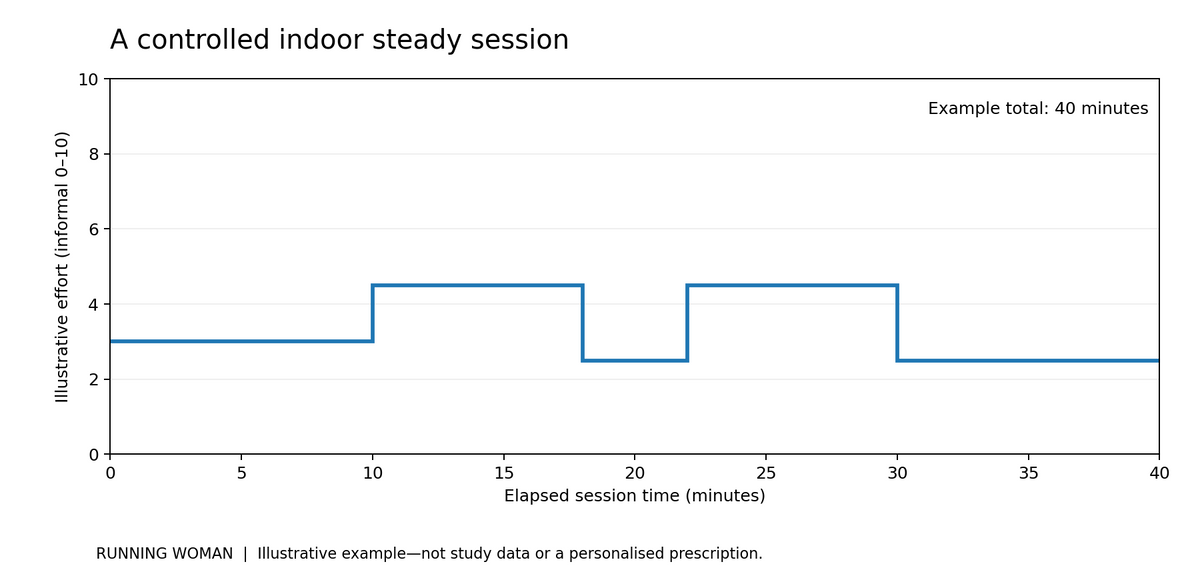
A controlled steady session might total 40 minutes: 10 minutes easy, 8 minutes steady, 4 minutes easy, another 8 minutes steady, and 10 minutes easy.
The steady sections should remain controlled, not become a competition with your previous treadmill setting. Leave enough time for safe speed transitions; approximate blocks are perfectly acceptable.
This is an illustration for a runner already used to that duration and a little purposeful work. It replaces a steady or other quality outing rather than joining the week as a bonus challenge.
What about hills and intervals?
A modest incline can create an uphill session without needing an outdoor hill, provided your machine and experience suit the task. Uphill training research should not be read as permission to make the gradient extreme.[4]
Very short fast repetitions can be awkward because the belt takes time to accelerate and decelerate. Do not jump onto or off a moving belt to imitate a track session. A simpler, longer controlled block—or a different workout—is usually the more sensible choice for this guide.
True maximal sprinting is not a generic treadmill recommendation. Its demands and the equipment risks deserve individual supervision.
Where it fits in your routine
Match the treadmill session to the session it replaces. An easy outdoor run becomes easy indoors; a long run remains a long run, with the same need to consider duration and the rest of the week.
Avoid adding incline merely because an indoor run feels insufficiently impressive. If you add a meaningful hill stimulus, you have changed the session, not simply corrected its location.
For an outdoor race, include opportunities to practise the relevant surface, turns and pacing decisions outside when practical. The treadmill is useful preparation, not a complete simulation of every event.
Equipment and safety questions
Learn the controls before starting, use the safety stop as directed by the manufacturer and keep children, pets and loose items away from the moving belt. Stop the belt fully before stepping off.
Can I hold the rails? Use support as needed for safe access, but if sustained running requires hanging on, reduce the setting or choose walking. A clinician may give different advice for a specific rehabilitation task.
Is watching something allowed? Only where it does not compromise your awareness or safe use. Entertainment is optional; staying upright is the priority.
Do indoor miles count? Completely. Choose the effort honestly, finish safely and let the weather have its own workout outside.
Keep exploring
- Easy runs: the everyday miles that deserve more credit
- Hill repeats: making friends with the uphill bits
- Run–walk training: a proper running strategy, not a consolation prize
Sources and further reading
This guide is general education for adults, not an individual medical, rehabilitation or pregnancy/postpartum training plan. Seek qualified advice when symptoms, a health condition or a return from injury make exercise decisions uncertain.
-
Miller JR, Van Hooren B, Bishop C, Buckley JD, Willy RW, Fuller JT (2019). A Systematic Review and Meta-Analysis of Crossover Studies Comparing Physiological, Perceptual and Performance Measures Between Treadmill and Overground Running. Sports Medicine. DOI:
10.1007/s40279-019-01087-9. ↩︎ -
Reed JL, Pipe AL (2014). The talk test: a useful tool for prescribing and monitoring exercise intensity. Current Opinion in Cardiology. DOI:
10.1097/HCO.0000000000000097. ↩︎ -
NHS (undated guidance; checked 3 October 2026). Get running with Couch to 5K. NHS. ↩︎
-
Barnes KR, Hopkins WG, McGuigan MR, Kilding AE (2013). Effects of different uphill interval-training programs on running economy and performance. International Journal of Sports Physiology and Performance. DOI:
10.1123/ijspp.8.6.639. ↩︎