
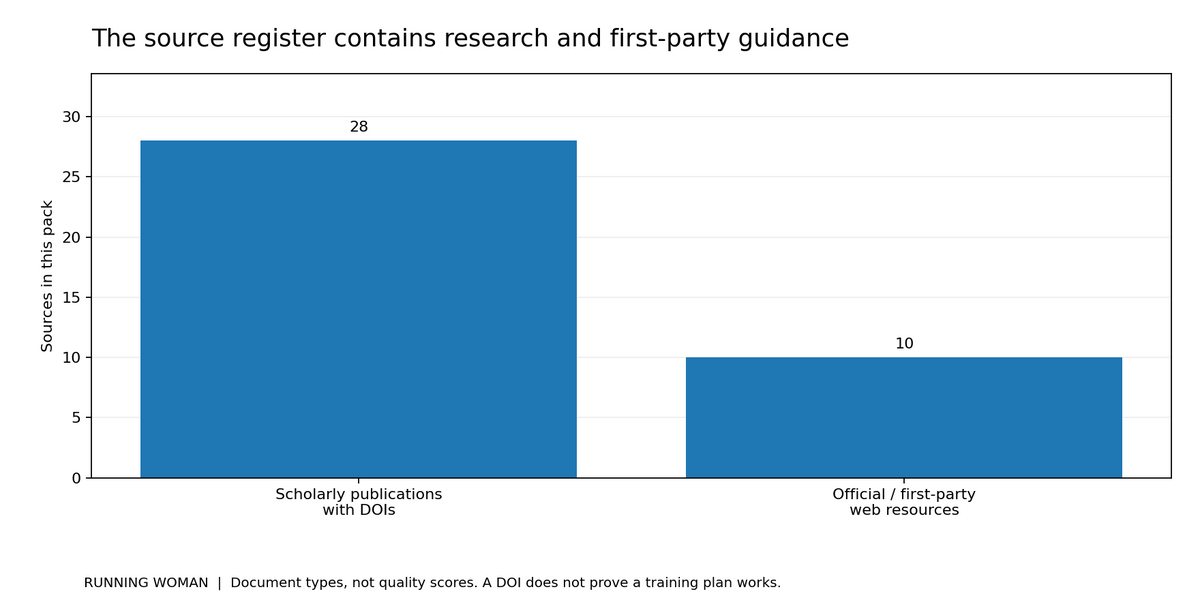
A plan can be informed by research without having been tested as a complete programme. That distinction is central to this collection.
Our schedules combine evidence-informed principles with original editorial decisions about starting requirements, session combinations, duration, cutbacks and practical presentation. No study has evaluated these Running Woman plans as a package.
A useful warning from the plan-analysis literature
Knopp and colleagues described the final twelve weeks of 92 published marathon plans. The authors explicitly identify “no evidence for the effectiveness of the training plans investigated” as a limitation.[1]
That does not make training plans useless. It means a familiar structure is not the same thing as a demonstrated outcome, and a collection of popular plans is not a clinical trial. Common practice does not mean scientifically proven best.
Different questions need different evidence
A randomised trial can compare interventions in a defined sample, but may be small or short. A systematic review can combine studies, while inheriting their limitations. An observational cohort can describe associations in real training, but cannot establish that the training choice caused the outcome. A consensus statement combines evidence with expert judgement. A coaching plan shows a practitioner's prescription, not necessarily an independently tested result.
We use all of these where appropriate, but label the type and avoid treating them as interchangeable.
The main research areas
Training load. The 2025 Frandsen cohort examines unusually long individual sessions relative to recent history. The Buist trial tests a particular graded novice progression. Neither establishes an injury-proof weekly percentage.[2][3]
Endurance preparation. Fokkema and colleagues examine associations between training and half-/marathon outcomes. The Boston cohort adds information from experienced marathon finishers, including women, but is not a novice intervention.[4][5]
Intensity distribution. A large marathon dataset describes patterns across performance levels. Smaller recreational trials compare approaches under specific conditions. The evidence does not justify a universal exact 80/20 split for every beginner and every training phase.[6][7][8]
Tapering. A meta-analysis supports reducing pre-event training, while the details vary with the populations and protocols. It does not validate our exact final weeks.[9]
Strength, nutrition and health. Reviews, position statements and guidance inform supporting principles. They are not endorsements of Running Woman or substitutes for individual assessment.[10][11][12]
Established plans used as benchmarks
We examined first-party programme descriptions to understand the range of public approaches. The following is a metadata comparison, not a reproduction of their schedules.
| Provider / resource | Published format examined | Useful lesson for this hub |
|---|---|---|
| NHS Couch to 5K | Nine-week progression; three weekly runs; final running portions of thirty minutes | Distinguish a duration achievement from a guaranteed measured 5K.[13] |
| Hal Higdon Novice 5K | Eight-week novice programme | Read the starting expectations, not only the word novice.[14] |
| Hal Higdon Novice 1 Half | Twelve-week, four-running-day format | A first-distance plan can assume an existing running routine.[15] |
| Hal Higdon Novice 1 Marathon | Eighteen-week, four-running-day format | Duration and frequency need to be displayed together.[16] |
| London Marathon Events | Sixteen-week beginner, improver and advanced resources among the 2026 options | Event-specific resources use levels, but their assumptions still need reading.[17] |
| Boston Athletic Association | Multiple marathon levels; Level One describes a four-day average and a substantial starting mileage | Beginner can mean beginner to the event, not beginner to running.[18] |
No provider's session table has been copied or reformatted as our own. The BAA explicitly restricts reproduction and repurposing without permission. Links direct readers to the original resources; inclusion is not a claim of affiliation or endorsement.
What we have chosen editorially
The catalogue includes complete templates from a walking foundation through 50K, with different durations and entry requirements. Most training is easy. Faster work is reserved for plans that ask for relevant experience. Weekday patterns and optional support are explicit. Race duration is left unknown. Long-outing caps have visible limitations.
Those are training-design choices. The exact numbers are not derived by solving an equation in a paper. Read each plan's starting requirements before choosing it.
Women-specific uncertainty
Not every study includes enough women to answer detailed questions about female runners, and a study of normally menstruating women is not a complete account of every life stage or contraceptive context.[19]
We do not respond by inventing precise cycle-synced calendars. We use symptom-led guidance, acknowledge the boundaries and direct individual health questions to appropriate professionals. The same caution applies to postpartum return: a newly developed guide is not automatically a validated intervention.[20]
What has not been done
This is a targeted evidence review, not a registered systematic review. It does not claim exhaustive identification of every study or every commercial training programme. Some papers were available as full text; others were assessed through the published abstract and first-party records.
No participants have trialled these complete schedules. No outcome, injury-risk reduction or finishing time is guaranteed.
Research and review
The research check date is 3 October 2026. It is not a publication date or a claim of medical review.
Evidence is most useful here when it makes the choices clearer, including the choices it cannot make for us.
Sources and further reading
-
Knopp M, Appelhans D, Schönfelder M, Seiler S, Wackerhage H (2024). Quantitative Analysis of 92 12-Week Sub-elite Marathon Training Plans. Sports Medicine - Open. DOI: 10.1186/s40798-024-00717-5. ↩︎
-
Schuster Brandt Frandsen J et al. (2025). How much running is too much? Identifying high-risk running sessions in a 5200-person cohort study. British Journal of Sports Medicine. DOI: 10.1136/bjsports-2024-109380. ↩︎
-
Buist I, Bredeweg SW, van Mechelen W, Lemmink KAPM, Pepping GJ, Diercks RL (2008). No effect of a graded training program on the number of running-related injuries in novice runners: a randomized controlled trial. American Journal of Sports Medicine. DOI: 10.1177/0363546507307505. ↩︎
-
Fokkema T et al. (2020). Training for a (half-)marathon: Training volume and longest endurance run related to performance and running injuries. Scandinavian Journal of Medicine & Science in Sports. DOI: 10.1111/sms.13725. ↩︎
-
DeJong Lempke AF et al. (2026). Training Volume and Training Frequency Changes Associated with Boston Marathon Race Performance. Sports Medicine. DOI: 10.1007/s40279-025-02304-4. ↩︎
-
Muniz-Pumares D, Hunter B, Meyler S, Maunder E, Smyth B (2025). The Training Intensity Distribution of Marathon Runners Across Performance Levels. Sports Medicine. DOI: 10.1007/s40279-024-02137-7. ↩︎
-
Festa L et al. (2020). Effects of Different Training Intensity Distribution in Recreational Runners. Frontiers in Sports and Active Living. DOI: 10.3389/fspor.2019.00070. ↩︎
-
Muñoz I, Seiler S, Bautista J, España J, Larumbe E, Esteve-Lanao J (2014). Does polarized training improve performance in recreational runners?. International Journal of Sports Physiology and Performance. DOI: 10.1123/ijspp.2012-0350. ↩︎
-
Wang Z, Wang YT, Gao W, Zhong Y (2023). Effects of tapering on performance in endurance athletes: A systematic review and meta-analysis. PLOS ONE. DOI: 10.1371/journal.pone.0282838. ↩︎
-
Llanos-Lagos C, Ramirez-Campillo R, Moran J, Sáez de Villarreal E (2024). Effect of Strength Training Programs in Middle- and Long-Distance Runners’ Economy at Different Running Speeds: A Systematic Review with Meta-analysis. Sports Medicine. DOI: 10.1007/s40279-023-01978-y. ↩︎
-
Thomas DT, Erdman KA, Burke LM (2016). American College of Sports Medicine Joint Position Statement. Nutrition and Athletic Performance. Medicine & Science in Sports & Exercise. DOI: 10.1249/MSS.0000000000000852. ↩︎
-
Mountjoy M et al. (2023). 2023 International Olympic Committee’s (IOC) consensus statement on Relative Energy Deficiency in Sport (REDs). British Journal of Sports Medicine. DOI: 10.1136/bjsports-2023-106994. ↩︎
-
NHS (accessed 2026-10-03). Get running with Couch to 5K. NHS. ↩︎
-
Hal Higdon (accessed 2026-10-03). Novice 1 Half Marathon. Hal Higdon. ↩︎
-
Hal Higdon (accessed 2026-10-03). Novice 1 Marathon. Hal Higdon. ↩︎
-
London Marathon Events (accessed 2026-10-03). Start training: 2026 TCS London Marathon training plans. London Marathon Events. ↩︎
-
Boston Athletic Association (accessed 2026-10-03). Boston Marathon Training. Boston Athletic Association. ↩︎
-
McNulty KL et al. (2020). The Effects of Menstrual Cycle Phase on Exercise Performance in Eumenorrheic Women: A Systematic Review and Meta-Analysis. Sports Medicine. DOI: 10.1007/s40279-020-01319-3. ↩︎
-
James ML et al. (2026). An interdisciplinary, co-designed guide for return to running postpartum: a mixed-methods study. Frontiers in Sports and Active Living. DOI: 10.3389/fspor.2026.1771882. ↩︎