
Two events can both say 50K and ask very different things of a runner. One may use clear, runnable woodland paths. Another may involve exposed mountains, technical descents, navigation and long gaps between support.
A training hub that matches only the distance can hide the most important part of the task. Our trail templates therefore come with a deliberately limited scope.
What these plans cover
The trail 10K, trail half and 50K routes are for familiar, non-technical terrain with manageable access. The first trail 10K assumes an existing running base. The first trail half assumes longer-outing experience and some trail familiarity. The first 50K expects marathon experience and substantial long outings already in place.
They are not programmes for technical mountain running, high altitude, desert heat, self-supported multi-day events or specialist fell-navigation challenges. Those activities may be worthwhile goals, but they require preparation beyond the supplied calendars.
Use the event information as an input
Read the current route description and rules directly from the organiser. Note climbing, descending, typical surface, remoteness, mandatory kit, aid-station gaps and every cut-off. Confirm whether cut-offs use elapsed or another defined event time.
Do not rely solely on the headline distance or another runner's moving-time pace. The practical question is whether you can manage the specific route with the required skills and supplies, not whether a calculator turns your road 10K into an attractive prediction.
Time on feet is useful but incomplete
Our trail schedules use time and effort so that walking steep climbs is compatible with the plan. But a long time on a smooth path does not prove competence on wet rock, loose descents or exposed terrain.
Record what the outing actually contained. Distance, climbing, descent, surface, walking, stops and navigation all contribute context. Avoid adding new technical difficulty, much more descent and a longer duration in the same session.
Downhill running needs its own progression
A downhill-running review describes distinctive mechanical demands and adaptation considerations.[1] That is why our plans introduce controlled exposure rather than treating every descent as free recovery or a chance to recover lost pace.
Choose a familiar, manageable slope and keep the descent within your skill. More speed is not the objective of early trail preparation. When the event demands descending skills you do not have, seek appropriate instruction rather than relying on additional mileage alone.
Hiking belongs in the plan
Walking uphill can be the intended movement. Practise it with the equipment and footwear appropriate to the event. It should still feel consistent with the purpose of the session, not become an unrecorded maximal hill workout.
The 50K templates use selected Saturday hikes before a Sunday long outing. They replace the Saturday run. These back-to-back exposures are coaching conventions intended to practise consecutive-day activity; they should not be treated as proven necessary or superior for every ultra runner.
Recovery can make a single longer outing or a different distribution more appropriate. Do not treat a back-to-back weekend as a compulsory rite of passage.
Food, drink and carrying systems
Ultra nutrition guidance emphasises individual preparation, tolerance and the practical demands of prolonged events.[2] Rehearse opening food, accessing bottles and carrying supplies during representative outings.
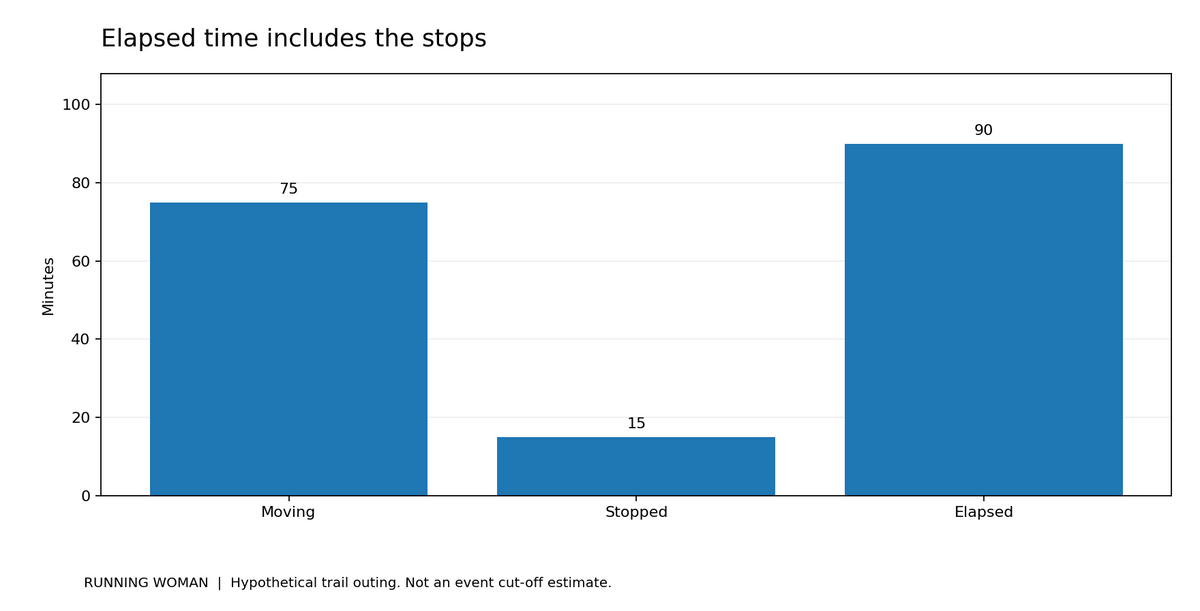
Aid stations are part of the timing problem. A stop that feels brief can matter when repeated. Count stops in elapsed time and practise a routine that is calm rather than hurried.
Avoid forcing fluid intake to meet a generic figure. Overdrinking can be dangerous, and sodium does not remove that risk.[3] Plan access to fluids and an individual strategy appropriate to conditions and advice.
The long-outing cap is not route clearance
The 50K templates peak at four and a half hours for the longest single outing. That is an editorial workload choice for these plans. It is not a declaration that every 50K can be prepared for with that maximum, nor that longer outings are universally unsafe.
For an event likely to take substantially longer or involve unfamiliar demands, an experienced coach should review the preparation. When meaningful representative exposure cannot fit within the template, the template is not a match.
A race itself can be a substantial increase over recent training exposure. The load literature offers useful questions but no injury-proof clearance number.[4]
A practical readiness review
At least four weeks before the event, discuss the evidence from actual outings. Can you manage representative terrain? Have you practised the required equipment and food? Are the cut-offs plausible using elapsed time? Can you navigate and seek help appropriately? Are you recovering from the whole training week?
These are decision prompts, not a validated medical test. A positive answer to one does not cancel a serious gap in another. A comfortable road marathon does not automatically provide mountain-navigation competence.
When to change the event
Choose a simpler route, shorter distance or later date when the required skills and current preparation do not align. Do not attempt to solve a terrain mismatch with a last-minute very long outing.
Trail running can be joyful precisely because it asks you to pay attention to the place as well as the pace. The plan should support that attention, not encourage you to run past it.
Sources and further reading
-
Bontemps B, Vercruyssen F, Gruet M, Louis J (2020). Downhill Running: What Are The Effects and How Can We Adapt? A Narrative Review. Sports Medicine. DOI: 10.1007/s40279-020-01355-z. ↩︎
-
Tiller NB et al. (2019). International Society of Sports Nutrition Position Stand: nutritional considerations for single-stage ultra-marathon training and racing. Journal of the International Society of Sports Nutrition. DOI: 10.1186/s12970-019-0312-9. ↩︎
-
Hew-Butler T, Loi V, Pani A, Rosner MH (2017). Exercise-Associated Hyponatremia: 2017 Update. Frontiers in Medicine. DOI: 10.3389/fmed.2017.00021. ↩︎
-
Schuster Brandt Frandsen J et al. (2025). How much running is too much? Identifying high-risk running sessions in a 5200-person cohort study. British Journal of Sports Medicine. DOI: 10.1136/bjsports-2024-109380. ↩︎