
The best-looking weekly plan is not necessarily the one you can live with. Three running days can be a useful, complete routine. Six can be appropriate for an experienced runner. Neither number tells the whole story without duration, intensity and recovery.
This guide explains our scheduling choices rather than claiming a universal ideal frequency.
Three days: clear gaps between outings
Our three-day routes use Tuesday, Thursday and Sunday. The days are placeholders, but the separation is deliberate. For a new runner, the whole routine is a new demand, so there is no need to squeeze in an extra hard session because Monday looks empty.
The trade-off is distribution. With only three outings, a growing long run can become a large share of the week. Do not make that one run carry the entire preparation for a much longer event. Our first-marathon templates therefore use four days rather than pretending one heroic Sunday can substitute for a broader base.
That is a design decision for this collection, not proof that every three-day marathon programme is ineffective.
Four days: more support around the long run
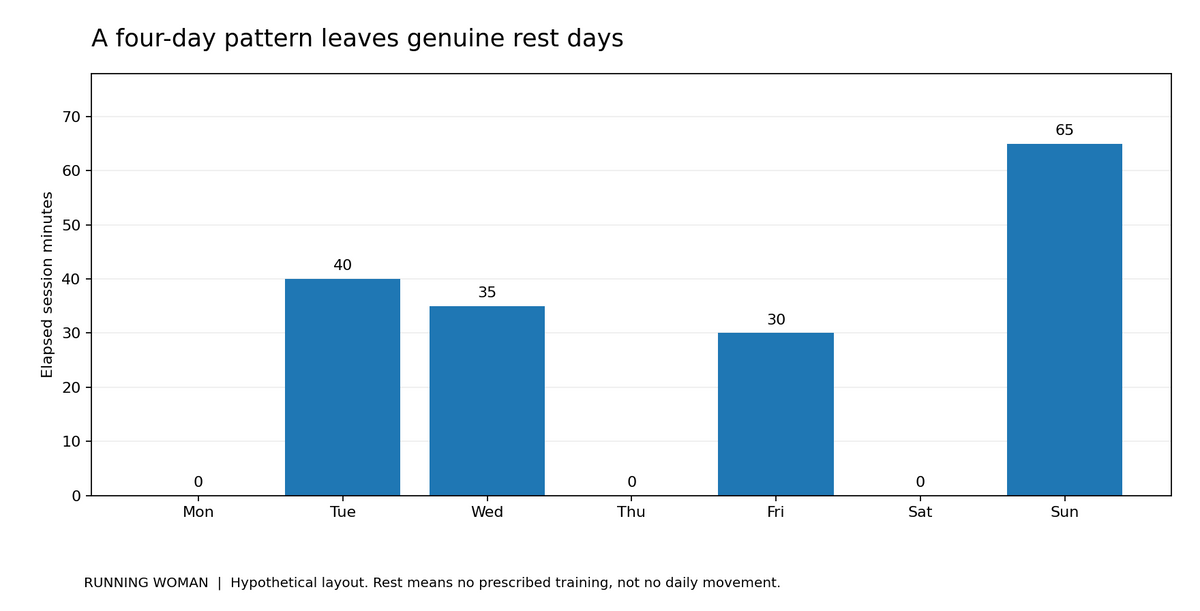
Our default four-day pattern is Tuesday, Wednesday, Friday and Sunday. Tuesday may hold the main workout in an improver plan; Wednesday and Friday are easy; Sunday is the longer outing. Monday, Thursday and Saturday have no scheduled running.
Two adjacent easy/running days can be appropriate for someone whose current routine already supports four days. They are not a requirement for a new runner who is still finding three separated outings manageable. The entry checks reflect that difference.
Optional strength sits after the Wednesday and Friday runs, leaving genuine days without prescribed training elsewhere. The support minutes are listed separately so the plan does not hide a second job in a footnote.
Five days: distribute, do not intensify everything
Five-day templates use Tuesday, Wednesday, Thursday, Saturday and Sunday. The additional session is usually easy. Tuesday contains the principal faster work where applicable, while Friday remains a no-training day and Saturday stays modest before the long outing.
A five-day label does not mean five purposeful “quality” workouts. In this collection, additional frequency primarily distributes easy training. Large observational marathon datasets describe greater easy-running exposure among faster groups, but cannot prove that adding days will improve any particular runner.[1]
For ultra plans, a scheduled hiking session may replace a running outing. The label then means five run/hike outings, not five days of continuous running plus a bonus hike.
Six days: for an already-established routine
The six-day marathon template adds a short easy Monday and retains Friday as a day without scheduled training. It expects a six-running-day base already in place.
Do not choose it because you have six free mornings next month. Availability is not adaptation. Increase frequency separately, using short easy sessions and a stable total where appropriate, before starting a demanding race block. Individual coaching is useful when changing this part of the routine.
The Boston observational cohort found a complex relationship between habitual training exposure, changes in frequency and performance.[2] It should not be simplified into “more days always wins” or “run less to get faster”. The runners were not randomly assigned to different weekly schedules.
Count demanding sessions honestly
Intervals, a fast club session, a raced parkrun, a hard hilly run and some long runs all draw on recovery. A session does not become easy because it is social or because it happens at the weekend.
Our practical rule is to identify the main demand before arranging the week. A first-distance plan may have no formal speed session; its growing long outing is already a substantial task. An improver plan has one main faster workout. An experienced runner may need a different arrangement, but should not obtain it by layering other programmes on top.
Moving the days
Move the pattern rather than isolated boxes. A Monday long run can work when the preceding and following days are arranged accordingly. A Saturday race means the final week's Sunday long run is removed, not completed the next day.
An example for a four-day runner who needs the longer outing on Saturday is Monday easy, Tuesday controlled workout, Thursday easy and Saturday long. This is an illustrative rearrangement, not an additional plan. Keep Wednesday, Friday and Sunday free of prescribed running and reassess whether Monday feels appropriate after Saturday.
A shift worker may prefer a rolling sequence rather than named weekdays. Preserve session order and recovery opportunities, and avoid forcing a seven-day template into four consecutive free days. A qualified coach can help adapt the sequence to your working pattern.
Strength and cross-training are not invisible
A difficult spin class, heavy lower-body strength session or long hike can change the demands of a running week. Record them in the same diary even when the running totals do not include them.
Strength training has evidence for improving running economy in certain programmes and populations, but the dose and context matter.[3] Optional support in our plans is deliberately modest and familiar. It is not a claim that twenty minutes of any exercise is equivalent to the protocols in a research review.
A week that fits real life
Start with non-negotiable responsibilities and sleep opportunities. Add the longer outing. Place the main workout far enough away that you ordinarily recover, then distribute easy sessions and support work. Keep at least one genuine no-prescribed-training day in these templates.
The plan is too crowded when completing it consistently requires borrowing from rest, repeatedly moving hard work together or treating every interruption as an emergency. Choose fewer days or less total training before deciding that you lack discipline. The diary is part of the training environment, not an enemy to defeat.
Sources and further reading
-
Muniz-Pumares D, Hunter B, Meyler S, Maunder E, Smyth B (2025). The Training Intensity Distribution of Marathon Runners Across Performance Levels. Sports Medicine. DOI: 10.1007/s40279-024-02137-7. ↩︎
-
DeJong Lempke AF et al. (2026). Training Volume and Training Frequency Changes Associated with Boston Marathon Race Performance. Sports Medicine. DOI: 10.1007/s40279-025-02304-4. ↩︎
-
Llanos-Lagos C, Ramirez-Campillo R, Moran J, Sáez de Villarreal E (2024). Effect of Strength Training Programs in Middle- and Long-Distance Runners’ Economy at Different Running Speeds: A Systematic Review with Meta-analysis. Sports Medicine. DOI: 10.1007/s40279-023-01978-y. ↩︎