
The final weeks before an event can feel oddly uncomfortable. You have spent time building a routine, and now the plan asks you to do less. The temptation is to add one more long run for reassurance.
A taper is not an emergency fitness-building phase. In this hub it is a planned reduction that protects the work already completed and creates space for the event.
What the evidence supports
Wang and colleagues' 2023 systematic review and meta-analysis included fourteen studies of endurance athletes. Reduced training volume with retained intensity and frequency, over tapers of up to twenty-one days, was associated with improved time-trial performance in the analysed subgroups.[1]
The authors describe a strategy that “maintained training intensity and frequency”.[1:1] That does not mean preserving the full amount of hard training. It means some familiar intensity may remain while the overall work is reduced.
The populations and protocols were varied, and subgroup results do not establish an exact percentage for every recreational runner. The review also does not justify deliberately overloading a beginner before tapering.
How our templates use tapering
Shorter-distance templates generally reduce the final preparation before event week. Marathon and 50K routes use a longer reduction. The exact pattern is an editorial design choice, not a reproduction of one research protocol.
Established improvers retain a brief, controlled reminder session. First-distance plans do not introduce intervals for the first time simply because a review mentioned maintaining intensity. Familiar training remains familiar; the total becomes smaller.
Optional strength is removed from the final taper in these templates. That is not a command for every experienced lifter to stop all strength work, but it avoids introducing new soreness within a generic plan.
Why the race is excluded from the training total
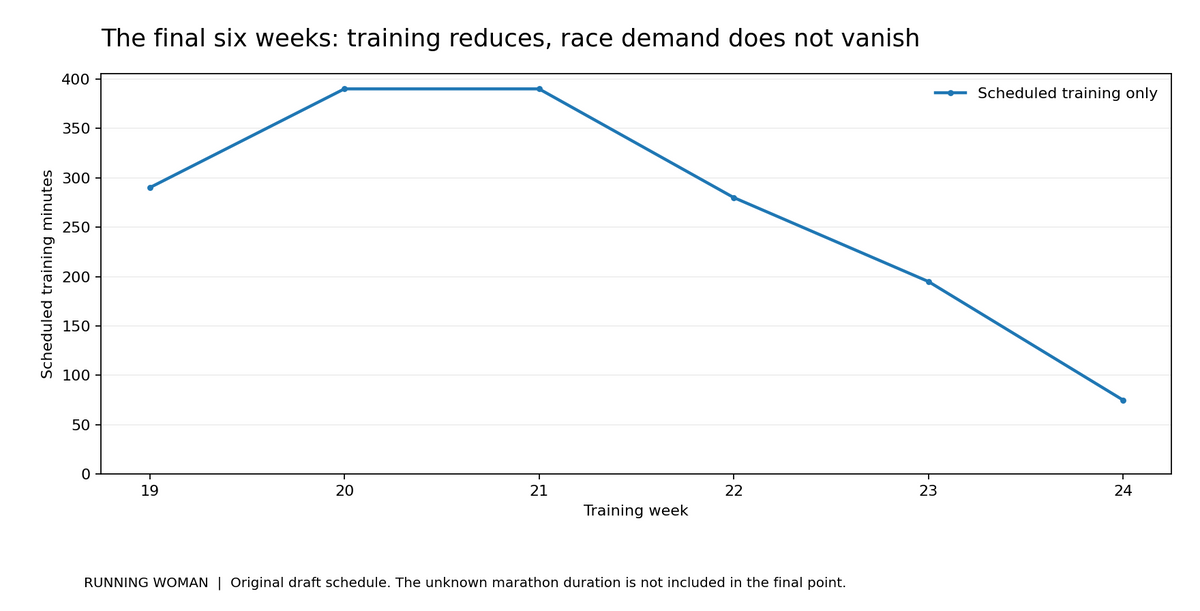
A race week can have a low training bar and still contain the most demanding outing of the entire block. Our totals therefore separate pre-event training, race preparation/finish time and the race itself.
For example, sixty minutes of training before a marathon does not make the entire week a sixty-minute exercise week. The marathon has an unknown duration and a known distance of 42.195 km.
Do not calculate a taper percentage after adding the race distance to the final week's running. That answers a different question from how much training was reduced before competition.
The missed long run stays missed
A late long run intended to restore confidence can change the taper substantially. Our default is not to insert it. Review the preparation honestly and consider changing the event goal when an important part of the build is missing.
A final training test cannot create the weeks that did not happen. Nor can a short taper make an underprepared runner ready for a much longer distance. The decision may be to start more conservatively, choose a different event where possible or not start.
Make race week practical
Check the organiser's current instructions, transport, number collection, start arrangements, bag drop, toilets, cut-offs and permitted equipment. Practise the route to the start where possible. None of this needs to become another exhausting project.
Use familiar food, shoes, clothing and any planned run-walk strategy. Nutrition planning should have occurred during the build, not begin with a new product at the expo.[2]
Keep the final short runs genuinely short. Feeling fresh is not a reason to extend them into a surprise workout.
A first finish and a time goal are different starts
For a completion goal, begin with the comfortable approach you rehearsed and use walking breaks where planned. For a performance goal, resist treating early excitement as evidence that your target was too cautious.
A pacing plan needs to remain responsive to conditions and symptoms. It is a framework, not a reason to ignore warning signs. An event's medical team and current organiser guidance take precedence over this article.
After the line
Begin with ordinary recovery: a manageable transition to walking, familiar food and fluids, rest and attention to how you feel. Do not force a cool-down when you feel unwell.
Tight or squeezing chest pain, severe breathing difficulty or unresponsive collapse require emergency help.[3] Persistent or concerning symptoms afterwards need appropriate assessment rather than an assumption that everything is normal because you finished.
For routine recovery, there is no universal return-to-hard-running date in this hub. Event duration, effort, terrain, prior experience and the actual response differ. Restore comfortable daily activity and easy running before planning another demanding block. Significant pain or unusual fatigue changes that process.
Review without judging yourself
Once you have recovered enough to reflect, note what worked: preparation consistency, pacing, food, clothing, route decisions and enjoyment. Separate controllable choices from conditions you could not change.
A personal best is one possible outcome. A well-managed first finish, an appropriate decision to stop or a clearer understanding of your next goal can also be useful outcomes. The plan ends with information, not a verdict on you.
Sources and further reading
-
Wang Z, Wang YT, Gao W, Zhong Y (2023). Effects of tapering on performance in endurance athletes: A systematic review and meta-analysis. PLOS ONE. DOI: 10.1371/journal.pone.0282838. ↩︎ ↩︎
-
Thomas DT, Erdman KA, Burke LM (2016). American College of Sports Medicine Joint Position Statement. Nutrition and Athletic Performance. Medicine & Science in Sports & Exercise. DOI: 10.1249/MSS.0000000000000852. ↩︎
-
NHS (accessed 2026-10-03). Heart attack. NHS. ↩︎