
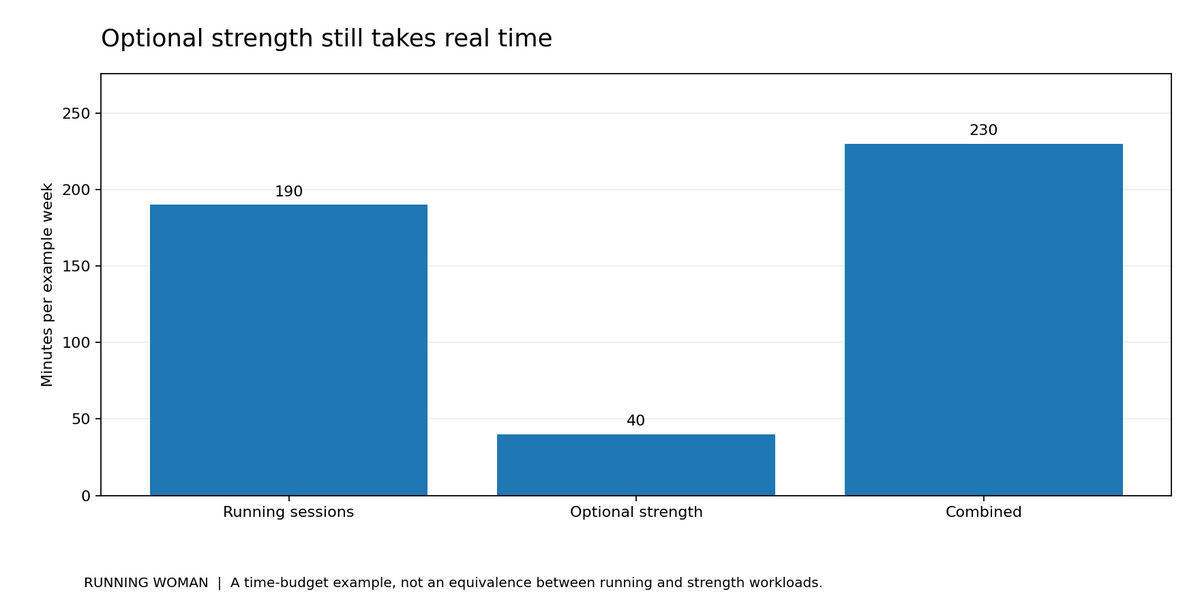
Running is the main activity in these schedules, but it does not exist in isolation. A hard spin class, an unfamiliar gym session or a very long walk can change how the next run feels, even when none appears in the running total.
Support training should support the plan. The name does not make it free of fatigue.
What strength research can tell us
The 2024 review by Llanos-Lagos and colleagues examined strength programmes and running economy across 31 studies, including 652 participants, 180 of them women. Some approaches improved economy, with certainty varying across the evidence.[1]
Running economy is not the same outcome as race time. An improvement in economy does not mean an identical percentage improvement in a marathon, nor does the review prove that a short generic routine prevents running injuries.
It also does not mean that a new runner should begin maximum lifts or plyometrics during the busiest week of a first-race plan. Training history, technique and progression matter.
Why the optional support slots are modest
Each plan shows optional twenty-minute strength sessions separately from running time. They are a place for familiar, manageable work, not a claim to reproduce the research protocols precisely.
The example routine covers comfortable squat or sit-to-stand, step-up or split-squat, hinge or bridge, calf work and simple upper-body or trunk movements. Start with a small amount and leave several repetitions in reserve. A qualified instructor can help select loads and alternatives.
Experienced strength trainees may maintain their own appropriate programme, but should account for its demands in the whole week. The optional slot is not an instruction to replace competent individual programming with a generic circuit.
Where to place it
Our three-day plans place support after the Tuesday and Thursday outings. Four-day plans use Wednesday and Friday. Five- and six-day plans use Tuesday and Thursday. The exact days are editorial choices designed to preserve no-prescribed-training days elsewhere.
A support session can follow a run when that is practical, but should not compromise safe technique. Separate sessions when fatigue makes that necessary. Do not add heavy unfamiliar leg work immediately before a key long outing simply because the calendar contains an empty evening.
The first week and cutback weeks contain less optional support. Taper weeks omit it from the template rather than introducing new loading close to the event.
Cross-training as a replacement
Cycling, swimming, elliptical exercise and other activities can provide alternative ways to be active. They are not automatically equivalent to running minutes or running distance.
A twenty-minute easy cycle is not a precise replacement for a particular run, and a vigorous ninety-minute class is not a recovery day. Choose the activity and effort for the purpose, then record it honestly. When changing a substantial amount of a race plan, individual coaching is more useful than a universal conversion factor.
For an interruption caused by pain or illness, cross-training is not automatically appropriate. The reason running stopped must be considered first. A clinician or physiotherapist may advise what is suitable.
The long walk that is not a rest day
Hiking can be part of trail and ultra preparation. In our 50K templates, a specified hike replaces a Saturday run on selected weeks. It is not an extra outing concealed behind the word optional.
A long hike over hills can still be demanding, especially when unfamiliar. Keep its duration, terrain and recovery in the log. Do not count the day as complete rest and then wonder why the next long outing feels heavy.
Sleep and ordinary recovery
Athlete sleep consensus guidance emphasises individual needs, habits and circumstances rather than a one-size-fits-all solution.[2] Our practical recommendation is to protect a workable sleep opportunity before adding another training session.
A plan that repeatedly requires very early starts after late work shifts may need fewer or shorter sessions. Persistent sleep difficulty or unusual fatigue deserves attention, not a stronger coffee and a harder workout.
Recovery also includes the uneventful things: food, fluids, comfortable daily movement and not filling every gap with another challenge. No gadget in this hub is presented as permission to ignore symptoms.
Complete rest is allowed
A no-prescribed-training day does not require you to lie still. It means there is no session to complete. Walking for ordinary life is fine when comfortable; a scheduled endurance challenge is a different matter.
Some runners enjoy a very short easy recovery run. It is not compulsory, and the fact that it feels pleasant does not establish that it speeds tissue recovery. Do not use the label recovery to justify maintaining a streak through pain or significant fatigue.
Maintain support when the goal changes
After an event, the next plan need not be a longer race. A period of manageable running, familiar strength and ordinary life can be a useful outcome in its own right.
Minimal-dose maintenance research provides examples of reduced training preserving certain performance qualities under particular conditions, but cannot guarantee an individual response.[3] Use it as a reason to think flexibly, not as a formula that every runner can apply unchanged.
The best support routine is one you can sustain without undermining the running, the recovery or your enjoyment of either.
Sources and further reading
-
Llanos-Lagos C, Ramirez-Campillo R, Moran J, Sáez de Villarreal E (2024). Effect of Strength Training Programs in Middle- and Long-Distance Runners’ Economy at Different Running Speeds: A Systematic Review with Meta-analysis. Sports Medicine. DOI: 10.1007/s40279-023-01978-y. ↩︎
-
Walsh NP et al. (2021). Sleep and the athlete: narrative review and 2021 expert consensus recommendations. British Journal of Sports Medicine. DOI: 10.1136/bjsports-2020-102025. ↩︎
-
Spiering BA, Mujika I, Sharp MA, Foulis SA (2021). Maintaining Physical Performance: The Minimal Dose of Exercise Needed to Preserve Endurance and Strength Over Time. Journal of Strength and Conditioning Research. DOI: 10.1519/JSC.0000000000003964. ↩︎