
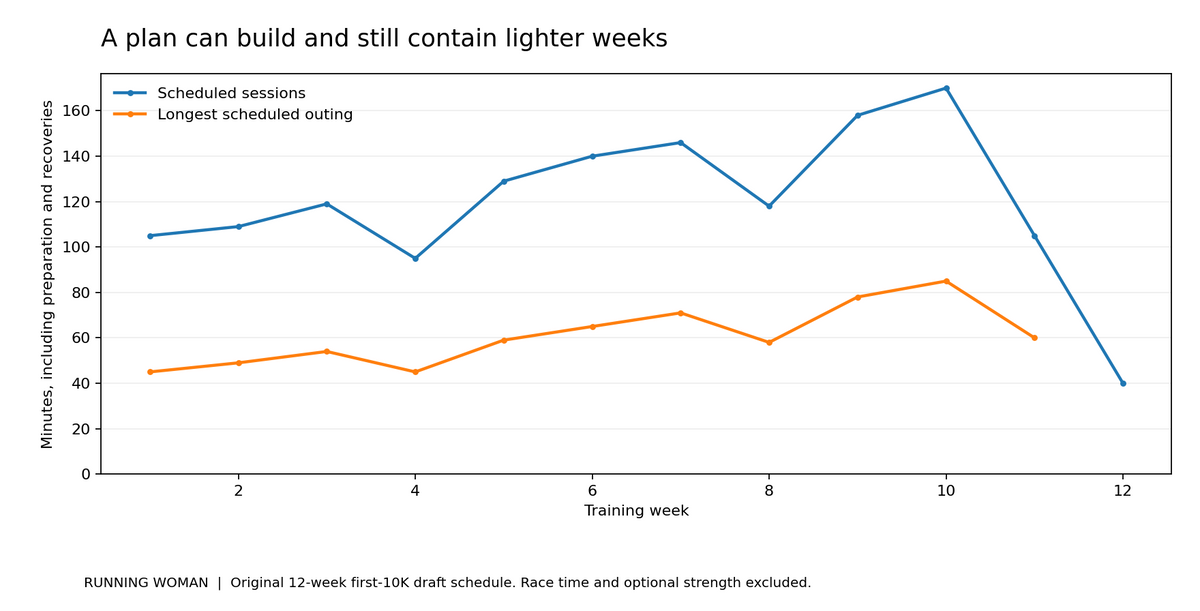
The appeal of a single progression rule is obvious. Add the permitted amount, tick the box and feel protected. Running research does not support that level of certainty.
A long run is one part of a week. A week is one part of a training history. Both matter, alongside intensity, terrain, health and recovery.
What are you increasing?
Duration, distance, running frequency, faster work, climbing, descending and the proportion spent running rather than walking can all change the task. A run-walk plan can keep total minutes similar while substantially increasing the running portions.
That is why our schedules explicitly state the ratios. Keeping an earlier ratio when extending time is a legitimate adaptation. Do not assume a stable elapsed duration means a stable impact load.
For ordinary running, compare the actual distances of similar outings as well as the minutes. A windy day or a new trail can make a direct comparison less meaningful, so keep the context rather than worshipping the percentage.
The familiar weekly 10% rule
The rule is often presented as never increasing weekly mileage by more than ten percent. It is easy to calculate but not a guarantee of avoiding injury.
Buist and colleagues compared a thirteen-week graded novice programme, using the 10% progression concept, with an eight-week standard programme. Injury incidence did not differ meaningfully between groups.[1] The finding challenges the rule as a proven protective formula; it does not say that abrupt changes are harmless.
Our plans do not advertise “10% safe progression”. They include smaller increases, repeated exposures and cutback weeks as coaching design choices, while keeping the uncertainty visible.
What the 2025 study actually measured
Frandsen and colleagues followed 5,205 runners in an observational cohort. Their important comparison was an individual session's distance relative to the longest session in the preceding thirty days, not the change in weekly mileage. Sessions exceeding that recent maximum by more than ten percent were associated with higher overuse-injury rates; the weekly change measure did not show the same association.[2]
Only about 22% of participants were women. Injury reporting and the observational design also limit interpretation. The study does not establish that staying within ten percent makes a run safe, or that a larger session caused a particular injury.
The practical implication we draw is to pay attention to unusually large individual outings, not just a tidy weekly total. That is an interpretation, not a validated prescription.
Why the long run cannot do everything
Imagine one runner spreads 180 minutes across three comfortable outings, while another completes 30 minutes twice and then 120 minutes on Sunday. The total is identical; the distribution is not.
This arithmetic example does not establish a safe maximum long-run percentage. It shows why a weekly total alone is incomplete. The second runner's long session deserves its own review, particularly when it is new.
As distance goals increase, the supporting easy runs should be part of the preparation rather than optional decoration. A first-marathon plan is not one long run plus three attempts to survive until the next long run.
Cutbacks and consolidation
A cutback deliberately reduces the training for a week. Consolidation means staying at a manageable level rather than increasing because the calendar has advanced. Neither is a punishment for insufficient fitness.
Our schedules often use cutbacks after several building weeks, but the exact rhythm is an editorial convention. There is no claim that every fourth week has special biological properties. Bring a lighter week forward when recovery or circumstances require it.
A return from a cutback may be a large increase relative to the previous week while remaining below a recent comfortable exposure. This is another reason a single week-to-week percentage can mislead. It is not permission to ignore the absolute load or your current condition.
Time caps and distance reviews
Our road-marathon templates cap the longest outing at around three hours, with a longer cap in the run-walk option. These are workload boundaries for these templates, not universal medical limits or claims of optimal preparation.
A runner whose comfortable pace covers relatively little distance within that time may not be well served by the template. Do not solve the mismatch by prescribing a faster long run or adding an unplanned hour late in the block.
The distance review ranges in the plans are editorial discussion points. They are not proven minimums and are not a requirement to run the full race distance in training. Research links training characteristics and performance in groups, but cannot turn one long run into an individual clearance test.[3]
A sensible decision after a difficult outing
Start with the experience, not the spreadsheet. Was the effort intended to be easy? Did it become unusually hard? Did you recover sufficiently for normal daily activity? Is there focal pain or a change in gait? Were heat, sleep, food or unfamiliar terrain involved?
A conservative response is to hold or reduce the next demand while you understand the problem. Persistent pain or concerning symptoms require appropriate assessment. Do not add another hard outing to prove the first was an exception.
The purpose of a progression is to make training repeatable. A number that looks good but leaves you unable to repeat the routine has stopped being useful.
Sources and further reading
-
Buist I, Bredeweg SW, van Mechelen W, Lemmink KAPM, Pepping GJ, Diercks RL (2008). No effect of a graded training program on the number of running-related injuries in novice runners: a randomized controlled trial. American Journal of Sports Medicine. DOI: 10.1177/0363546507307505. ↩︎
-
Schuster Brandt Frandsen J et al. (2025). How much running is too much? Identifying high-risk running sessions in a 5200-person cohort study. British Journal of Sports Medicine. DOI: 10.1136/bjsports-2024-109380. ↩︎
-
Fokkema T et al. (2020). Training for a (half-)marathon: Training volume and longest endurance run related to performance and running injuries. Scandinavian Journal of Medicine & Science in Sports. DOI: 10.1111/sms.13725. ↩︎